Week 11: What the First Ten Thinkers Were Saying Together
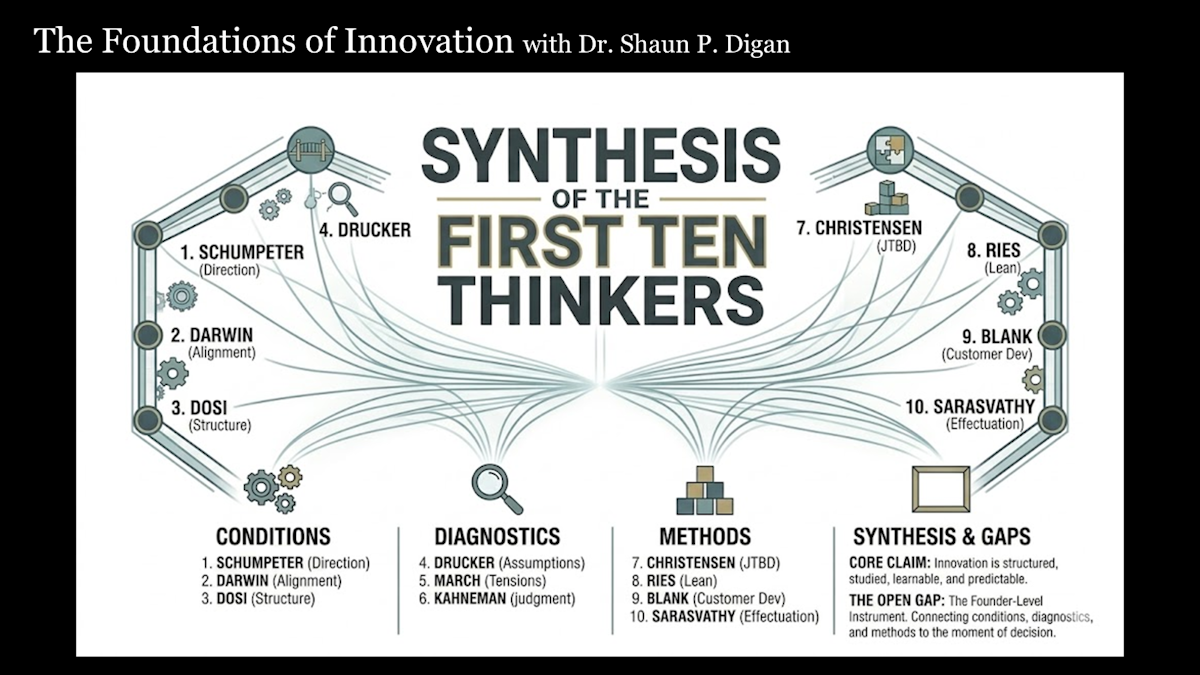
Eleven essays in, the series has covered ten thinkers. (Schumpeter, Darwin, Kahneman, Ries, Drucker, Christensen, March, Blank, Dosi, Sarasvathy.)
Each piece stood alone. That was the design. Each thinker got the same four-part treatment. Contribution. Why it mattered. What it left open. What it means for founders now.
The takeaways collected across those essays were not just summaries. They were each making the same kind of claim, in different vocabularies, about different parts of the same problem.
Worth pausing to see them together.
What the first ten thinkers were collectively saying
The first ten essays of this series, taken together, make a claim that none of them makes alone.
The claim is this.
Innovation has structure.
The structure can be studied.
The reasoning required to do it well is real and learnable.
The judgment failures along the way are predictable.
The methods for testing assumptions exist.
The conditions for survival are knowable.
What has not existed is the layer that connects all of that to the individual founder, at the moment they are deciding what to build, before the resources are committed, while the assumptions are still examinable and the costs of being wrong are still small.
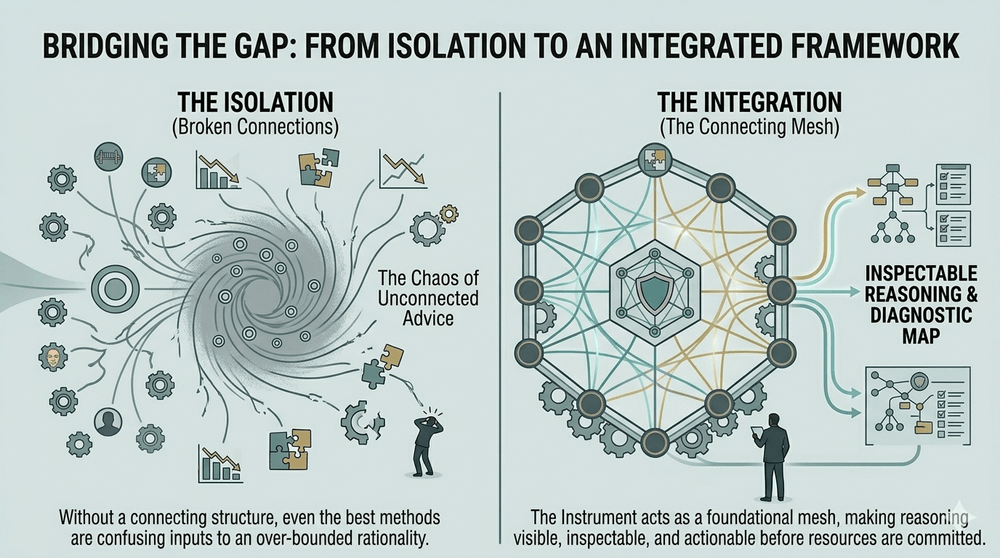
That layer is not a method. Methods exist.
It is not a theory. Theories exist.
It is not advice. There is more advice than any founder can read.
The rest of this essay is the case for that claim.
The ten takeaways, stated tight
Schumpeter named the direction. Routinization was where innovation was heading, and the systematization of building new things was both possible and necessary. He aimed it at the large firm. He never asked whether the same logic applied before the firm existed.
Darwin named the condition. Survival is a relationship between an organism and its environment at a particular moment. Fit is not a quality. It is alignment. His mechanism for producing it was random, slow, and terminal. He did not describe deliberate adaptation.
Dosi named the legitimacy. Innovation has structure. The structure operates at multiple levels. The founder-level work is not random and can therefore be reasoned about systematically. Without that claim, none of the rest holds up.
Drucker named the discipline. The theory of the business is the practice of surfacing and stress-testing the assumptions an organization is built on. His subjects were mature firms with obsolete assumptions. He did not translate the discipline to the founder whose assumptions are unexamined rather than outdated.
March named the tension. Exploration and exploitation are the two modes every learning system has to balance. Explore too long and you never converge. Exploit too early and you build on foundations you have not validated. He did not build the system for navigating the tension deliberately.
Christensen named the unit. Founders do not build products. They build solutions to jobs customers are trying to get done. Identifying the job is the right starting move. It does not tell a founder whether they are equipped to build a business around it.
Ries named the loop. Build, measure, learn. The mechanism for reducing uncertainty under conditions where nothing is yet known. The loop tests assumptions. It does not tell a founder which assumption to test first, or which one collapses everything else if it is wrong.
Blank named the phase. The work before product is the most important work. Get out of the building. Test the hypotheses. He told founders what to do. He did not evaluate whether they were ready to do it.
Kahneman named the failure mode. Founder judgment fails systematically, not randomly. The errors are knowable. Awareness of them does not reduce them. Structure does. He identified what needed to be built. He did not build it.
Sarasvathy named the reasoning. Expert entrepreneurs reason effectually, not causally, under conditions of true uncertainty. The reasoning is real, learnable, and observable. She did not solve the development question: how to produce that reasoning in someone who is not yet expert.
The pattern across the ten
The order above is not the order the essays were published. It is the order the argument runs in. Outside-in. From the widest frame to the moment of decision. Three groups emerge when you read it that way.
The condition-setters. Schumpeter, Darwin, Dosi. These three describe the world inside which entrepreneurial work happens. Schumpeter tells us the direction the system is heading. Darwin tells us what survival depends on. Dosi tells us the work has structure that can be studied.
Together, they answer: what is the territory.
The diagnostics. Drucker, March, Kahneman. These three describe what fails and why. Drucker on the assumptions that quietly stop being true. March on the structural tension every learning system carries. Kahneman on the judgment failures that are predictable rather than random.
Together, they answer: what breaks, in knowable ways, that a founder needs to see.
The methodologists. Christensen, Ries, Blank, Sarasvathy. These four built methods. Jobs to Be Done, Lean Startup, Customer Development, Effectuation. Each is a serious contribution. Each is a partial answer.
Together, they answer: how the work has been described so far.
These four are not the same kind of contribution. Christensen built a theory of why customers buy. Ries and Blank built procedures. Sarasvathy described how experts actually reason. What they share is that each tried to operationalize the work.
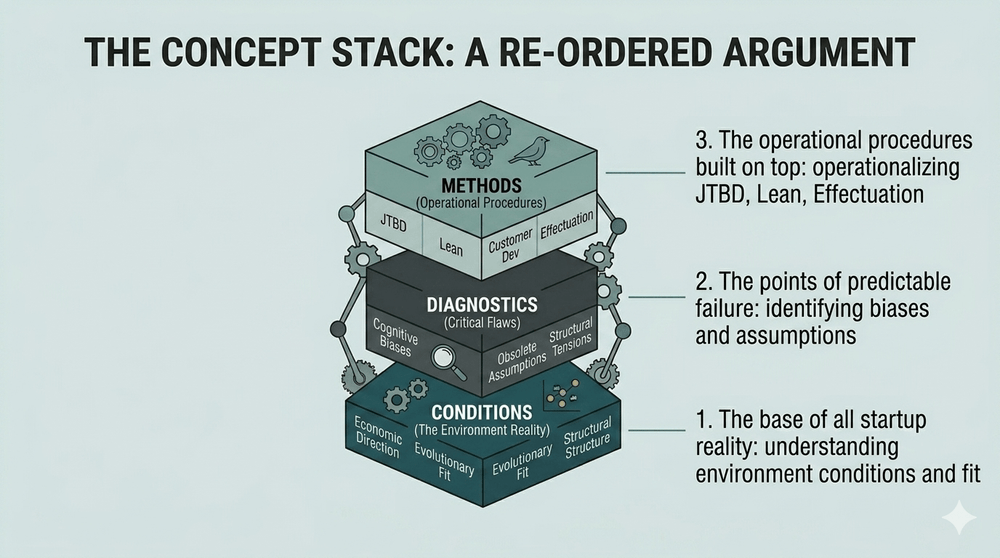
The synthesis is that the methodologists were building on top of conditions and diagnostics that no one had yet pulled into one frame. The methods are real. The frame underneath them was assembled piece by piece, by the people on either side of them in this list.
What every one of them left open
Every takeaway in this series ends the same way. Contribution, then a sentence beginning with "what they left open."
That is not a stylistic tic. It is the argument.
The pattern across ten thinkers is that the contribution and the gap are both real. Each of them was correct about what they named. Each of them stopped short of the same place.
The place they stop is the individual founder, before the organization exists, at the moment of decision under genuine uncertainty.
Darwin's mechanism does not operate at the speed a founder needs. Schumpeter aimed his theory at the firm. Dosi gave us permission to systematize without telling us at what level. Drucker aimed his at the mature organization. March and Christensen aimed theirs at the incumbent. Ries and Blank built methods that assume the founder already knows what is most urgent to learn. Kahneman described the bias without building the structure that interrupts it. Sarasvathy described the reasoning without solving how it gets developed in someone who is not yet expert.
The gap is not in any single thinker. The gap is that the founder-level instrument, the thing that sits underneath the methods and on top of the conditions and inside humans bounded rationality.
What gets built on top of all of that
The layer that has not existed, named at the start of this essay, has a shape.
It is an instrument. Something the founder can use on their own situation to make their reasoning visible to themselves, see where it holds, see where it breaks, and act from a clearer picture. The role of the instrument is not to predict outcomes but to make reasoning inspectable before commitment.
That is what the next phase of this series will start to describe. The thinkers ahead, beginning in the next issue, get more specific. Some are well-known inside their fields and almost never read outside them. Some are about cognition, some about organization, some about access, some about practice. They share something with the first ten. Each of them got one part of the picture right, and left the rest for someone else to finish.
The series will keep doing what it has been doing. Honor what each thinker got right. Name what they left open. Ask what closing that gap would require.
The first ten told us the territory exists, that it has structure, that the reasoning matters, that the methods are partial.
The work from here is to describe what gets built on top of all of that.
Follow on Substack to get the weekly series directly to your inbox.
Theoretical takeaway. The first ten thinkers, taken together, make a claim that none of its individual thinkers makes alone: innovation has structure, the reasoning required for it is real and learnable, the failures along the way are predictable, and the methods for testing assumptions exist, yet no thinker in the canonical lineage built the founder-level instrument that connects all of that to the moment of decision before the organization exists. The gap is not a missing theory. It is a missing layer of infrastructure. The work of the rest of the series, and of the broader project behind it, is to describe what gets built on top of ten correct partial answers.
Next week: We'll return to the Simon article that was paused this week to instead reflect on the series and tie the first ten thinkers together.
Original Publication Date: May 18, 2026
Last Updated: May 18, 2026
By Dr. Shaun P. Digan, MBA, PhD
Sources
Issue 1: What Schumpeter Got Wrong About the Routizination of Innovation
Issue 2: What Darwin Actually Said About Survival
Issue 3: Kahneman Knew Founders Think Fast and Slow
Issue 4: Eric Ries and the Lean Startup’s Missing Layer
Issue 5: What Drucker Had to Say About the Business You Are Building
Issue 6: Clayton Christensen and Jobs to Be Done
Issue 7; What March Got Right, What My Dissertation Couldn’t Prove, and What Both Point Towards
Issue 8: Steve Blank and the Customer Development Method
Issue 9: Geovani Dosi and the Structure Beneath Innovation
Issue 10: Saras Sarasvathy and the Reasoning Founders Use
Foundational works referenced
Capitalism, Socialism and Democracy, Joseph A. Schumpeter, Harper & Brothers (1942)
On the Origin of Species, Charles Darwin, John Murray (1859)
Thinking, Fast and Slow, Daniel Kahneman, Farrar, Straus and Giroux (2011)
The Lean Startup, Eric Ries, Crown Business (2011)
Management: Tasks, Responsibilities, Practices, Peter F. Drucker, Harper & Row (1973)
The Innovator's Dilemma, Clayton M. Christensen, Harvard Business Review Press (1997)
"Exploration and Exploitation in Organizational Learning", James G. March, Organization Science (1991)
The Four Steps to the Epiphany, Steven Gary Blank, K&S Ranch (2005)
"Technological Paradigms and Technological Trajectories", Giovanni Dosi, Research Policy (1982)
"Causation and Effectuation: Toward a Theoretical Shift from Economic Inevitability to Entrepreneurial Contingency", Saras D. Sarasvathy, Academy of Management Review (2001)
About the Author
Dr. Shaun P. Digan is the founder of Startup.Ready and the creator of the Startup Readiness Framework, a research-based system for evaluating and strengthening the foundations of early-stage startups. He holds a PhD in Entrepreneurship from the University of Louisville and has spent 15 years teaching, advising, and consulting with founders. In this series, The Foundations of Innovation, he writes on the ideas that built the startup world and the one idea still missing from all of them.