Week 1: What Schumpeter Got Wrong About the Routinization of Innovation
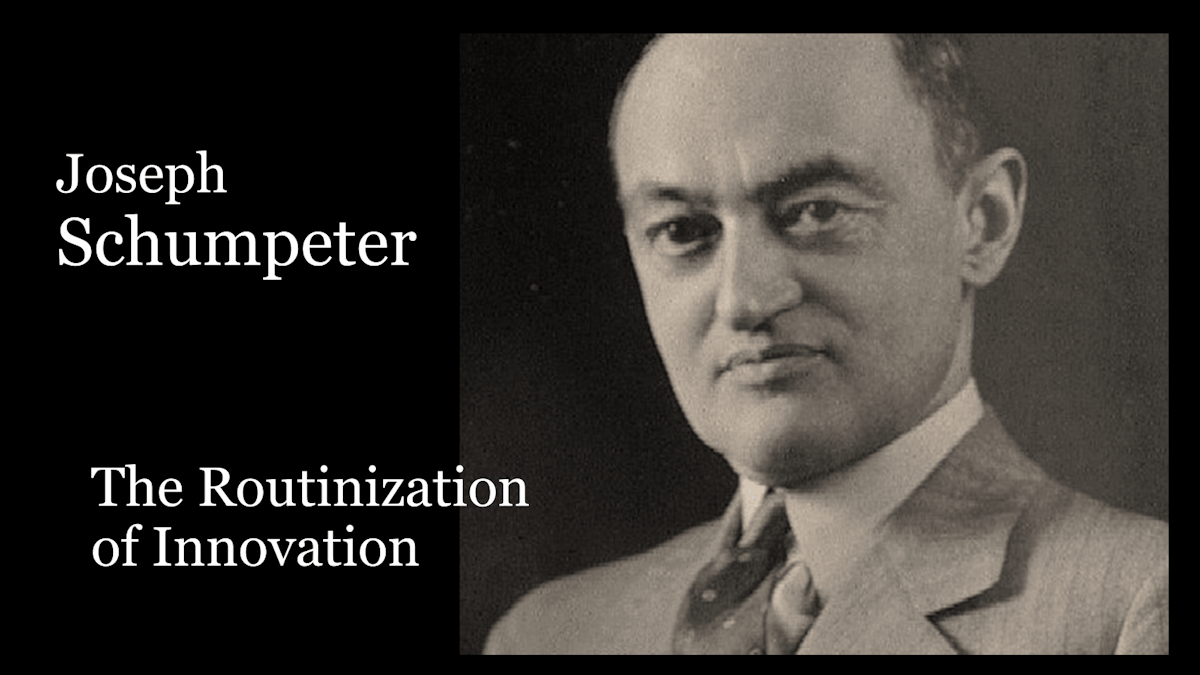
Week 1: What Schumpeter Got Wrong About the Routinization of Innovation
This series begins with Joseph Schumpeter because he identified the direction innovation was heading more clearly than anyone before him.
In 1942, Schumpeter made a prediction about the future of innovation that turned out to be both right and profoundly incomplete.
As capitalist enterprises matured, he argued, innovation would become routinized. The heroic individual entrepreneur, the daring visionary who disrupted existing structures through what Schumpeter called creative destruction, would gradually be replaced by R&D departments inside large corporations.
Innovation would become systematic. Institutionalized. Managed by salaried professionals rather than driven by individual genius.
He was right that routinization was the direction.
He was wrong about almost everything else.
Schumpeter’s Contribution
Schumpeter's contribution was twofold. First, he gave us the concept of creative destruction, the idea that capitalism advances not through gradual improvement but through the periodic and often violent displacement of old structures by new ones.
The entrepreneur was the engine of this process, the agent who introduced new combinations of resources, products, and methods that rendered existing arrangements obsolete.
Second, and less discussed, he predicted that this entrepreneurial function would eventually be absorbed by large organizations. As capitalism matured, he argued, the individual entrepreneur would give way to the corporate R&D department. Innovation would become a managed process rather than a heroic act.
Routinization, in his view, was both inevitable and desirable. It would make innovation more reliable, more predictable, and more productive.
This second prediction is the one this series begins with. Because Schumpeter was right about the direction and wrong about almost everything else.
Why It Mattered
Schumpeter's framework changed how economists, policymakers, and business leaders thought about innovation for the rest of the twentieth century.
Before Schumpeter, innovation was largely treated as an external shock, something that happened to markets rather than something that could be understood, managed, or systematized. His work made innovation a subject of serious analysis rather than romantic mythology.
The concept of creative destruction in particular gave the business world a language for something it had always experienced but never clearly named.
Industries do not just grow. They get disrupted. The disruption is not a bug in the system. It is the mechanism through which the system advances. That insight, radical in 1942, is now so thoroughly absorbed into how we talk about business that it is easy to forget someone had to name it first.
His prediction about routinization also shaped how governments and institutions thought about innovation policy for much of the twentieth century.
If large firms were the natural home of systematized innovation, then supporting large firms, through favorable regulation, public research funding, and patent protection, was the rational approach to fostering innovation at scale.
What It Left Open
But for all that his framework got right, Schumpeter left the most important problem untouched.
Schumpeter's blind spot was the individual founder.
His model assumed the large corporation as the vehicle for routinized innovation. Scale, in his framework, was the prerequisite for systematizing the innovative function.
What he could not see from 1942 was that the most consequential innovation today is not inside corporations. It is happening at the earliest possible stage of company formation, before the organization exists, before the product is built, before the first customer has paid.
The startup ecosystem has exploded in ways Schumpeter never anticipated. And the founders driving it have almost none of the institutional resources he assumed were necessary.
They are operating on instinct, on incomplete information, on assumptions that were never tested, with access to structure and guidance determined almost entirely by who they know and how lucky they are.
Schumpeter also assumed that routinization and innovation were fundamentally in tension. That systematizing the process of building new things would reduce it to incremental improvement, stripping away the creative destruction that made entrepreneurship valuable.
What we now know is the opposite. The founders who build the most disruptive companies are not operating on pure instinct and raw talent. They are the ones who have developed a disciplined practice of testing assumptions, identifying structural contradictions in their own thinking, and making decisions grounded in evidence rather than hope.
The discipline does not reduce the disruption. It makes it more likely to survive long enough to matter.
What This Means for Founders Now
The access problem Schumpeter never addressed is still the central problem of early-stage entrepreneurship.
The founders who succeed today did not succeed because innovation was routinized inside a large firm. Most succeeded because they happened to have the right mentor at the right moment, or got into the right accelerator, or built in a city where the ecosystem gave them access to pattern recognition that most founders never encounter.
Even the best startup ecosystems in the world reach only a fraction of the founders who need what they offer.
Not because the knowledge is scarce, but because no system existed to deliver it at scale, to every founder, regardless of where they were building or who they happened to know.
Schumpeter named the destination. He identified routinization as the direction innovation was heading and recognized that systematizing the process of building new things was both possible and necessary.
What he could not build in 1942, and what remained unbuilt for the eighty years that followed, was the infrastructure to deliver that systematization to the individual founder, before the company exists, independent of institutional scale, available to anyone willing to do the work.
That is the real project his work points toward.
To make the thinking, the pattern recognition, and the decision-making clarity that the best founders in the world have always had access to available to every founder, at every stage, in every moment they need it.
Not talent. Not luck. Not connections.
A discipline. A system. A practice.
Schumpeter was right that routinization was the direction. He just aimed it at the wrong level.
Follow on Substack to get the weekly series directly to your inbox.
Next week: What Darwin Actually Said About Survival. The most misquoted idea in business and what it actually means for founders trying to build something that lasts.
Published March 9, 2026
By Dr. Shaun P. Digan, MBA, PhD
Sources
Capitalism, Socialism and Democracy, Joseph Schumpeter (1942)
The Theory of Economic Development, Joseph Schumpeter (1911)
The Innovator’s Dilemma, Clayton Christensen (1997)
About the Author
Dr. Shaun P. Digan is the founder of Startup.Ready and the creator of the Startup Readiness Framework, a research-based system for evaluating and strengthening the foundations of early-stage startups. He holds a PhD in Entrepreneurship from the University of Louisville and has spent 15 years teaching, advising, and consulting with founders. In this series, The Foundations of Innovation, he writes on the ideas that built the startup world and the one idea still missing from all of them.