Week 6: Clayton Christensen and Jobs to Be Done

In the late 1990s, Clayton Christensen was asked to help a school district solve a discipline problem.
Students were disrupting class. Talking out of turn. Acting out. The district had tried the obvious responses: stricter rules, more consequences, better classroom management training for teachers. Nothing worked.
Christensen looked at the problem differently. Instead of asking why students were misbehaving, he asked what job the misbehavior was doing for them.
The answer was uncomfortable. Students were not disrupting class because they were bad students or because the rules were unclear. They were disrupting class because they were bored; and boredom is a struggle that demands a solution.
Talking to a friend, acting out for a laugh, staring at a phone, these were not failures of discipline. They were products being hired to do a job. The job was entertainment and social connection. The school had not provided anything to compete with that job. So students hired the next best available option.
This was not a discipline problem. It was a competition problem.
That reframe is at the heart of everything Christensen built.
Christensen's Contribution
Clayton Christensen spent his career asking a question that most businesses never think to ask: what is the customer actually trying to accomplish?
Not what do they say they want. Not what demographic profile they fit. Not what features they respond to in a focus group. What is the underlying struggle, the specific circumstance of their life, that creates the need for a solution in the first place?
He called this Jobs to Be Done. The core idea is deceptively simple. People do not buy products. They hire them to make progress in a specific situation. When the job is done well enough by something else, or when the job disappears, they fire the product and move on.
This shifted the unit of analysis entirely. Before Christensen, most businesses thought about customers in terms of demographics and preferences. After Christensen, the right question became: what situation is this person in, and what are they trying to get done?
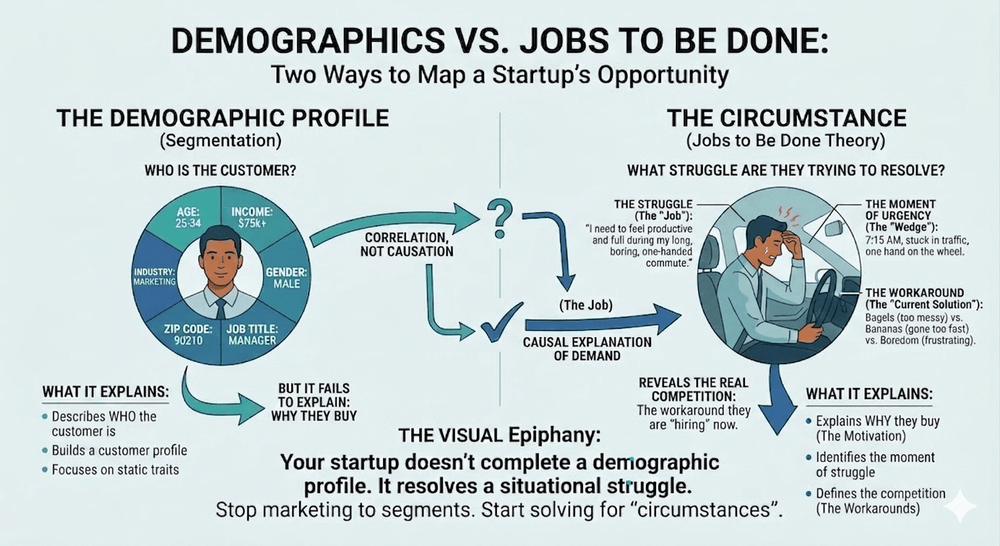
The distinction matters enormously. Two people with identical demographic profiles (same age, same income, same zip code) can have completely different jobs to be done depending on their circumstances. And two people with nothing in common demographically can share exactly the same job and be equally valuable customers.
Christensen demonstrated that the most important competitor is often not another product in the same category. It is whatever the customer is currently doing instead.
The school's real competition was not another school. It was boredom itself, and the readily available solutions students had already hired to address it.
Why It Mattered
Before Jobs to Be Done, the dominant framework for understanding customers was segmentation. Divide the market by age, income, geography, behavior. Build profiles. Target the profiles. Measure whether the profiles respond.
Christensen exposed the fundamental flaw in this approach. Segmentation describes who the customer is. It tells you almost nothing about why they buy. And why they buy is the only thing that actually matters when you are trying to build something new.
His insight reoriented the entire question of product development. Instead of asking what features customers want, the right question is what struggle they are trying to resolve.
Instead of asking who the customer is, the right question is what situation they are in.
Instead of asking how to beat competitors, the right question is what the customer is currently hiring to do the job and why that solution is falling short.
This reframe had immediate practical consequences. It explained why so many well-funded, well-researched products failed despite positive focus group results. The products were designed around customer profiles rather than customer struggles.
It explained why seemingly inferior products sometimes won in the market. They addressed the actual job better than the technically superior alternative.
It explained why customers sometimes behaved in ways that defied demographic predictions. Because the situation mattered more than the profile.
Jobs to Be Done gave businesses a more accurate map of why demand actually exists. Not a perfect map. But a fundamentally more honest one than what came before.
What It Left Open
Christensen was a theorist and a diagnostician. He was extraordinarily good at explaining why things happened after the fact. The disrupted industries, the failed products, the unexpected winners. Jobs to Be Done made sense of all of them in retrospect.
What he left open was the forward-looking discipline. Knowing that a job exists is an insight. Being ready to build a business around it is something else entirely.
Christensen could tell you that the school's real competition was boredom. He could not tell you whether a specific founder had the capacity, the market access, the business model, and the financial clarity to build something that actually won that competition at scale.
He identified the job. He did not build the system for determining whether a founder was actually prepared to do it.
This gap shows up constantly in early-stage startups. A founder identifies a genuine struggle. They understand the job clearly. They build a solution that addresses it. And then they fail. Not because the job was wrong, but because they did not understand who else was in that struggle, could not reach them reliably, could not deliver value at a price that worked, or ran out of runway before any of it came together.
The job was real. The readiness was not.
Christensen gave founders a better question to ask about their customer. What he left open was a framework for honestly answering whether the business around that customer was structurally sound.
What This Means for Founders Now
The most uncomfortable question a Jobs to Be Done framework forces is this: what would have to happen in a customer's life for them to fire what they are currently doing and hire you instead?
If the answer is "my product is faster" or "my product is cheaper," you have not found a job. You have found a feature improvement. Feature improvements get noticed. They rarely get hired.
The founders who get this right are the ones who can describe the specific moment of struggle. Not the demographic profile of the person experiencing it, but the situation they are in when the need becomes urgent enough to act. The commuter who needs both hands free. The student who needs to get through the next forty minutes without dying of boredom. The founder who needs to know whether their business is structurally sound before they commit the next six months of their life to it.
The struggle is not a market segment. It is a circumstance. And circumstances are specific, observable, and often completely invisible to businesses that are too focused on who their customer is to notice what their customer is trying to do.
There is also a harder implication that most founders avoid. If customers are not currently hiring anything to do the job, if there is no workaround, no makeshift solution, no bad alternative they are tolerating, then the job may not be urgent enough to drive action. Non-consumption is not always an opportunity. Sometimes it is a signal that the struggle is not painful enough to solve.
The question is not whether the job exists. The question is whether it is urgent enough, frequent enough, and frustrating enough that a customer would fire their current solution the moment something better appeared.
Before you build the solution, understand the struggle well enough to answer that question honestly.
Follow on Substack to get the weekly series directly to your inbox.
Next week: James March on Exploration, Exploitation, and Learning in Entrepreneurship.
Published April 13, 2026
Last Updated April 13, 2026
By Dr. Shaun P. Digan, MBA, PhD
Sources
The Innovator's Dilemma, Clayton Christensen (1997)
Competing Against Luck, Clayton Christensen, Taddy Hall, Karen Dillon, David Duncan (2016)
About the Author
Dr. Shaun P. Digan is the founder of Startup.Ready and the creator of the Startup Readiness Framework, a research-based system for evaluating and strengthening the foundations of early-stage startups. He holds a PhD in Entrepreneurship from the University of Louisville and has spent 15 years teaching, advising, and consulting with founders. In this series, The Foundations of Innovation, he writes on the ideas that built the startup world and the one idea still missing from all of them.