Week 8: Steve Blank and the Customer Development Model
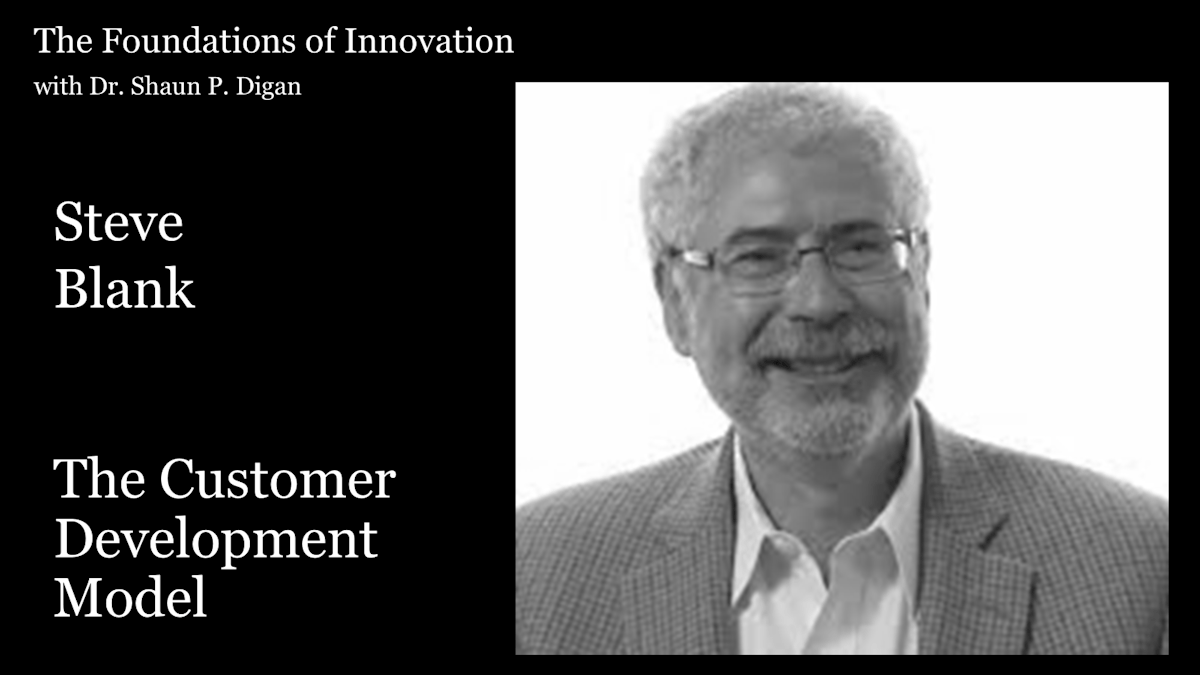
Steve Blank spent twenty years building and selling companies before he figured out why most of them almost failed.
Not why competitors failed. Why his own companies, the ones he built and ran and took public, kept arriving at the edge of disaster before finding their way back. The products were real. The teams were capable. The markets existed. And yet, again and again, the process of getting from idea to revenue was messier, more expensive, and more contingent than it had any right to be.
By the time he sat down to teach at Stanford in the early 2000s, he had a theory about why.
The problem was not execution. It was sequence. Founders were executing the right activities in the wrong order. They were building products before they understood customers, hiring sales teams before they understood the market, and spending capital to scale processes that had never actually been validated. They were running a business before they had finished learning what business they were actually in.
He called the alternative the Customer Development Model. And it changed how an entire generation of founders thinks about what to do before they build.
Blank's Contribution
The insight at the center of Customer Development is deceptively simple: a startup is not a small version of a large company. It is a temporary organization in search of a repeatable, scalable business model.
That distinction carries more weight than it appears to. A large company executes a known business model. It has customers, channels, pricing, and processes that have been validated over time. The job of management is to run those processes efficiently and improve them incrementally.
A startup has none of that. It has hypotheses. Assumptions about who the customer is, what problem they have, how much they will pay, and how to reach them. Some of those assumptions will be right. Most of them, in Blank's experience, will be wrong in ways that are not obvious until real customers are involved.
The traditional response to this uncertainty was to treat it like an execution problem. Write a detailed business plan. Build the product to spec. Hire the team. Launch. The plan provided the illusion of certainty, and the organization executed against it. When reality diverged from the plan, which it always did, the response was to execute harder.
Blank's argument was that this sequence was backwards. The plan could not be written before the hypotheses were tested, because the plan depended on answers that only customers could provide. Before a startup could execute, it had to learn. And learning required a process as rigorous and deliberate as the execution process it was meant to precede.
Customer Development was that process. It consisted of four stages: customer discovery, customer validation, customer creation, and company building. The first two stages were explicitly about learning. The second two were about scaling what had been learned. The division was not incidental. It was the whole point.
Get out of the building, Blank told his students. Before you write another line of code, before you hire another salesperson, before you spend another dollar on marketing, go talk to customers.
Not to pitch them. Not to validate your assumptions by selecting the feedback that confirms them. To find out whether the problem you think you are solving is the problem they actually have.
This was not obvious advice in 2003. It was, in many circles, actively counterintuitive. The prevailing model was to build in stealth, launch with confidence, and let the market respond. Showing an unfinished product to potential customers felt like weakness. Admitting that you did not yet know who your customer was felt like incompetence.
Blank reframed both. Not knowing was not incompetence. It was the accurate description of every startup's situation at the beginning. The incompetence was pretending otherwise and spending capital to execute a plan built on untested assumptions.
Why It Mattered
Customer Development arrived at a specific moment in the history of startups. The first dot-com boom had just collapsed, taking with it billions of dollars invested in companies that had scaled their spending before validating their business models. The wreckage was everywhere. The diagnosis was unclear.
Blank's framework provided one. The companies had not failed because the internet was a bad idea or because the founders were incompetent. They had failed because they had executed before they had learned. They had built products nobody wanted, hired sales teams to sell things nobody was buying, and raised capital to accelerate processes that were accelerating toward nothing.
Customer Development gave founders a vocabulary for what had gone wrong and a process for doing it differently. It separated the learning phase from the execution phase and insisted that the first had to precede the second. That insistence was not philosophical. It was practical. Every dollar spent executing an unvalidated hypothesis was a dollar that could not be recovered if the hypothesis turned out to be wrong.
The framework also did something subtler and arguably more important. It legitimized uncertainty as the starting condition of every startup. Before Blank, uncertainty was something to be hidden, managed, or overcome as quickly as possible. After Blank, uncertainty was the thing you worked with systematically until it resolved into knowledge.
That shift in framing changed what founders thought their job was in the early stages. Not to build. Not to sell. To learn. To generate the specific knowledge that would eventually make building and selling possible.
Eric Ries extended this thinking into the Lean Startup methodology, which brought Customer Development to a much wider audience and added the build-measure-learn loop as its operational engine. But the foundation was Blank's. The insight that a startup is a search before it is a business, and that the search requires a methodology as rigorous as the business that follows it, was his.
What It Left Open
Blank was a practitioner writing for practitioners. His framework was grounded in his own experience building companies and refined through years of watching his students try to do the same. It was specific, actionable, and honest about the messiness of early-stage building in a way that most academic frameworks were not.
What it left open was the question of readiness.
Customer Development tells founders what to do in the discovery phase. Get out of the building. Talk to customers. Test your hypotheses. It provides a process for learning and a set of criteria for knowing when enough has been learned to move forward.
What it does not provide is a way to evaluate whether the founder is equipped to execute that process effectively. Whether they have the domain knowledge to ask the right questions and interpret the answers. Whether they have the market access to reach the customers who matter. Whether their problem hypothesis is specific enough to test or still too broad to produce useful signal. Whether the business they are searching for is structurally sound enough to be worth finding.
Customer Development assumes a capable, well-positioned founder with a specific enough hypothesis to test. In practice, many founders begin the discovery process without those conditions in place. Their interviews produce mixed signals not because the market is ambiguous but because their problem definition is too broad to generate consistent responses. Their customer access is too limited to produce a representative sample. Their interpretation of feedback is too heavily influenced by confirmation bias to produce honest learning.
Blank identified the right starting point. He did not build the diagnostic for determining whether a founder was actually ready to start.
What This Means for Founders Now
The most important thing Blank gave founders was permission to not know.
Permission to begin without a complete business plan. Permission to talk to customers before the product was finished. Permission to treat the early stage as a search rather than an execution, and to pursue that search with the same rigor and discipline that execution would eventually require.
That permission matters more than it might appear, because the alternative, the illusion of certainty that a detailed plan provides, is genuinely seductive. A plan feels like progress. A hypothesis feels like uncertainty. Blank argued that the honest description of every startup's situation at the beginning is uncertainty, and that the founders who pretend otherwise are not more confident. They are less prepared.
The practical implication is straightforward. If you are in the early stages of building, the question is not whether your plan is detailed enough. It is whether your hypotheses are specific enough to test, whether you have access to the customers who can test them, and whether you are genuinely prepared to hear answers that contradict what you want to believe.
Customer Development is a rigorous process. But it produces useful results only when the founder entering it is positioned to execute it honestly. That positioning is not assumed. It is built. And building it is the work that precedes the work.
Follow on Substack to get the weekly series directly to your inbox.
Next week: The intellectual case for routinizing innovation does not begin with a productivity hack or a startup methodology. It begins with Giovanni Dosi, who showed that innovation follows structured paths rather than random leaps. That idea is the foundation everything I build is pointed toward.
Published April 27, 2026
Last Updated April 27, 2026
By Dr. Shaun P. Digan, MBA, PhD
Sources
The Four Steps to the Epiphany, Steve Blank (2003)
The Startup Owner's Manual, Steve Blank and Bob Dorf (2012)
About the Author
Dr. Shaun P. Digan is the founder of Startup.Ready and the creator of the Startup Readiness Framework, a research-based system for evaluating and strengthening the foundations of early-stage startups. He holds a PhD in Entrepreneurship from the University of Louisville and has spent 15 years teaching, advising, and consulting with founders. In this series, The Foundations of Innovation, he writes on the ideas that built the startup world and the one idea still missing from all of them.