Week 12: Herbert Simon and the Cognitive Environment Every Founder Is Trapped Inside
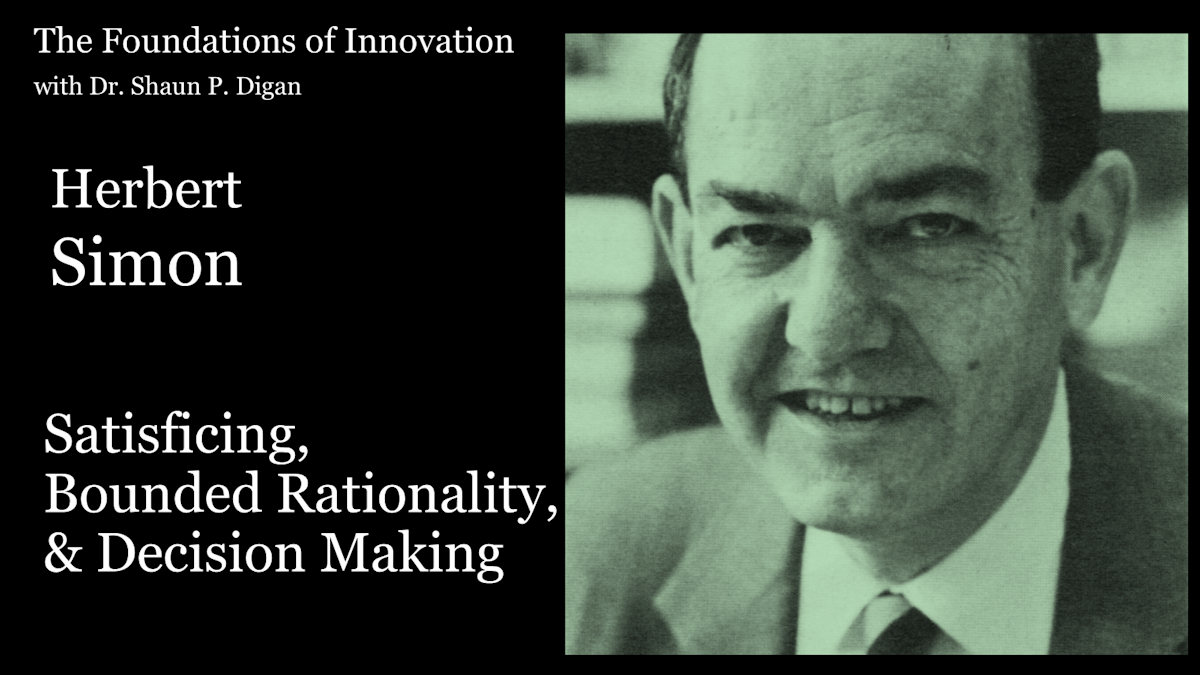
Herbert Simon did not set out to study entrepreneurs.
He set out to understand how people actually make decisions, as opposed to how economists assumed they did. What he found changed the behavioral sciences, earned him a Nobel Prize, and laid the foundation on which Saras Sarasvathy, working in his department at Carnegie Mellon decades later, would build the most precise description of entrepreneurial reasoning the field has produced.
Simon's contribution is upstream of everything else. Before you ask how a founder should reason, you have to ask what reasoning is possible inside the environment a founder actually occupies. Simon answered that question first.
The answer was uncomfortable.
The Problem with the Standard Model
The dominant economic model of decision-making, the one that governed the field when Simon arrived in the 1940s and 1950s, assumed that people were rational agents. Given a set of options, a rational agent would evaluate each one against all available information, calculate the expected utility of each outcome, and select the option that maximized their preference.
It was an elegant model. It was also a fiction.
Simon was not the first person to notice this. He was the first to name it precisely and show, empirically, what was actually happening instead.
Real people, Simon observed, do not have access to all relevant information. They cannot hold all options simultaneously. They cannot calculate expected utility across complex, uncertain futures. Their cognitive capacity is finite. Their time is finite. The information they would need to reason optimally is often incomplete, unavailable, or too expensive to acquire.
Simon's framework becomes especially important under genuine uncertainty rather than calculable risk. In many startup environments, founders cannot assign reliable probabilities to outcomes because the market itself is still forming. Optimization breaks down not because founders are careless, but because the underlying probability distributions do not yet exist in a stable form.
He called this condition bounded rationality.
Not irrationality. Not stupidity. Bounded rationality. Reasoning that is real, effortful, and often sophisticated, but constrained by the cognitive limits of the person doing it and the informational limits of the environment around them.
The constraint is the default. It is not the exception.
From this constraint, Simon derived one of the central behavioral patterns of human decision-making.
Satisficing
From bounded rationality, Simon derived a behavior pattern he called satisficing.
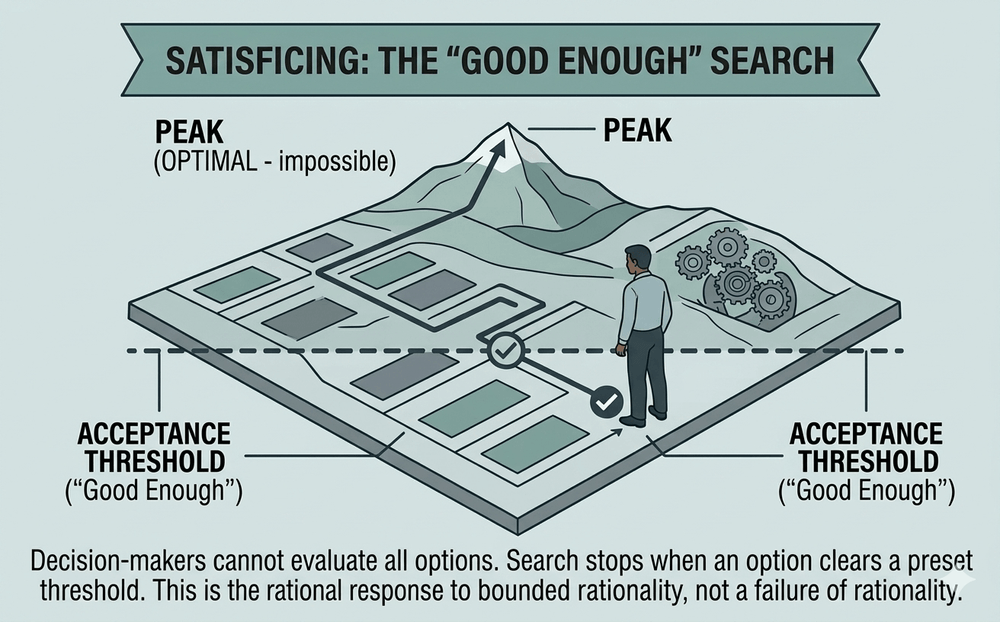
The word is a combination of "satisfying" and "sufficing." It describes what people actually do when they cannot optimize. They search for an option that is good enough. Not the best option in the space of all possible options. An option that clears a threshold they have set, implicitly or explicitly, for what acceptable looks like.
They stop searching when they find it.
This is not a failure of rationality. It is the rational response to bounded rationality. When you cannot know all the options, when you cannot calculate all the outcomes, when the cost of further search exceeds the expected benefit, stopping at "good enough" is the correct move.
Simon was describing what every founder already does.
Every pricing decision made without a full competitive analysis. Every co-founder selection made without a formal evaluation process. Every go-to-market choice made with partial information about how customers actually find solutions. These are not failures of discipline or intelligence. They are the inevitable output of bounded rationality applied to a startup's actual information environment.
The founder who believes they are making optimal decisions is not reasoning more clearly than the one who accepts constraints. They are reasoning about themselves incorrectly.
What Bounded Rationality Is Not
Simon was careful about what his framework implied and what it did not.
Bounded rationality is not a license for sloppy thinking. It does not mean all decisions are equal because perfect information is unavailable. It means the quality of a decision is determined not by whether it was optimal in some theoretical sense, but by whether it was the best decision possible given the actual constraints the decision-maker faced.
That distinction has practical teeth.
A founder who makes a go-to-market decision based on two customer conversations is operating under bounded rationality. A founder who makes the same decision based on thirty customer conversations with documented patterns is also operating under bounded rationality. Both are constrained. One is much more constrained than the other.
The bounds are real. They are not fixed.
Simon's framework does not tell founders to accept cognitive limits as permanent. It tells them to take those limits seriously as the actual conditions of their decision-making, to understand where their information is thin, to invest search effort where it produces the most reduction in uncertainty, and to stop pretending that commitment feels the same as evidence.
The Environment Problem
Simon made another contribution that matters at least as much as bounded rationality, though it is cited less often.
He argued that the complexity we observe in intelligent behavior is frequently not the product of complex internal processes. It is the product of the environment those processes are navigating.
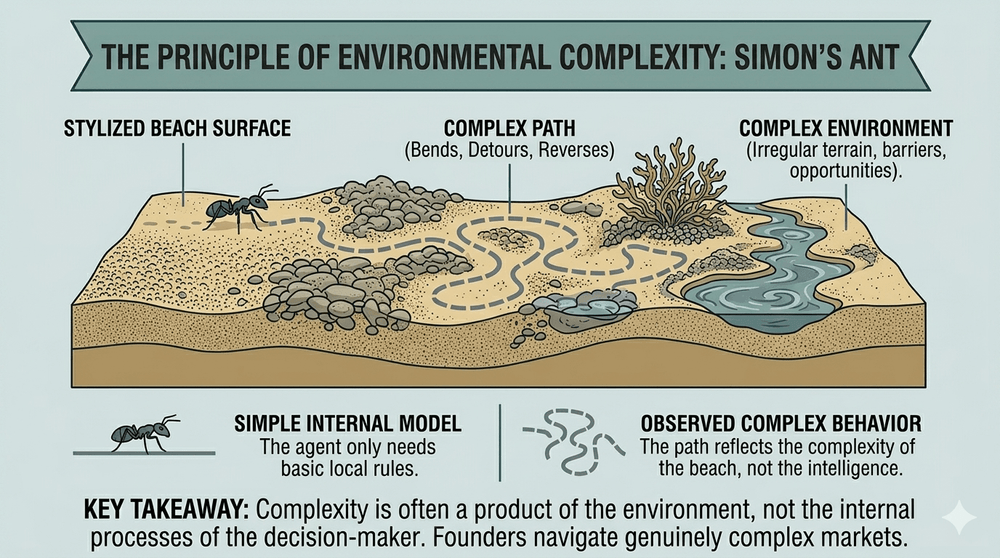
To describe this, Simon used the image of an ant walking across a beach. The ant's path looks complicated. It bends, reverses, detours. A naive observer might conclude that the ant has a complex internal model of the terrain. Simon argued the opposite. The ant's internal model is simple. The beach is complex. The path reflects the environment, not the intelligence.
He called this the principle of environmental complexity.
For founders, this is a clarifying observation.
A startup's decision environment is genuinely complex. The market is uncertain. Customer behavior is unpredictable. Competitor moves are unknown. Technology changes faster than models of it can stabilize. Funding depends on social dynamics no spreadsheet captures. The regulatory environment shifts.
This complexity is not a failure of the founder's reasoning. It is a property of the environment the founder is navigating.
The practical implication: reducing the apparent complexity of founder decision-making sometimes requires changing the environment the founder operates in, not just sharpening their internal reasoning. Structure, checklists, frameworks, and scaffolding are not crutches that substitute for intelligence. They are environmental modifications that extend the reach of bounded rationality by reducing the information-processing load each individual decision requires.
Simon built this argument in the 1950s. 75 years later the implications of this argument are still not fully integrated into much of entrepreneurship education and founder support infrastructure.
Why Simon Is the Foundation Sarasvathy Built On
When Sarasvathy sat down in Simon's department at Carnegie Mellon to study how expert entrepreneurs actually reasoned, she was not starting from scratch. She was starting from bounded rationality.
Her central research question was, in effect, a Simon question: given that people cannot reason optimally, what does expert reasoning look like inside realistic cognitive constraints? Simon had asked this about decision-makers in general. Sarasvathy asked it specifically about entrepreneurs.
The effectuation framework she produced is the answer.
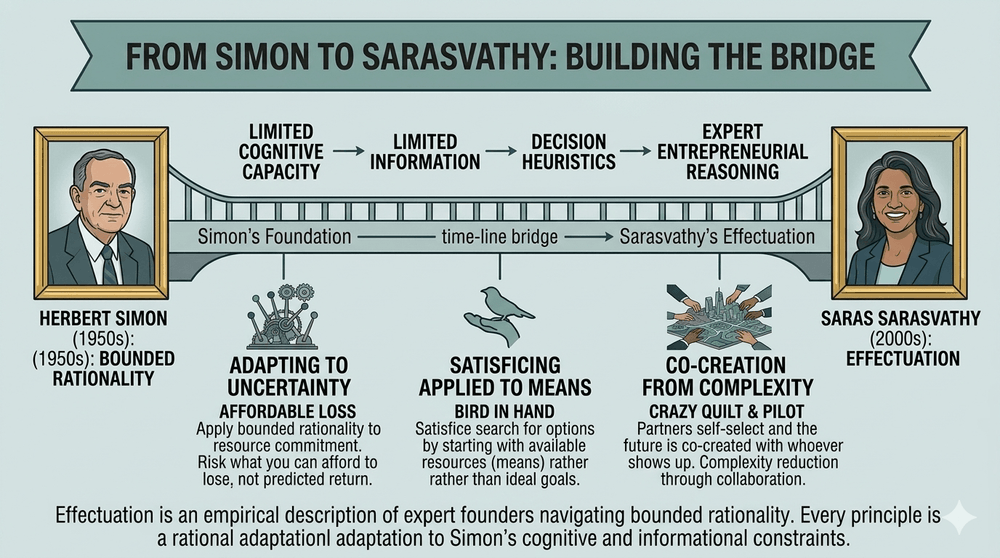
Effectuation is not a philosophy of reasoning, and it is not advice. It is an empirical description of how experienced founders navigate bounded rationality. Bird in hand, starting with available means rather than ideal goals, is a satisficing strategy. It is the rational response to a decision environment where all possible goals cannot be evaluated and the optimal one cannot be identified.
Affordable loss is bounded rationality applied to resource commitment. Under uncertainty, the question "what can I afford to lose" is more tractable than "what is the expected return on this investment." The first question requires only knowledge of current resources. The second requires knowledge of future outcomes that cannot be known.
The crazy quilt principle, building a venture through partnerships with self-selected stakeholders, is bounded rationality applied to market definition. When the market cannot be fully specified in advance, the rational move is to let the market define itself through the commitments of early participants.
Every principle in effectuation is a rational adaptation to the cognitive constraints Simon named. Sarasvathy showed that expert entrepreneurs had discovered these adaptations through experience. Simon explained why the adaptations were the right ones.
The two bodies of work fit together because they are asking the same question at different levels of abstraction.
What Simon Left Open
Simon was precise about the conditions of bounded rationality and clear about the satisficing behavior it produces. He was interested in how decision-makers could improve their performance inside those conditions, and his later work explored the role of expertise, heuristics, and institutional structure in extending the reach of bounded reasoning.
But the question he left most open was the one most relevant to founders who are not yet experts.
Expert decision-makers, Simon showed, develop cognitive shortcuts through experience. A chess grandmaster does not calculate all possible moves. They recognize patterns and apply rules of thumb that decades of play have validated. Their satisficing is informed by a library of patterns they have built from exposure.
First-time founders do not have that library. Their satisficing is informed by analogies from domains that may not transfer, intuitions shaped by markets they have not actually studied, and assumptions that have never been stress-tested against real customer behavior.
This is not a character flaw. It is the predictable consequence of being early in a domain where expertise has to be earned through iteration.
What Simon pointed toward, but did not build, was the scaffolding that could give a non-expert access to something closer to expert pattern-recognition without requiring years of prior founding experience. The heuristics that experienced founders have internalized need to be made available to founders who do not yet have them.
The challenge is not merely giving novice founders heuristics. It is helping them understand when a heuristic applies, when it breaks, and what environmental assumptions it depends on.
Follow on Substack to get the weekly series directly to your inbox.
Theoretical Takeaway
Simon helped establish the behavioral foundation on which much later entrepreneurship theory would build. Bounded rationality is not a description of how some founders reason under some conditions. It is a description of how all founders reason under all conditions of genuine uncertainty. The question the field has been answering ever since, from Kahneman's cognitive biases to Sarasvathy's effectuation, is not how to escape those bounds. It is how to reason well inside them. Simon named the room.
Next week: Scott Shane and the individual-opportunity nexus. Why the same opportunity produces different ventures in different founders' hands, and what that means for how we think about fit.
Publication Date: May 18, 2026
Last Updated: May 18, 2026
By Dr. Shaun P. Digan, MBA, PhD
Sources
Administrative Behavior: A Study of Decision-Making Processes in Administrative Organization, Herbert A. Simon, Macmillan (1947)
A Behavioral Model of Rational Choice, Herbert A. Simon, Quarterly Journal of Economics (1955)
The Sciences of the Artificial, Herbert A. Simon, MIT Press (1969)
Models of Bounded Rationality, Herbert A. Simon, MIT Press (1982)
About the Author
Dr. Shaun P. Digan is the founder of Startup.Ready and the creator of the Startup Readiness Framework, a research-based system for evaluating and strengthening the foundations of early-stage startups. He holds a PhD in Entrepreneurship from the University of Louisville and has spent 15 years teaching, advising, and consulting with founders. In this series, The Foundations of Innovation, he writes on the ideas that built the startup world and the one idea still missing from all of them.