Week 9: Giovanni Dosi and the Structure Beneath Innovation
In 1982, an Italian economist published a paper that changed how a generation of researchers thought about technological change.
Giovanni Dosi was working through a problem that Schumpeter had named but never resolved, and that Nelson and Winter had begun to formalize a few years earlier. If innovation was the engine of capitalism, what were its rules? If new technologies displaced old ones, did they arrive randomly, or did they follow patterns that could be studied?
The dominant view at the time treated innovation as stochastic. Breakthroughs happened. They were unpredictable. The job of the economist was to measure their effects, not to explain how they emerged. Innovation was a black box that produced outputs the economy then absorbed.
Dosi argued that the box was not black. It was structured. And the structure was visible if you looked at the right level.
His paper, "Technological Paradigms and Technological Trajectories," made a quiet claim that has aged into one of the most important ideas in the economics of innovation. Innovation is not a series of random leaps. It is a directed search along paths that the underlying technology and its surrounding institutions make possible.
That claim sits underneath everything this project is trying to build.
Dosi's Contribution
Dosi's central move was to take a concept from the philosophy of science and apply it to technology.
Thomas Kuhn had argued that science does not advance through steady accumulation. It advances through paradigms: shared sets of assumptions, methods, and exemplary problems that define what counts as legitimate work in a field. Most science happens inside a paradigm, refining and extending it. Occasionally a paradigm breaks, and a new one replaces it. The transition is the revolution. The work in between is what Kuhn called normal science.
Dosi saw the same structure in technology.
A technological paradigm, in his framing, is a model of how to solve specific technical problems, grounded in a particular set of physical principles and engineering practices. The internal combustion engine was a paradigm. The semiconductor was a paradigm. Each one defined a space of possible problems, a set of techniques for solving them, and an implicit ranking of which problems mattered.
Inside that space, technological progress unfolded along what Dosi called trajectories. A trajectory is the cumulative path that engineers, firms, and industries follow as they exploit the possibilities of a paradigm. Faster processors. Lighter materials. Lower-energy chemical processes.
The trajectory is heavily constrained, even though no specific outcome is predetermined. The paradigm shapes which improvements are possible, which are difficult, and which are off the map entirely.
This was a structural claim about innovation. Not every direction was equally available at every moment. The technologies that surrounded a problem, the firms that had developed expertise in that problem, the institutions that funded its study, all of these created a landscape in which some moves were natural and others were nearly impossible.
Innovation did not happen in a vacuum. It happened inside a paradigm, along a trajectory, shaped by the cumulative choices of everyone who had worked on the problem before.
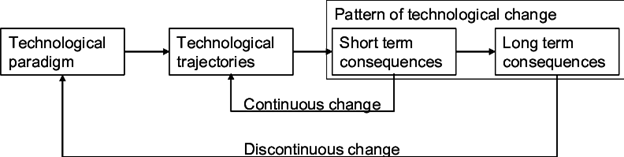
Figure: Technological Paradigms and Trajectories (Dosi, 1982)
Dosi was careful about what this did and did not mean. The paradigm did not determine the outcome. There was real variation, real creativity, real surprise. But the variation was not unbounded. It happened within a structure. And the structure was the thing that had been missing from earlier accounts of innovation.
He was also careful to distinguish the trajectory from the paradigm. A trajectory could be exhausted. A paradigm could be overthrown. The difference between incremental progress and a true revolution was the difference between traveling along a trajectory and switching to a new one. Most technological change was the first. The second was rare, disruptive, and often unrecognized until well after it had happened.
Why It Mattered
Dosi's framework gave researchers a vocabulary for something the field had been trying to name for decades.
Before Dosi, two views of innovation competed for attention. One treated it as a series of essentially random breakthroughs whose timing and direction could not be predicted. The other treated it as demand-driven, a response to market signals in which firms produced what customers were willing to pay for.
Both views captured something real. Neither could explain why certain technologies clustered together, why certain industries advanced along strikingly similar paths, or why some directions of improvement that seemed obviously valuable nonetheless went unexplored for decades.
The paradigm-and-trajectory framework explained all three. Technologies clustered because they shared underlying principles. Industries advanced along similar paths because they were exploiting the same structural possibilities. Some directions went unexplored because the paradigm did not point that way, no matter how valuable the destination might have been.
The framework also reshaped how economists thought about firms. In the dominant model of the time, firms were treated as profit-maximizing agents that selected among available technologies based on cost.
Dosi, drawing on Nelson and Winter's evolutionary economics, argued that firms were better understood as bundles of routines and competencies that had evolved within a particular paradigm. A firm could not simply switch paradigms because doing so meant abandoning the routines and knowledge that defined what the firm could do. Capability was sticky. Paradigms were sticky. The economy as a whole moved more slowly than a frictionless model would suggest, and the friction was where most of the interesting dynamics lived.
This had implications that reached well beyond economics. Innovation policy could not just fund research and assume breakthroughs would follow. It had to think about the paradigms a country or region was positioned to develop, the trajectories its firms could plausibly follow, and the institutional capabilities required to sustain either. Innovation was not just a function of money and talent. It was a function of structure.
For the next four decades, the paradigm-and-trajectory framework became one of the standard lenses through which scholars analyzed technological change. It informed how we understood the rise of Silicon Valley, the trajectory of the pharmaceutical industry, the evolution of clean energy, and the path dependencies that shape why some regions innovate and others stagnate.
What It Left Open
Dosi solved an enormous problem. He showed that innovation has structure, and that the structure can be mapped.
What he did not solve is the problem at the level the founder lives in.
Dosi's paradigms operate at the level of industries and technologies. The trajectory of semiconductors. The trajectory of biotech. The trajectory of mobile communications. These are useful units of analysis for an economist studying decades of technological change across whole sectors. They are too coarse to help a founder deciding what to build on a Tuesday morning.
The founder is not choosing among paradigms. The founder is operating inside one, often without knowing which one, and trying to figure out what specific move to make next. Which problem to focus on. Which assumption to test first. Which version of the product is worth building. Which customer is worth a conversation. The questions Dosi's framework answers about the technology landscape do not translate directly into the questions the founder is asking about their startup.
There is also a second gap, and it matters more.
Dosi's structure is descriptive. It describes how innovation has unfolded, looking back. It does not give the individual builder a system for reasoning forward. A founder cannot simply read Dosi and know what to do, any more than a sailor can read a map and know how to sail. The structure is real. The capacity to navigate inside it is a separate skill.
That capacity, the ability to reason structurally about a venture, has historically been distributed by accident. Some founders develop it through years inside a domain. Some inherit it from operators on speed dial. Some absorb it from accelerators or investors who have seen enough patterns to recognize them quickly. Most founders never get access to it at all. They build by intuition, on assumptions they have never named, in directions they have never examined, and they run out of time before they figure out what they did not know.
Dosi's framework implies that this is fixable. If innovation has structure, the structure can be taught. If the structure can be taught, the capacity to reason about it can be built rather than inherited. The implication is there, even if Dosi never wrote it that way.
What Dosi did not build, and what the field has not completed since, is the bridge from his structural account of innovation to a usable practice the individual founder can pick up and apply. The map exists. The instrument that lets a single founder navigate it does not.
What This Means for Founders Now
The most important thing in Dosi's work, for a founder, is the claim that the structure is there.
Not the specific paradigms he named. Not the trajectories he mapped. The deeper claim. That innovation is not random. That the leap from idea to viable company is not a coin flip. That the work of building something new takes place inside a structure that can be understood, mapped, and reasoned over.
If that claim is true, then the difference between founders who build durable companies and founders who do not is not primarily a difference in talent or luck. It is a difference in how clearly each one sees the structure they are operating inside, and how disciplined each one is about reasoning within it.
That is a different conclusion than the one most founders carry. The dominant story the startup world tells about itself is romantic. The visionary who saw what no one else saw. The pivot that came from nowhere. The breakthrough that defied prediction. Those stories are not false, exactly. They are incomplete in the same way Schumpeter's account of the heroic entrepreneur was incomplete. They make the structure invisible by focusing on the leap.
The leap is real. So is the structure. The founders who succeed reliably are not the ones who leap hardest. They are the ones who see the landscape they are leaping across.
Dosi gave us the language for that landscape at the level of industries and technologies. The work that remains is at the level of the individual venture. To take the structural claim he made about innovation in general and translate it into a practice the founder can use on the startup in front of them.
That translation is what the next several issues are about. Sarasvathy at the level of how founders reason under uncertainty. Simon at the level of the cognitive constraints they reason within. Shane at the level of the opportunity itself. Each one moves the structural account closer to the founder.
Dosi is the spine. The rest of the series is the journey from his level of analysis down to the one where the work has to happen.
If you take one thing from his work into your own building, take this. The next move is not a guess. It is a question with structural features you can reason about. Where you are in the trajectory. What the paradigm makes possible. Which assumption is load-bearing. What evidence would move it. The reasoning is available. The instrument that makes it usable is what the rest of this project is for.
Theoretical Takeaway
Innovation has structure that can be mapped, and the structure operates at multiple levels at once. Dosi's contribution to the argument this series is building is the foundational claim that the founder-level work is not random and can therefore be reasoned about systematically. Without that claim, the rest of the project does not stand up.
Next week: Saras Sarasvathy and the theory of effectuation. The most prominent existing account of how entrepreneurs actually reason under uncertainty, what it gets right, and the specific gap it leaves open.
Published May 4, 2026
Last Updated May 4, 2026
By Dr. Shaun P. Digan, MBA, PhD
Sources
Technological Paradigms and Technological Trajectories, Giovanni Dosi, Research Policy (1982)
An Evolutionary Theory of Economic Change, Richard R. Nelson and Sidney G. Winter (1982)
The Structure of Scientific Revolutions, Thomas S. Kuhn (1962)
About the Author
Dr. Shaun P. Digan is the founder of Startup.Ready and the creator of the Startup Readiness Framework, a research-based system for evaluating and strengthening the foundations of early-stage startups. He holds a PhD in Entrepreneurship from the University of Louisville and has spent 15 years teaching, advising, and consulting with founders. In this series, The Foundations of Innovation, he writes on the ideas that built the startup world and the one idea still missing from all of them.