Week 2: What Darwin Actually Said About Survival
Week 2: What Darwin Actually Said About Survival
Everyone knows the phrase. Survival of the fittest.
Four words that have been applied to business, startups, markets, and competitive strategy so many times that most founders treat them as settled truth.
Build something strong enough to survive. Outcompete the weak. Only the fittest make it through.
There is one problem with this.
Darwin never said it.
The phrase was coined by the philosopher Herbert Spencer, who borrowed Darwin's ideas and applied them to human society in ways Darwin himself was uncomfortable with.
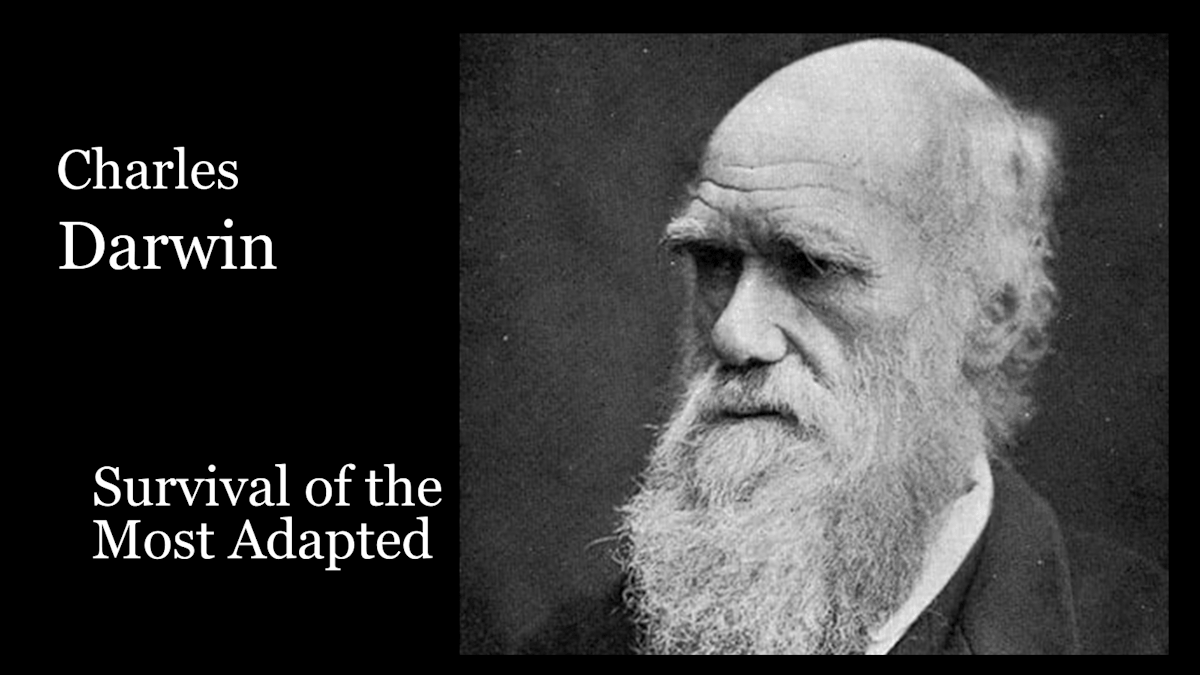
What Darwin actually described was not the survival of the strongest, the fastest, or the most powerful. What he described was the survival of the most adapted.
The organisms that persisted were not the ones that were objectively superior. They were the ones whose characteristics happened to fit the demands of the environment they were operating in at that particular moment.
Fit was not an absolute quality. It was a relationship. Between an organism and its context. And that context was always changing.
This distinction sounds academic until you apply it to early-stage startups. Then it becomes one of the most practically important ideas in this whole series.
Darwin's Contribution
Darwin's real contribution to how we understand survival was not a hierarchy. It was a framework for thinking about fit.
Before Darwin, the dominant explanation for why some organisms thrived and others disappeared was design and the assumption that successful creatures were built for success, that their strength or speed or size reflected some inherent superiority.
Darwin dismantled this entirely. What looked like superiority was always contextual. The characteristic that made an organism fit in one environment could make it catastrophically unfit in another.
There was no absolute advantage. There was only alignment between what an organism was and what its environment demanded at a particular moment.
This was a radical reframing. Survival was not about being the best. It was about being the most aligned. And alignment was not permanent. It had to be continuously maintained against an environment that was continuously changing.
Why It Mattered
The reason Darwin's framework matters beyond biology is that it shifted the question. Before Darwin, the question was: how do I build something strong enough to survive? After Darwin, the better question became: how do I stay aligned with an environment that will not hold still?
That second question is the one almost no startup founder is asking. The startup culture around resilience, grit, and pushing through adversity is built on the first question. Work harder. Move faster. Outlast the competition. Be strong enough to survive.
This is not wrong exactly. Resilience matters. Persistence matters. But it is dangerously incomplete as a theory of survival. Because the startups that fail are rarely the ones that ran out of effort. They are the ones that ran out of fit.
Their product did not fit the problem. Their go-to-market did not fit the customer. Their business model did not fit the economics of the market. Their timing did not fit the readiness of the buyer.
They worked extremely hard in a direction that was never going to work; not because they were weak, but because they were misaligned. Strength in the wrong direction is not an advantage. It is just a slower way to fail.
What It Left Open
Darwin described adaptation as a process of random variation and natural selection. Organisms varied randomly. The environment selected the ones that happened to fit. It was not intentional. It was not fast. It consumed enormous numbers of lives across enormous spans of time before producing anything that looked like progress.
That is the part Darwin left open… and the part that matters most for founders.
Natural selection is a brutal and inefficient mechanism. The variation is random. The feedback loop is generational. There is no way for an organism to detect that it is becoming misaligned before the environment eliminates it. The only signal is survival or death, and by the time the signal arrives it is too late to do anything with it.
Founders do not have to operate this way. The variation does not have to be random. The selection does not have to be natural. The feedback loop can be made faster, more structured, and more intentional.
But Darwin's framework, as powerful as it is, gives us no mechanism for doing that. It describes the problem of alignment without offering any path to solving it deliberately. That gap, between understanding that fit matters and having a system for detecting and maintaining it, is the gap that most early-stage founders fall into.
What This Means for Founders Now
The most important thing Darwin's framework implies for founders is not that they need to be more adaptable in some general sense. It is that they need a way to detect misalignment before it becomes fatal.
The organisms in Darwin's world had no such mechanism. They adapted through the slow, painful, resource-consuming feedback loop of survival and death. Founders who rely on the equivalent (building and shipping and failing until the market eventually tells them what it actually wanted) are running the same process at startup speed. It works sometimes. It is catastrophically expensive when it does not.
The founders who survive are not the ones who were strongest. They are the ones who treated their assumptions as hypotheses rather than conclusions. Who held their conviction loosely enough to update it when the environment gave them new information. Who could hear a customer say something unexpected and let it actually change their thinking rather than explaining it away.
That ability, to detect the distance between where you are and where you need to be, and close it before the environment closes it for you, is not a personality trait. It is a practice. It can be built. It can be developed. It can be systematized in ways that make any founder more adaptive, not just the naturally gifted ones.
Darwin gave us survival of the most adapted. The question is whether adaptation has to be accidental.
It does not.
Follow on Substack to get the weekly series directly to your inbox.
Next week: Daniel Kahneman Knew Founders Think Fast and Slow. On the two systems inside every founder's head and why the one that feels most confident is usually the one most likely to lead you astray.
Published March 16, 2026
By Dr. Shaun P. Digan, MBA, PhD
Sources
On the Origin of Species, Charles Darwin (1859)
The Descent of Man, Charles Darwin (1874)
About the Author
Dr. Shaun P. Digan is the founder of Startup.Ready and the creator of the Startup Readiness Framework, a research-based system for evaluating and strengthening the foundations of early-stage startups. He holds a PhD in Entrepreneurship from the University of Louisville and has spent 15 years teaching, advising, and consulting with founders. In this series, The Foundations of Innovation, he writes on the ideas that built the startup world and the one idea still missing from all of them.