The 6 Pillars
of Startup Readiness
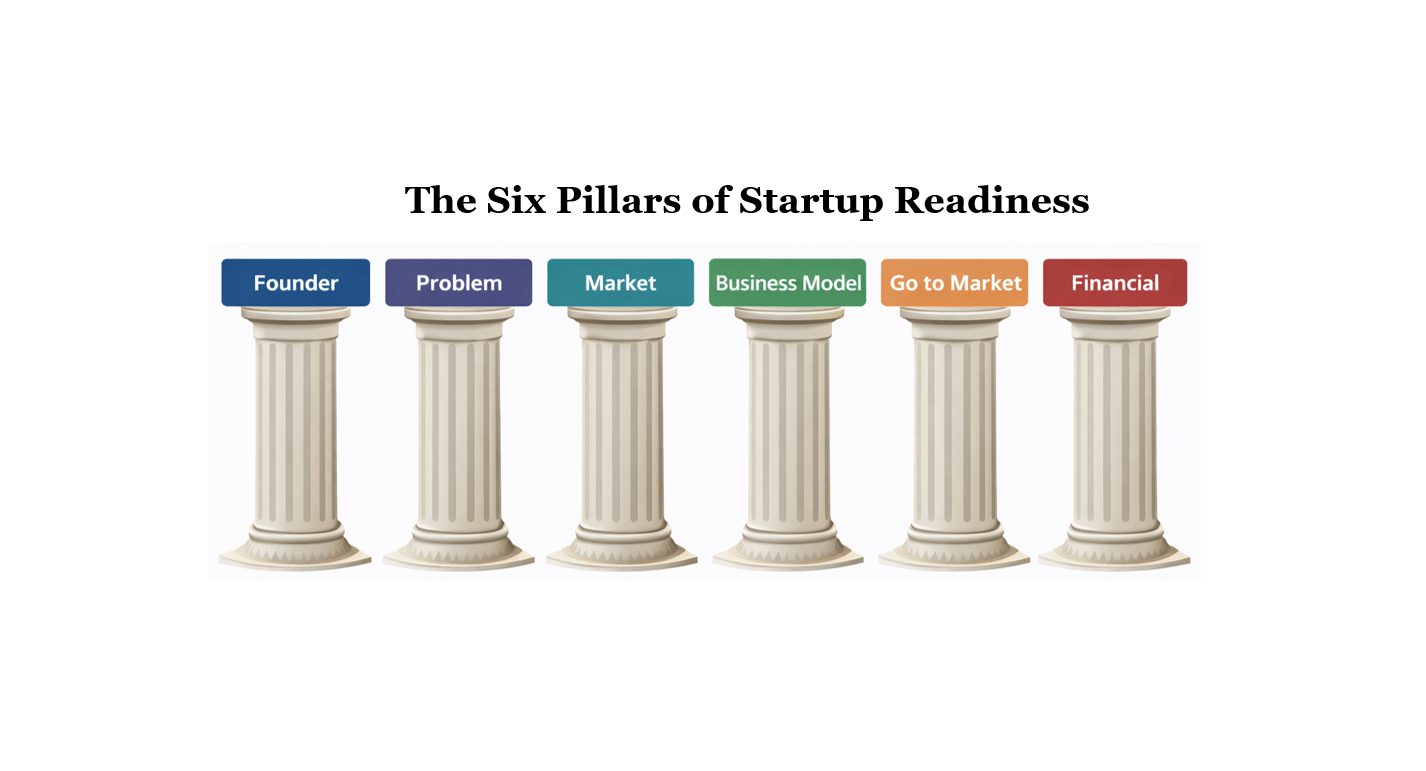
The 6 Pillars
of Startup Readiness
The 6 Pillars of Startup Readiness are a structured framework used to evaluate early-stage startups across founder, problem, market, business model, go-to-market, and financial readiness. This framework helps founders and startup programs identify gaps, reduce risk, and make better decisions before major commitments.
Why These 6 Pillars?
After working with 500+ early-stage founders over 15+ years, the same readiness gaps appear again and again regardless of industry, business model, or founder background.
The pattern is clear: Founders who struggle aren't missing effort, intelligence, or passion. They're missing clarity in one or more of six foundational areas.
These six pillars represent the minimum viable foundation required before major commitments like quitting your job, raising capital, or applying to accelerators. Miss one pillar, and the others can't compensate.
The Startup Readiness Score measures these six dimensions to reveal where you're strong and where critical gaps exist, before the stakes get higher.
The Research Behind the Framework
The 6 Pillars framework is grounded in:
15+ years of direct coaching with early-stage founders navigating ideation, strategy, funding, and critical pivots.
Academic research in entrepreneurship, including dissertation work on founder learning and decision-making.
Pattern recognition across hundreds of founding teams at multiple stages: from idea validation to Series A.
These patterns align closely with how leading startup programs and investors evaluate early-stage companies across founder, market, and execution readiness.
The framework synthesizes established startup methodologies (Lean Startup, Jobs to Be Done, Crossing the Chasm) with behavioral insights about what founders actually need to know at the earliest stages.
This isn't theory. It's a distillation of what separates founders who move forward with confidence from those who spin their wheels for months.
The 6 Pillars Explained
The six pillars represent the core dimensions used to evaluate startup readiness in a structured and systematic way.
Each pillar focuses on a specific area of the startup foundation ranging from founder capability and problem clarity to market definition, business model viability, go-to-market execution, and financial understanding.
Together, they provide a complete view of whether a startup is positioned to move forward or still operating on unclear or untested assumptions.
Rather than evaluating isolated pieces of a business, the Startup Readiness Assessment uses these pillars to diagnose how well the entire system holds together.
This makes it possible to identify not just what is missing, but where misalignment or hidden risk exists across the foundation.
The result is a clearer understanding of readiness, constraint, and the specific areas that need to be strengthened before progress can be made with confidence.
Pillar 1: Founder Readiness
The Question: Is the founder realistically positioned to carry this business forward?
What It Measures:
Capacity: Time and energy available without harming critical obligations.
Skills: Ability to execute the most critical work at this stage.
Motivation: Why building this business matters to you now.
Learning & Decision-Making: How you handle uncertainty and unknown variables.
Support & Resources: Financial runway, co-founder alignment, mentor access, family support.
Constraints: What limits your ability to execute.
Why It Matters:
Without founder readiness, nothing else works. You can validate a brilliant idea, identify a massive market, and design a perfect business model, but if you don't have the capacity, skills, or support to execute, the startup stalls.
Founder readiness gaps show up as:
Burning out after 3 months because capacity was fragile.
Progress slowing because critical skills are missing.
Making reactive decisions under pressure instead of deliberate experiments.
Giving up when inevitable obstacles appear because motivation wasn't rooted in real stakes.
The Startup Readiness Assessment reveals whether you can sustain the effort required and what support systems need to be in place before you commit.
Pillar 2: Problem Clarity
The Question: Is the problem real, painful, and clearly understood in customer language?
What It Measures:
Problem Specificity: Whether you can describe the problem in concrete, observable terms.
Pain Intensity: Whether people take costly or effortful action to avoid this problem today.
Frequency: How often the problem occurs for the same people.
Customer Clarity: Whether you know understand how the customer thinks and speaks about the problem.
Validation: Whether you've observed real workarounds, tools, or manual processes people use to cope.
Why It Matters:
Most startups fail not because they build the wrong solution, but because they solve the wrong problem or a problem that isn't painful enough to drive action.
Problem clarity gaps show up as:
Customers saying "that's interesting" but not buying.
Building for 6 months before realizing the problem isn't urgent.
Pitching features instead of outcomes because you don't understand the real pain.
Targeting "everyone with this problem" because you can't identify who feels it most.
The Startup Readiness Assessment reveals whether your problem is strong enough to support a business... or whether you're solving a "nice to have" that won't drive revenue.
Pillar 3: Market Clarity
The Question: Is there a specific, reachable group of people who feel this problem most intensely?
What It Measures:
Wedge Specificity: Whether you can describe your first target customer in one clear sentence.
Concentration: Whether you can identify specific places where these customers spend time.
Proximity: Whether you know and can access specific places to find them.
Triggers & Urgency: What situations cause this problem to become urgent enough to act.
Market Clarity: Whether you understand their language, pain points, current solutions, and decision-making process.
Why It Matters:
A painful problem without a reachable market is just an idea. You need to know not just WHO has the problem, but WHERE they are and WHEN they're most motivated to solve it.
Market clarity gaps show up as:
Spending months "talking to customers" without a clear profile of who you're targeting.
Building marketing messages that don't resonate because you don't know their language.
Struggling to find customers even though "everyone has this problem".
Launching with no clear channel strategy because you don't know where they congregate.
The Startup Readiness Assessment reveals whether you can actually reach the people who need your solution... not just theoretically, but practically.
Pillar 4: Business Model Clarity
The Question: Does the way value flows through this business make sense?
What It Measures:
Value Creation: What becomes measurably better for customers after using your solution.
Value Capture: What customers give, when they give it, and what they receive in return.
Value Delivery: Whether you understand how to consistently deliver the promised value.
Scalability: What would limit your ability to scale (serve 5x, 10x, 20 customers).
Leverage: Whether the business has sources of compounding advantage (reusable assets, automation, network effects).
Defensibility: Whether there's a structural reason this business is hard to copy.
Why It Matters:
You can have a real problem and a reachable market, but if the business model doesn't work, you'll struggle to build a sustainable company. Business model clarity determines whether value flows efficiently (or leaks at every step).
Business model gaps show up as:
Requiring heroic founder effort to deliver value to each customer.
Competitors easily copying your model because there's no moat.
Growth stalling because every customer requires the same manual work.
Customers saying "this is great" but not paying because the value exchange isn't clear.
The Startup Readiness Assessment reveals whether your business can scale and survive long term... or whether you're building a consulting practice disguised as a startup.
Pillar 5: Go-to-Market Clarity
The Question: Can this startup reliably reach customers in a way that matches their behavior?
What It Measures:
Buying Behavior Clarity: Whether you understand how target customers make buying decisions.
Channel Selection & Fit: Whether you've chosen 1-3 channels that give repeatable access to customers.
Message Resonance: Whether your message connects problem, urgency, and outcome.
Acquisition Clarity: Whether you understand the step-by-step journey from awareness to conversion.
GTM Clarity: Whether you see how channel, message, path, and offer work together.
Why It Matters:
A great product that no one discovers is worthless. Go-to-market clarity determines whether you can systematically and repeatably turn awareness into action or whether every customer acquisition feels like starting from scratch.
GTM gaps show up as:
Trying 5 different channels simultaneously without focus.
Messaging that explains features instead of outcomes.
Customers saying "I don't get it" or "Is this for me?".
Converting only through personal relationships because there's no repeatable system.
The Startup Readiness Assessment reveals whether you have a customer acquisition engine... or just hope and hustle.
Pillar 6: Financial Clarity
The Question: Does the founder understand the financial realities that determine this startup's survivability?
What It Measures:
Revenue Clarity: Whether you can describe what must happen for money to change hands.
Cost Clarity: Whether you can identify the things that consume the most resources.
Unit Economics: Whether you understand what one customer pays, what it costs to serve them, and what it costs to acquire them.
Business Cycle Clarity: Whether you understand the time from first contact to payment, payment to value delivery, and effort to learning.
Runway Awareness: Whether you know how long the business can operate with current resources.
Why It Matters:
Startups don't fail because they run out of ideas. They fail because they run out of time and money. Financial clarity determines how long you have to figure things out and whether the unit economics will ever work.
Financial gaps show up as:
Running out of runway before achieving key milestones.
Discovering too late that customer acquisition costs exceed lifetime value.
Not understanding how long it takes to close deals, which kills cash flow planning.
Spending months on activities that don't move the revenue needle.
The Startup Readiness Assessment reveals whether you understand the financial clock ticking in the background... and whether the math works.
How the 6 Pillars Work Together
The 6 pillars aren't independent. They're interdependent.
Foundation Layer: Founder + Problem
Without founder readiness and problem clarity, nothing else matters. You can't validate a market, build a business model, or execute go-to-market if you don't have capacity or aren't solving a real problem.
Market Fit Layer: Market + Business Model
Once the foundation is solid, market clarity tells you who to serve, and business model clarity determines how to serve them sustainably. These two pillars answer: "Can we build a business here?"
Execution Layer: GTM + Financial
With a solid market and business model, go-to-market clarity determines whether you can reach customers, and financial clarity determines whether you can survive long enough to prove it works.
The Weak Link Principle
Your startup is only as strong as your weakest pillar.
A brilliant founder with a vague problem won't get traction
A painful problem without a reachable market won't generate revenue
A validated market without a business model won't scale
A solid business model without go-to-market won't acquire customers
Strong GTM without financial clarity will run out of runway
The Startup Readiness Assessment uses these pillars to generate your score.
This is why the assessment measures all 6 pillars. It reveals which one is holding you back.
6 Pillars of Startup Readiness FAQs
What are the 6 pillars of startup readiness?
The 6 Pillars of Startup Readiness are a structured framework used to evaluate whether an early-stage startup is prepared to move forward. They include Founder, Problem, Market, Business Model, Go-to-Market, and Financial clarity. Together, they provide a complete view of whether a startup’s foundation is strong, aligned, and based on evidence rather than assumptions.
Why are these 6 pillars important for early-stage startups?
Most early-stage startups don’t fail because of effort or execution. They fail because key assumptions are unclear or misaligned. The six pillars isolate where those gaps exist so founders can address them before committing significant time, money, or resources. This reduces risk and increases the likelihood of making meaningful progress.
How do you evaluate a startup using the 6 pillars?
Each pillar is evaluated based on specific signals of clarity, alignment, and evidence. This includes things like how well the problem is understood, whether a clear market exists, how value flows through the business model, and whether the founder has the capacity to execute. A structured startup readiness assessment applies this framework to generate a clear diagnosis of strengths, gaps, and constraints.
What is the most important pillar?
There is no single “most important” pillar because they are interdependent. However, Founder Readiness and Problem Clarity form the foundation. Without the ability to execute or a real problem worth solving, the other pillars cannot compensate. Ultimately, a startup is limited by its weakest pillar.
How do the 6 pillars relate to getting into an accelerator?
Most incubators and accelerators evaluate startups across similar dimensions: founder capability, market opportunity, business model viability, and execution readiness. The six pillars mirror how these programs assess early-stage companies, making them a useful way to determine whether a startup is ready to apply or where it may fall short.
Can a startup succeed if one pillar is weak?
It’s possible to make progress with gaps in one area, but over time, weaknesses compound. A weak pillar often becomes the bottleneck that slows growth, creates confusion, or increases risk. The goal of the framework is to identify and strengthen these weak points early before they limit the entire system.
Is this framework only for new startups?
No. While the 6 Pillars are most useful in the early stages, they can be applied at any point where clarity is needed. Founders often revisit these pillars when preparing for funding, entering new markets, or trying to diagnose why growth has stalled.
What’s the difference between the 6 pillars and a startup checklist?
Most startup checklists focus on tasks like things to do or complete. The 6 Pillars focus on clarity. What is actually understood, validated, and aligned? A startup can complete many tasks and still lack clarity. This framework is designed to evaluate the underlying foundation, not just surface-level activity.
How can founders identify gaps across the 6 pillars?
The most effective way is through a structured startup readiness assessment that evaluates each pillar systematically. Rather than relying on intuition or fragmented feedback, the assessment provides a clear breakdown of where assumptions are strong, where they are weak, and what needs to be clarified next.
What should founders do after identifying gaps in the 6 pillars?
Once gaps are identified, the focus should shift to targeted validation and learning. This means testing assumptions, gathering evidence, and improving alignment within and across pillars. Progress comes from increasing clarity in the areas that are currently limiting forward movement, not from doing more activity without direction.
Published: April 10, 2026
Last Updated: April 10, 2026
We use cookies to improve user experience. Choose what cookie categories you allow us to use. You can read more about our Cookie Policy by clicking on Cookie Policy below.
These cookies enable strictly necessary cookies for security, language support and verification of identity. These cookies can’t be disabled.
These cookies collect data to remember choices users make to improve and give a better user experience. Disabling can cause some parts of the site to not work properly.
These cookies help us to understand how visitors interact with our website, help us measure and analyze traffic to improve our service.
These cookies help us to better deliver marketing content and customized ads.