Week 10: Saras Sarasvathy and the Reasoning Founders Already Use
In the late 1990s, a doctoral student at Carnegie Mellon set out to answer a question the field of entrepreneurship had been asking sideways for decades.
Saras Sarasvathy wanted to know how expert entrepreneurs actually thought. Not what they said in interviews about their journeys, scrubbed and shaped for public consumption. Not what business schools taught about how to build companies. What they did, in real time, when faced with the decisions a startup demands.
She was working under Herbert Simon, whose own Nobel-winning research on bounded rationality had reshaped how economists understood human decision-making. Simon's framework said people do not optimize. They satisfice. They make decisions under cognitive constraints with limited information and limited time. The question Sarasvathy carried into her dissertation was whether expert entrepreneurs did something distinctive inside those constraints, something that separated them from the rest of the population making decisions under uncertainty.
She found that they did. And what expert entrepreneurs did was almost exactly the opposite of what every textbook on entrepreneurship at the time was teaching.
Her 2001 paper in Academy of Management Review, "Causation and Effectuation: Toward a Theoretical Shift from Economic Inevitability to Entrepreneurial Contingency," named the pattern. The dominant model treated entrepreneurship as goal-directed action. Identify the opportunity. Calculate the means required. Execute. Sarasvathy showed that expert entrepreneurs ran a different process. They started with means. They formed goals from what they had. They built the venture by acting, observing, and adapting, not by planning, predicting, and executing.
She called it effectuation.
Sarasvathy's Contribution
Sarasvathy's central move was empirical before it was theoretical.
She recruited twenty-seven entrepreneurs, all of whom had taken at least one company from idea to public listing or to revenues between $200 million and $6.5 billion. She gave them the same hypothetical startup, a company called Venturing, and asked them to think out loud as they worked through ten decision problems. Pricing. Market entry. Hiring. Funding. The kind of decisions every founder faces.
The transcripts were striking. The experts ignored most of the analytical tools the textbooks recommended. They did not start by asking what market was largest or what segment was most profitable. They asked who they were, what they knew, and whom they knew. They built from there.
From that empirical pattern, Sarasvathy distilled five principles that organized the expert behavior.
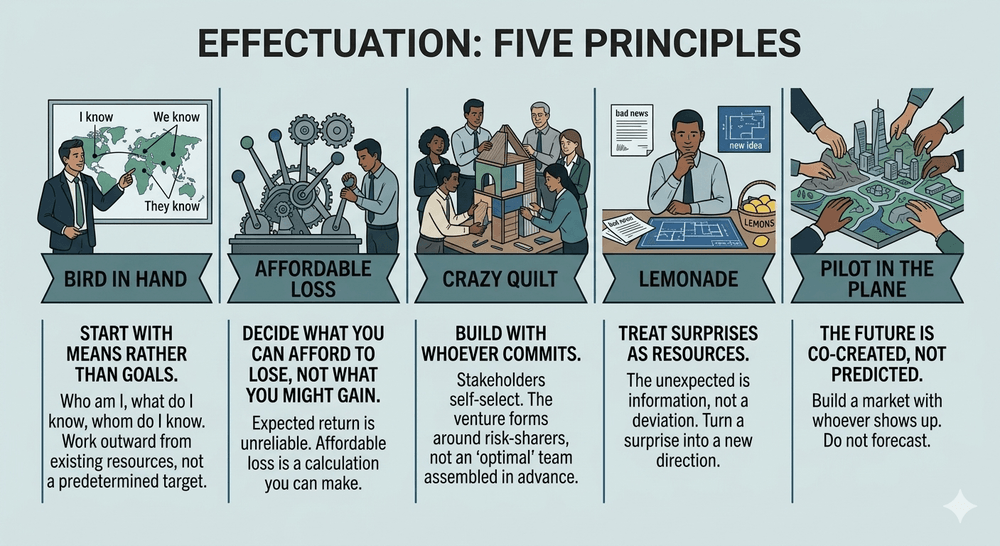
Bird in hand. Start with means rather than goals. Who am I, what do I know, whom do I know. The entrepreneur works outward from existing resources, contacts, and capabilities, not inward toward a predetermined target.
Affordable loss. Decide what you can afford to lose on a given commitment, not what you might gain. Expected return is a calculation the entrepreneur cannot reliably make under uncertainty. Affordable loss is one they can.
Crazy quilt. Build the venture with whoever commits, not with whom you would ideally choose. Stakeholders self-select by stepping in. The venture forms around the people willing to share the risk, not around an optimal team assembled in advance.
Lemonade. Treat surprises as resources. The unexpected is not a deviation from the plan to be corrected. It is information to be incorporated. The founder who can turn a surprise into a new direction is the founder who survives the inevitable contingencies of building.
Pilot in the plane. The future is co-created through human action, not predicted from external trends. The entrepreneur does not forecast a market. They build one in collaboration with whoever shows up.
Together, these five principles described a logic of action that ran in the opposite direction from the planning-and-execution model. Causation, as Sarasvathy named the dominant alternative, asked what means were required to achieve a given goal. Effectuation asked what goals were achievable given a particular set of means. The first treated the future as predictable enough to plan against. The second treated it as constructible through committed action.
She was careful about what the framework did and did not claim. Effectuation was not a rejection of causal reasoning. Expert entrepreneurs used both. They moved between them as the situation demanded. The deeper claim was that effectual reasoning was the dominant logic under high uncertainty, when goals were unclear, means were limited, and the environment was not stable enough to predict. That was the domain in which most early-stage entrepreneurship lived.
The framework also implied something that mattered for how the field thought about expertise. Entrepreneurship was not a trait. It was not a personality. It was a learnable practice characterized by a specific kind of reasoning, observable in the protocols of people who had done it well. The expertise was in the reasoning itself.
Why It Mattered
Effectuation gave entrepreneurship research a foundation it had been missing.
For most of the twentieth century, the field had oscillated between two unsatisfying frames. Either entrepreneurship was a trait, something people either had or did not, observable in retrospective biographies of successful founders. Or it was a market function, the activity that filled gaps in equilibrium models, with the entrepreneur as a placeholder for whatever made the economic story work. Neither frame told a working entrepreneur anything useful about how to think.
Sarasvathy's framework did. It described, in operational terms, how experts reasoned under the specific conditions startups produce. It was empirically grounded, theoretically coherent, and immediately recognizable to anyone who had built a company. Founders read effectuation and saw themselves on the page.
The framework reshaped entrepreneurship research within a decade. The Society for Effectual Action formed to organize a community of scholars extending and testing the theory. The 2001 paper has been cited more than ten thousand times. Effectuation became, alongside the resource-based view and disruption theory, one of a small handful of frameworks taught in nearly every entrepreneurship program in the world. Sarasvathy's 2008 book, Effectuation: Elements of Entrepreneurial Expertise, became the standard reference.
Beyond the research community, the framework changed what could be taught. Before Sarasvathy, entrepreneurship education was uneasy with itself. Programs taught business planning, market analysis, financial modeling, and pitch development, all of which assumed the causal model the experts in her study were not using. Schools knew the tools they were teaching did not match the practice of the most successful founders, but they had no alternative framework that could be operationalized in a syllabus.
Effectuation provided one. It said expert reasoning could be observed, named, and developed. Students could be taught to start with means rather than goals. They could be taught to think in terms of affordable loss rather than expected return. They could be taught to treat surprises as resources. The framework gave entrepreneurship education a defensible content, grounded in evidence about what working founders did.
For practitioners, the framework was permission and clarification at the same time. Permission to operate without a plan, because expert entrepreneurs did. Clarification of what disciplined non-planning looked like, because Sarasvathy had named the principles that organized it.
Founders who had been operating effectually without a vocabulary now had one. Founders who had been forcing themselves to operate causally because that was what the textbooks said now had license to stop.
Effectuation was one of the first frameworks in entrepreneurship to take the working founder seriously as the unit of analysis, alongside developing traditions in entrepreneurial cognition, bricolage, and what would later be called the discovery and creation debates. It became one of the small number of frameworks every serious researcher in the field engages.
The framework has also faced criticism inside the field, primarily on questions of generalizability beyond the original elite sample, the operational difficulty of distinguishing effectual from causal action in real venture data, and the methodological reliance on retrospective protocols from founders who had already succeeded.
What It Left Open
What effectuation does, and where its support runs thin, is more specific than a simple descriptive-vs-developmental distinction.
Sarasvathy's research was protocol analysis of expertise. Twenty-seven founders, all of whom had already succeeded at the highest level, thinking out loud about hypothetical problems. The patterns she identified were patterns of expert practice. The five principles were a distillation of what experts already did, named in a form that other people could engage with.
The framework does scaffold novice founders in real ways. It reduces paralysis by giving the founder permission to start with means rather than wait for a complete plan. It narrows decision complexity by replacing expected return calculations with affordable loss calculations the founder can actually make. It legitimizes iterative learning, encourages stakeholder interaction, and orients the founder toward action when the alternative is analysis. Founders who internalize the five principles operate differently from founders who do not. That is developmental work, and effectuation does it.
What the framework does less well is the next layer down. The scaffold it provides is incomplete in specific ways.
Affordable loss is a powerful frame, but the principle does not tell a first-time founder what counts as affordable when they have never operated under uncertainty before, do not yet know what kinds of losses are recoverable, and cannot tell the difference between a productive misstep and a fatal one. The expert can run the calculation intuitively because the expert has lost things before and remembers what came back. The novice has to learn that distinction in real time, often on the venture itself.
Bird in hand has the same shape. Start with means. But what counts as means for a first-time founder who is uncertain which of their skills, relationships, and resources are actually relevant to the venture they are building? The expert sorts means from non-means automatically. The novice often does not know which ledger to look at.
Crazy quilt asks the founder to build with whoever commits. The principle is sound. The execution requires the founder to recognize commitment when they see it, distinguish committed partners from interested observers, and structure relationships in ways that survive the early period when commitment is being tested. None of that is in the principle. The expert has watched enough commitments dissolve to know the difference. The novice usually finds out by being burned.
Lemonade tells the founder to treat surprises as resources. The framework does not tell the founder which surprises are signals worth incorporating and which are noise that should be ignored. The expert knows from experience. The novice has to learn the difference, and effectuation alone does not accelerate that learning.
None of this is a failure of Sarasvathy's research. Her project was descriptive. She set out to characterize how experts reasoned, and she did. The framework is doing what it was designed to do, and the developmental scaffolding it provides is real.
The harder, more interesting question is how to operationalize what effectuation describes into something a first-time founder can use the way an expert does. That is a curriculum problem, an instrument problem, and a translation problem. It is the gap several lines of work are trying to close, and it is the gap most of this series is pointed at.
What This Means for Founders Now
The most useful thing in effectuation, for a founder, is the permission it grants.
The dominant narrative of entrepreneurship still leans on the causal model Sarasvathy showed expert entrepreneurs were not using. Identify the opportunity. Build the plan. Execute against the plan. The narrative survives because it is legible to people who fund startups, evaluate startups, and report on startups. A clean plan can be presented in a deck. An effectual process cannot.
Effectuation says the founder is allowed to start with what they have. They are allowed to form goals as they go. They are allowed to treat the venture as something built through committed action rather than something predicted from market analysis. Founders who internalize this stop apologizing for not having a five-year plan and start operating in the way the evidence says experts operate.
That is a real shift. It moves the founder closer to the practice of expertise, and the developmental support effectuation provides is genuine.
What the framework does not do, on its own, is close the distance between expert reasoning and the founder's actual decisions on a given week. The principles give the founder the right orientation. Working through a specific decision still requires structure the principles alone do not supply. Which means to lead with. Which losses are recoverable. Which committed partners are the right ones. Which surprises are signals.
That gap is one of the open questions in entrepreneurship research and education. Several traditions are engaging it from different angles. The cognition literature is asking how expert pattern recognition develops. The bricolage literature is asking what counts as a resource and how founders see resources others do not. The lean and customer development traditions are asking how to test the assumptions the founder is operating under. Each one is closing some part of the distance. None of them has yet produced the kind of scaffolded curriculum that medicine and engineering have for their practices. The work continues, and this series is one place where it is being thought through publicly.
If you take one thing from Sarasvathy's work into your own building, take this. The reasoning you are doing is not the wrong reasoning. The textbook was incomplete, and the research backs the instinct most founders have to work effectually. What is missing is not better reasoning. It is the operational structure that makes the reasoning easier to develop in someone who is not yet expert.
The reasoning is real. The work of making it teachable is ongoing.
Follow on Substack to get the weekly series directly to your inbox.
Theoretical takeaway. Effectuation is the most precise existing description of how expert entrepreneurs reason under uncertainty, and the closest the field has come to a theory of entrepreneurial reasoning. Sarasvathy's contribution to the argument this series is building is the demonstration that the reasoning is real, learnable, and observable, while leaving open the question of how to develop that reasoning in someone who is not yet expert. The scaffolding problem is the one the rest of the series, and the work behind it, is built to address.
Next week: Herbert Simon and the cognitive constraints inside which all entrepreneurial reasoning happens. What bounded rationality means for the founder, and why Simon is the foundation Sarasvathy built on.
Published May 11, 2026
Last Updated May 18, 2026
By Dr. Shaun P. Digan, MBA, PhD
Sources
Causation and Effectuation: Toward a Theoretical Shift from Economic Inevitability to Entrepreneurial Contingency, Saras D. Sarasvathy, Academy of Management Review (2001)
Effectuation: Elements of Entrepreneurial Expertise, Saras D. Sarasvathy, Edward Elgar (2008)
What Makes Entrepreneurs Entrepreneurial?, Saras D. Sarasvathy (2001)
About the Author
Dr. Shaun P. Digan is the founder of Startup.Ready and the creator of the Startup Readiness Framework, a research-based system for evaluating and strengthening the foundations of early-stage startups. He holds a PhD in Entrepreneurship from the University of Louisville and has spent 15 years teaching, advising, and consulting with founders. In this series, The Foundations of Innovation, he writes on the ideas that built the startup world and the one idea still missing from all of them.