Week 7: What March Got Right, What My Dissertation Couldn't Prove, and What Both Point Toward
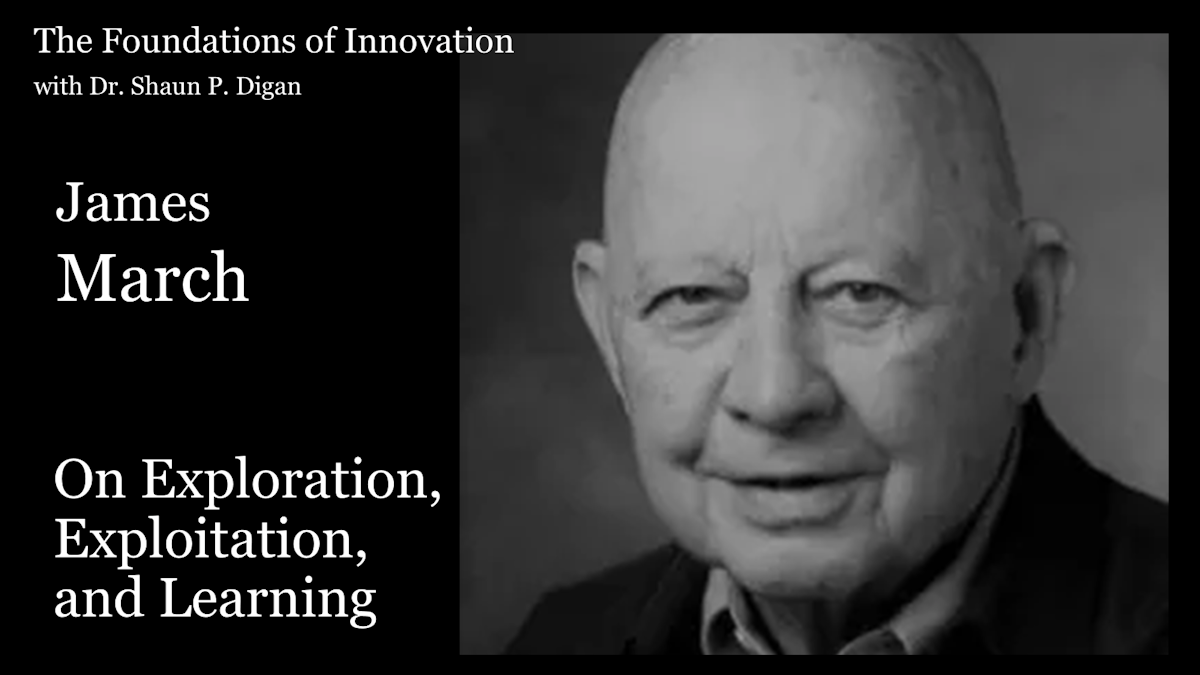
In 1991, James March published what would become one of the most cited papers in organizational science.
In it, he described a fundamental tension at the heart of every learning system: the choice between exploration (searching for new possibilities) and exploitation (refining what already works).
He argued that both were necessary, that neither alone was sufficient, and that managing the balance between them was one of the central challenges of organizational survival.
March was writing about organizations. But his framework reached further than he may have intended. It reached all the way down to the individual founder, sitting alone at a desk at eleven at night, trying to figure out what to do next.
I spent the better part of five years trying to prove that his framework explained how entrepreneurs learn. My dissertation attempted to show that exploratory learning, exploitative learning, and efficiency learning were three distinct and measurable dimensions of entrepreneurial behavior.
I built a rigorous measurement instrument. I collected data from hundreds of entrepreneurs. I ran the structural equation model.
It did not hold.
What the Data Said Instead
What emerged was something I did not expect and initially did not know what to do with.
The exploration-exploitation framework, which had seemed so theoretically elegant, failed to emerge as a meaningful structure in how entrepreneurs actually described their learning behaviors. The distinctions March had drawn at the organizational level did not translate cleanly to the individual level.
What did emerge was something different. Three types of learning organized not around what entrepreneurs were learning but around how they were learning it. Experiential learning: the active doing, testing, and iterating in the real world. Vicarious learning: observing and absorbing from the experience of others. And passive learning: the quieter accumulation that happens through routines, through solving the same kinds of problems repeatedly, through the gradual embedding of what works into daily practice.
The data was telling me something that took years to fully understand. March's question was the right question. But the answer was not about the content of entrepreneurial learning. It was about the process.
Most founders think the challenge is deciding when to explore vs. exploit. My research suggests that’s not the real problem. The real problem is that founders lack a system for learning at all.
The Finding That Changed How I Think About Founders
The founders who learned most effectively were not necessarily the ones who balanced exploration and exploitation most elegantly.
They were the ones who had a high learning orientation. Learning orientation is the degree to which a founder actively seeks, values, and applies new information rather than defaulting to what they already believe. It is a disposition, not a skill; and in my data, it was the single most consistent predictor of learning effectiveness across all three dimensions.
Across experiential learning, vicarious learning, and passive learning, the pattern held. It was not what entrepreneurs were learning that mattered most. It was whether they were oriented toward learning at all.
This distinction matters more than it might appear. March gave us a theory of learning content. He described what kinds of knowledge organizations should pursue and in what proportions.
What he did not give us was a theory of learning infrastructure. Learning infrastructure is the structure that determines whether a founder's experience actually produces usable knowledge. It is the systems, sequences, and interpretive frameworks that turn market feedback into decisions rather than noise. Without it, even a highly learning-oriented founder accumulates experience without compounding it.
That gap is the one I have spent the years since working toward.
What it Left Open
Most founders are not failing because they chose the wrong balance of exploration and exploitation.
They are failing because they have no systematic way to know which mode they should be in at any given stage of any given part of their business. Their learning is reactive rather than structured.
They get feedback from the market and do not know how to interpret it. They make decisions on assumptions they have never articulated clearly enough to test. The knowledge they accumulate through experience stays tacit and fragmented and never gets organized into a form that can actually inform the next decision.
March identified the tension. What he could not see from 1991 is that the real problem for individual founders is not which side of the tension to favor. It is building the infrastructure to engage with the tension deliberately in the first place.
A founder in the exploration phase needs to know they are in the exploration phase. They need a structured way to identify which assumptions are most critical to test, in what order, with what evidence.
Without that structure, exploration becomes wandering. Every customer conversation feels like signal. Every pivot feels like progress. The learning accumulates but never compounds.
A founder moving toward exploitation needs to know when they have actually earned that transition. When the assumptions are validated enough to justify narrowing focus and building for efficiency. Without that clarity, exploitation happens prematurely, before the foundation is strong enough to build on, and the founder finds themselves optimizing a business that was never coherent in the first place.
March described the tension. What he left open was the system for navigating it.
What This Means for Founders Now
My dissertation found that learning orientation was the strongest predictor of entrepreneurial learning across all three dimensions. But learning orientation alone is not enough.
A founder who genuinely wants to learn, who stays curious, who treats every setback as information; that founder still needs a structure that tells them what to learn, in what order, with what evidence, at what stage.
Without that structure, even the most learning-oriented founder is working with an incomplete map. They are asking the right questions in the wrong sequence. They are testing assumptions that do not yet need testing while leaving the critical ones untouched. They are moving fast in a direction they have not yet confirmed is right.
This is the infrastructure March never built. Not a theory of what founders should learn, but a system for how they should learn it. A structure that turns the messy, reactive, assumption-laden process of early-stage building into something more systematic. Something that treats every decision as a hypothesis. Every pillar of the business as a set of assumptions to be tested in a specific order. Every piece of customer feedback as a data point to be interpreted against a framework rather than absorbed without context.
March asked what organizations should learn and in what proportions. The more useful question for individual founders is what they need to learn, in what order, with what evidence; and how we make that process available to everyone regardless of who they know or where they are building.
March gave us the tension. What we are building is the map.
Follow on Substack to get the weekly series directly to your inbox.
Next week: Next week: Steve Blank spent twenty years building and selling companies before he figured out why most of them almost failed. What he learned became the Customer Development Model, and it changed how an entire generation of founders thinks about what to do before they build.
Published April 20, 2026
Last Updated April 20, 2026
By Dr. Shaun P. Digan, MBA, PhD
Sources
Exploration and Exploitation in Organizational Learning, James G. March (1991)
A Behavioral Theory of the Firm, James G. March & Richard Cyert (1963)
Next week: Steve Blank spent twenty years building and selling companies before he figured out why most of them almost failed. What he learned became the Customer Development Model, and it changed how an entire generation of founders thinks about what to do before they build.
About the Author
Dr. Shaun P. Digan is the founder of Startup.Ready and the creator of the Startup Readiness Framework, a research-based system for evaluating and strengthening the foundations of early-stage startups. He holds a PhD in Entrepreneurship from the University of Louisville and has spent 15 years teaching, advising, and consulting with founders. In this series, The Foundations of Innovation, he writes on the ideas that built the startup world and the one idea still missing from all of them.