The Problem Pillar: Is the Problem Strong Enough to Carry a Business?
The Problem Pillar: Is the Problem Strong Enough to Carry a Business?
Problem validation answers one question: is the problem real, painful, and specific enough to move people before you show up with a solution? Prove that, and everything downstream gets easier. Miss it, and no amount of product polish saves you.
Most founders test their idea. Fewer test the problem underneath it. This page shows you how to validate a business problem the only way that counts: by watching what people already do about it, across three tests, pain, frequency, and specificity.
TL;DR: Interest Is Not the Problem. Behavior Is.
Most startups fail because the problem was never strong enough to force action. Problem validation measures whether yours is, before you build on top of it.
The Problem Pillar measures pain, frequency, and specificity, not how interesting your idea sounds.
Most startups don't fail because they built the wrong solution. They fail because the problem never had enough force to drive action.
Signals your Problem Pillar is fragile: customers say "that's interesting" instead of describing the pain unprompted, and no real workaround exists yet.
The rest of this page shows you how to tell a real problem from a polite one.
Founders often think problem strength comes from originality, from finding an angle no one else has noticed. It doesn't. The Problem Pillar measures one thing: whether the problem creates enough pressure to move people without persuasion. Cleverness has nothing to do with it.
The Question This Pillar Answers
Is the problem real, painful, and clearly understood in customer language?
Not: is the problem interesting, or does it make sense to you. Founders can articulate almost any problem persuasively to themselves. The question that matters is whether the people who supposedly have this problem already act like it, before you show up with a solution.
What Problem Validation Actually Measures
Problem validation rests on three elements, and a problem needs all three to carry a business. Any one of them can make an idea feel worth building. All three together are what make people act before you show up.
Pain. The cost of the problem in time, money, risk, or stress. Mild annoyance produces almost no action. Disruptive pain bends the curve straight up. The threshold matters more than the average.
Frequency. How often the problem shows up in the customer's life or work. A problem that occurs weekly is a dramatically different business than one that occurs once a year. Frequency fuels repeatable demand, clearer priorities, and easier acquisition. Defining your problem around the job the customer is trying to get done is one of the fastest ways to surface true frequency instead of a guessed one.
Specificity. How clearly the problem affects a defined group, described in their words, not yours. "People waste time managing projects" is not a problem statement. "Freelance consultants lose billable hours because their tracking system breaks when they're juggling multiple clients" is.
When these three align, the problem pulls the business forward. When they're misaligned, founders substitute effort for demand, and the difference is exhausting to sustain.
Stable, Fragile, and Breaking
A problem doesn't flip from weak to strong at a threshold. It sits on a spectrum, and most early-stage founders are further toward fragile than the enthusiasm in the room suggests.
Stable: Customers describe the pain unprompted. Language repeats across conversations without your prompting. A workaround already exists, even an inefficient one.
Fragile: Curiosity without urgency. Compliments without follow-through. The pain is acknowledged but treated as low priority.
Breaking: Customers tolerate the problem. The pain is abstract, infrequent, or optional. No real workaround exists because nothing forces one to.
A stable Problem Pillar sounds like: "This costs me more than I'd like to admit." A breaking one sounds like: "That would be nice to have." The gap between those two sentences is the gap between a business and a hobby.
Four Signals Your Problem Pillar Is Fragile
A weak problem is easy to miss because people are polite. These are the tells that the pain isn't yet strong enough to drive action.
Customers say "that's interesting" but don't take the next step.
You've spent months talking to customers without a clear pattern emerging in how they describe the pain.
You can't describe the problem without referencing your own product.
The workaround people currently use is optional, not something they're actively frustrated by.
None of these mean you have the wrong problem. They mean the version you're describing isn't sharp enough yet, and sharpening usually beats starting over.
One Tool to Use This Week
Ask the next five people you talk to: "Tell me about the last time you tried to solve this."
Not whether the problem matters to them in theory. What actually happened last time it occurred. Listen for whether they've already spent time, money, or effort coping with it. People vote with effort. Compliments are free. If they haven't tried to fix it, the problem probably isn't strong enough yet to carry a business. Reading the workarounds your customers already use is the structured version of this same test.
You're testing one assumption, that the pain drives action, against evidence you can see. That loop, assumption to evidence to decision, is the unit the Startup Readiness Assessment tracks across all six pillars.
Why Problem Clarity Comes Before Everything Else
A painful, frequent, specific problem does most of the work for you. Market definition sharpens. Messaging simplifies. The business model becomes obvious because the value is already understood by the people who need it. A weak problem does the opposite: every downstream pillar gets harder, because you're manufacturing demand that should have already existed.
Run the test. If customers describe this pain unprompted, use consistent language, and lean on a real workaround, you have a real problem to build around. If one of those fails, you have a more specific question to answer before you build further. Either outcome moves you forward.
Where This Fits in the Framework
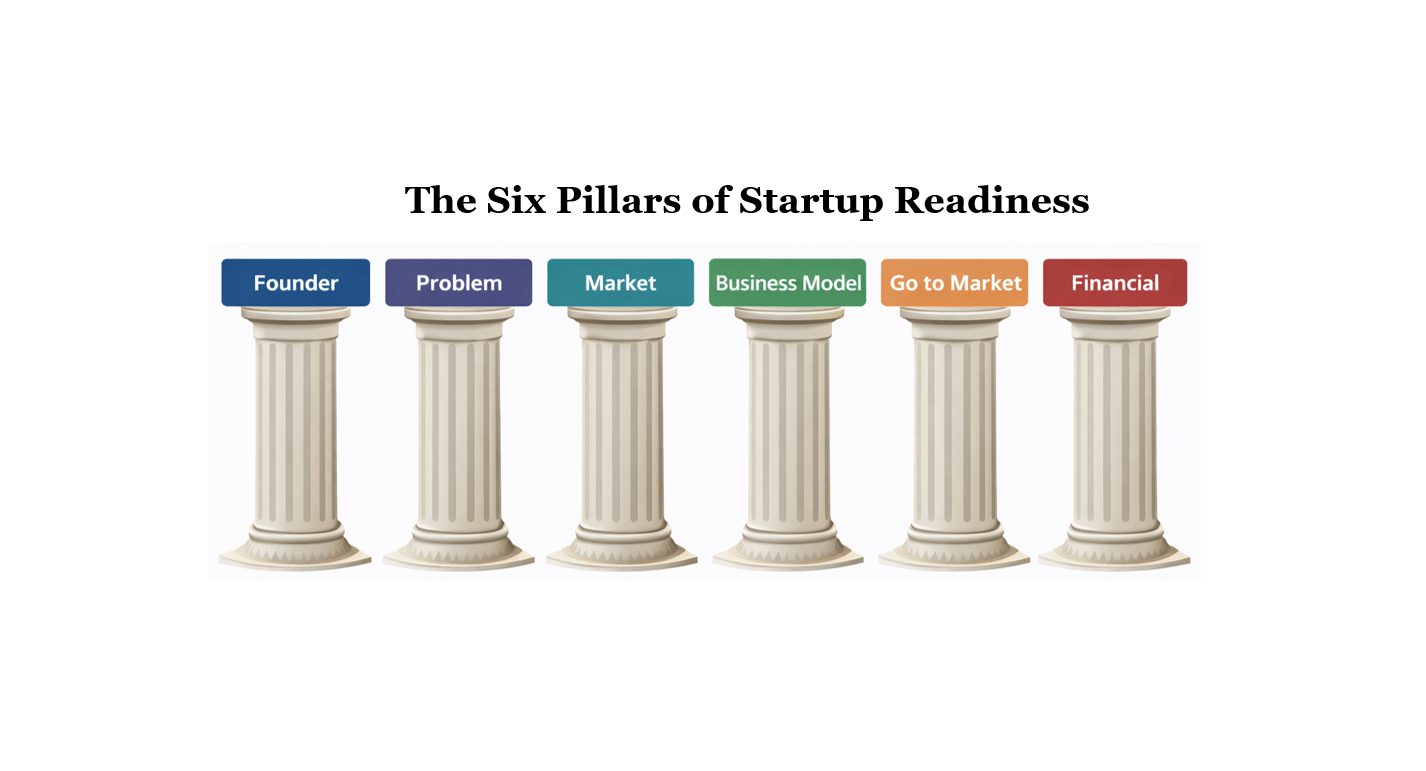
The Market Pillar is one of the 6 Pillars of Startup Readiness. Alongside the Founder Pillar, it forms the foundation layer: without a founder who can execute and a problem worth solving, no other pillar can compensate.
The Startup Readiness Assessment evaluates your Problem Pillar alongside the other five, showing you exactly where the evidence is strong and where you're still working from assumption.
See Where Your Problem Pillar Stands
The Startup Readiness Assessment scores your Problem Pillar on pain, frequency, and specificity, then routes you to the worksheets that close the gaps. Find out whether the pain drives behavior before you build on it.
What is the Problem Pillar in the 6 Pillars framework?
The Problem Pillar is the second of the 6 Pillars of Startup Readiness. It measures whether the problem a startup solves is real, painful, frequent, and specific enough to drive customer behavior without persuasion.
How do you validate a business problem?
Validate a business problem by testing three things: pain, frequency, and specificity. Talk to the people who have it, ask what happened the last time it occurred, and watch whether they've already spent time, money, or effort coping with it. A workaround is evidence. A compliment is noise. When people describe the pain in their own words without your prompting, you're validating a real business problem instead of a preference.
How do I know if my problem is strong enough?
Watch behavior. A strong problem produces unprompted description, consistent language across different customers, and an existing workaround people already tolerate the cost of. If customers only agree the problem exists when you ask them directly, it hasn't been validated yet. Testing your problem statement with five real customers [link green text to Article 18: How to Test Your Problem Statement With Five Customers Before You Trust It] is the fastest way to find out which one you're dealing with.
What's the difference between problem validation and idea validation?
Idea validation asks whether people like your solution. Problem validation asks whether the underlying pain is real and urgent enough to matter before a solution exists at all. A problem can be real and still not be strong enough to support a business if it's infrequent or low-stakes.
Why do customers say "that's interesting" but not buy?
"That's interesting" is a polite response to a problem the person hasn't personally felt with enough force to act on. It signals curiosity. A validated problem signals urgency. Strong problems produce specific, unprompted stories about cost and consequence.
How do I strengthen my Problem Pillar?
Describe the problem in one sentence without mentioning your product. Replace abstract language ("inefficient," "confusing") with concrete consequences ("missed deadlines," "lost revenue"). Test the description in real conversations and watch whether people recognize themselves instantly or need it explained.
Published: July 29, 2026
Last Updated: July 29, 2026
We use cookies to improve user experience. Choose what cookie categories you allow us to use. You can read more about our Cookie Policy by clicking on Cookie Policy below.
These cookies enable strictly necessary cookies for security, language support and verification of identity. These cookies can’t be disabled.
These cookies collect data to remember choices users make to improve and give a better user experience. Disabling can cause some parts of the site to not work properly.
These cookies help us to understand how visitors interact with our website, help us measure and analyze traffic to improve our service.
These cookies help us to better deliver marketing content and customized ads.