The Go-to-Market Pillar: Can You Reliably Reach Customers, Or Does It Feel Like Starting Over Each Time?
The Go-to-Market Pillar: Can You Reliably Reach Customers, Or Does It Feel Like Starting Over Each Time?
GTM readiness answers one question: is there a reliable path from what you offer to the people ready to act on it? Not exposure. A path that produces the same outcome twice. Most founders answer slow traction by adding channels. That multiplies the guessing.
This page lays out the go-to-market framework the assessment scores, the five things GTM readiness measures, from buying behavior to how channel, message, path, and offer work together, plus a go-to-market checklist for spotting where the path breaks before you spend to scale it.
TL;DR: More Channels Is Not the Answer. One Repeatable Path Is.
A great product no one can reliably find goes nowhere. GTM readiness measures whether awareness turns into action through a path you can repeat on purpose.
The Go-to-Market Pillar measures buying behavior, channel fit, message resonance, the acquisition path, and how they work together, not how many channels you're active on.
A great product no one discovers is worthless. GTM clarity determines whether awareness turns into action systematically or by accident.
Signals your GTM Pillar is fragile: you're trying several channels at once without focus, or your message explains features instead of outcomes.
The rest of this page shows you how to build one repeatable path before you try to scale it.
Founders often respond to slow traction by adding channels: more posts, more outreach, more experiments. That usually makes things worse. The Go-to-Market Pillar measures one thing: whether the path from problem awareness to customer action can happen the same way over and over again.
The Question This Pillar Answers
Can this startup reliably reach customers in a way that matches their behavior?
Not: are you doing marketing. Almost every founder is doing something that looks like marketing. The question is whether that activity produces a repeatable path, or whether every customer acquisition starts from zero.
What GTM Readiness Actually Measures
Go-to-market readiness comes down to five things. Most founders have one or two. Rarely all five at once, and when one is missing the path turns fragile.
Buying behavior clarity. Whether you understand how your target customers actually make buying decisions: who's involved, what triggers the purchase, and what has to be true before they act.
Channel selection and fit. Whether you've chosen one to three channels that give repeatable access to those customers, the paths they already use for this kind of problem. If each interaction needs a new search strategy, the channel isn't proven yet.
Message resonance. Whether your message connects problem, urgency, and outcome, so the customer recognizes themselves fast and says "that's exactly what we're dealing with" without explanation.
Acquisition clarity. Whether you understand the step-by-step journey from awareness to conversion, and can see where customers move and where they stall.
GTM clarity. Whether you see how channel, message, path, and offer work together as one system instead of four separate tactics.
These five come together in one path. Go-to-market is not about visibility. It is about conversion: a specific customer, reached a specific way, who moves predictably from awareness to a decision. Objections about timing or scope are normal. Confusion is a signal the path doesn't fit yet.
Stable, Fragile, and Breaking
A go-to-market path doesn't flip from broken to working at a threshold. It moves along a spectrum, and most early paths run on effort that hides how much is still guesswork.
Stable: Customers recognize themselves immediately in the message. The channel feels natural to the customer. Each interaction improves the next one.
Fragile: The audience is broad or shifting. The message requires explanation before it lands. Channels are guessed or borrowed rather than proven.
Breaking: Every interaction feels like a cold start. The problem is acknowledged but consistently deprioritized. Conversion depends entirely on personal relationships.
A stable GTM Pillar sounds like: "This is exactly what we're dealing with. How soon can we try this?" A breaking one sounds like founders explaining the same thing five different ways to five different audiences, hoping one sticks.
Four Signals Your GTM Pillar Is Fragile
A fragile GTM path can look like plenty of activity. These are the signs the activity isn't yet a repeatable path.
You're active across several channels simultaneously without a clear read on which one is actually working.
Your messaging leads with features rather than the outcome the customer gets.
Customers say "I don't get it" or "is this for me?" more often than they say "that's us."
Conversion only happens through personal relationships, not a repeatable process.
None of these mean the product is wrong. They mean the path isn't repeatable yet, and the fix is to narrow and prove one before you add another.
One Tool to Use This Week
Write one sentence, in the customer's language, that describes the problem so precisely they finish it in their head before you do. Test it on the next five people you talk to. If they say "that's interesting," the message isn't there yet. If they say "that's exactly it," you've found the mirror. Here's how to test message clarity properly with five target users before you scale a channel around it.
That sentence is an assumption about what your customer feels. Their reaction is the evidence. That loop, assumption to evidence to decision, is the unit the Startup Readiness Assessment tracks across all six pillars.
Why GTM Clarity Determines Whether Traction Compounds
A strong go-to-market path means each interaction teaches you something and the next one gets easier. A weak one means every customer acquisition feels like starting over, and founders substitute activity for structure: more posts, more outreach, more noise.
The goal at this stage is repeatability. Scale comes after. Prove the path works once, twice, three times, before you try to make it bigger.
Run the check. If you understand how your customer buys, one channel reaches them repeatably, your message lands without explanation, and the path ends in a decision, you have a go-to-market foundation to build on. If one is missing, you have a specific link to fix before you add more channels. Either outcome moves you forward.
Where This Fits in the Framework
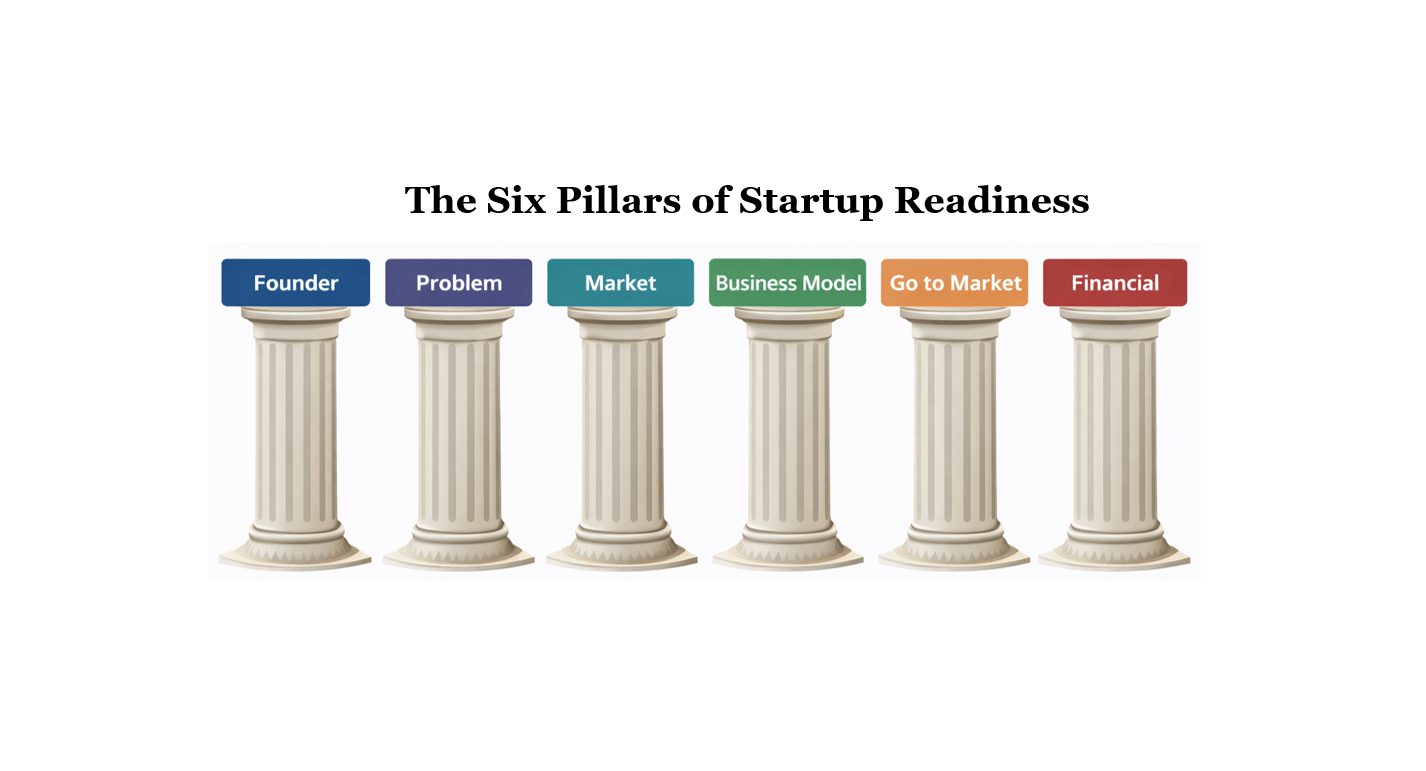
The Go-to-Market Pillar is one of the 6 Pillars of Startup Readiness. It sits in the execution layer alongside the Financial Pillar: together they determine whether you can reach customers and survive long enough to prove it works.
The Startup Readiness Assessment evaluates your GTM Pillar alongside the other five, showing you exactly where the path breaks down before you spend real budget finding out.
See Where Your Go-to-Market Pillar Stands
The Startup Readiness Assessment scores your GTM readiness across buying behavior, channels, message, and acquisition path, then routes you to the worksheets that close the gaps. It reveals whether you have a customer acquisition engine or just hope and hustle.
What is the Go-to-Market Pillar in the 6 Pillars framework?
The Go-to-Market Pillar is the fifth of the 6 Pillars of Startup Readiness. It measures whether a startup can reliably reach customers through a repeatable path, evaluated through buying behavior clarity, channel selection and fit, message resonance, acquisition clarity, and overall GTM clarity.
What is a go-to-market framework?
A go-to-market framework is the structure that turns reaching customers from guesswork into a repeatable path. This one measures five things that have to work together: buying behavior clarity, channel selection and fit, message resonance, acquisition clarity, and how they combine into one system. When they line up, similar customers show up for similar reasons through similar paths and convert in similar ways.
Is there a go-to-market checklist for early-stage startups?
Yes. Run this GTM readiness checklist before you scale a channel. Do you understand how your customer makes the buying decision? Have you chosen one to three channels that reach them repeatably? Does your message connect problem, urgency, and outcome without explanation? Can you map the journey from awareness to conversion? Do channel, message, path, and offer work together as one system? Any answer of no is the link to fix first.
Why doesn't trying more channels fix weak traction?
Trying more channels at once usually signals that the underlying path, who the entry customer is, what message resonates, which channel reaches them, isn't clear yet. Adding channels multiplies the guessing instead of resolving it. Channel fit is its own decision, worth resolving before you expand. It's a selection question, and this walks through it.
What's the difference between exposure and go-to-market?
Exposure is activity: posting, outreach, experiments. Go-to-market is a path that produces the same outcome more than once. Exposure creates noise. A real GTM path creates signal, because behavior repeats in a way you can observe and refine.
How do I know if my message is working?
Listen for the difference between "that's interesting" and "that's exactly what we're dealing with." The first is polite curiosity. The second is recognition. A strong message causes the second reaction without requiring explanation first.
How do I strengthen my Go-to-Market Pillar?
Narrow to a single entry customer you can describe in one sentence. Write your message in the customer's language. Pick one primary channel and pressure test it before adding a second. Confirm the path repeats before you try to scale it.
Published: July 29, 2026
Last Updated: July 29, 2026
We use cookies to improve user experience. Choose what cookie categories you allow us to use. You can read more about our Cookie Policy by clicking on Cookie Policy below.
These cookies enable strictly necessary cookies for security, language support and verification of identity. These cookies can’t be disabled.
These cookies collect data to remember choices users make to improve and give a better user experience. Disabling can cause some parts of the site to not work properly.
These cookies help us to understand how visitors interact with our website, help us measure and analyze traffic to improve our service.
These cookies help us to better deliver marketing content and customized ads.