The Market Pillar: Can You Actually Reach the People Who Have This Problem?
The Market Pillar: Can You Actually Reach the People Who Have This Problem?
Market validation answers a narrow question: does a specific, reachable group feel your problem sharply enough to act? Prove that, and you have market clarity. You know who has the problem, where to find them again, and when it pushes them to move.
This is the point where most founders reach for market size. Size is the wrong measure this early. Target market validation measures reachability and urgency. The number on the slide can wait. This page shows you how to validate your market through three tests, concentration, proximity, and urgency, and how to find the smallest place where all three hold at once.
TL;DR: Market Size Is Not the Problem. Reachability Is.
The Market Pillar measures concentration, proximity, and urgency, not how big the total addressable market looks on a slide.
A painful problem without a reachable market is just an idea. You need to know who has it, where they are, and when they're motivated to act.
Signals your Market Pillar is fragile: you can reach people but the problem isn't urgent for them, or the problem is urgent but you can't reliably find more people who have it.
The rest of this page shows you how to find the smallest market where all three conditions hold at once.
Founders often think market strength is about size. It isn't. A billion-dollar total addressable market is meaningless if you can't reliably reach anyone inside it. The Market Pillar is about whether a specific, identifiable group responds to the problem in a repeatable way.
The Question This Pillar Answers
Is there a specific, reachable group of people who feel this problem most intensely?
Not: does a market exist somewhere out there for this idea. Almost every idea has a theoretical market. The question is narrower: can you find the same type of person, in the same situation, more than once, and does the problem push them to act when you do.
What Market Validation Actually Measures
Market validation rests on three elements, and all three have to hold in the same place at the same time.
● Concentration. The problem repeats in the same situation, with the same type of customer. If every conversation teaches you a new definition of the problem, you're still meeting individuals, not a market.
● Proximity. You can repeatedly reach those customers through stable channels, without needing scale, brand, or luck. If every interaction requires a new search strategy, proximity is missing.
● Urgency. The problem creates pressure to act now, not eventually. You're not measuring interest. You're measuring interruption, whether the problem actually changes what someone does next.
This overlap is called the wedge: the smallest place where concentration, proximity, and urgency all hold at once. You don't need the whole market. You need one wedge that's real. If you're not sure whether you've found a real wedge or just a favorite customer you'd like to be true, that distinction is worth checking directly.
Stable, Fragile, and Breaking
Here are what stable, fragile, and breaking market pillars look like.
Stable: Customers recognize themselves immediately in the message. The path to the next customer is known. Urgency shows up without persuasion.
Fragile: Two of the three conditions hold, but not all three. You can reach people, but the problem isn't urgent for them. Or it's urgent, but the customers are scattered and hard to find twice.
Breaking: The problem doesn't repeat in a consistent situation. The customer can't be reached again without major scale. The problem is acknowledged but never acted on.
A stable Market Pillar sounds like: "We deal with this all the time. If this worked, we'd switch." A breaking one sounds like: "This isn't a priority right now." Founders often try to fix a breaking market by broadening the audience. That makes it worse. The fix runs the other way: narrow the target until the problem repeats.
Four Signals Your Market Pillar Is Fragile
You can describe your target market as a category ("small businesses," "busy parents") but not as a specific recurring situation.
Each new customer conversation requires a different outreach approach than the last one.
People agree the problem matters but consistently defer action: "send me updates," "maybe once it's more built."
You're spending real effort finding customers even though, in theory, "everyone has this problem."
One Tool to Use This Week
Pick one concrete environment where the problem occurs and have several conversations inside it without expanding outward. Ask each person: "Where do you already go when this problem shows up?"
You're testing whether access repeats. If the same source that produced your last three conversations can produce your next three, you're standing inside a wedge. If each conversation demands a fresh search, you're still looking for one. For the deeper version of this test, define who your target customer actually is before you widen the search.
You're testing one assumption, that access repeats, against real evidence. That loop, assumption to evidence to decision, is the unit the Startup Readiness Assessment tracks across all six pillars.
Why Market Clarity Determines Everything Downstream
When the market is well defined, acquisition cost, messaging, pricing, and channel selection all sharpen at once, because you know exactly who you're talking to and where to find them again. When the market is vague, every one of those decisions turns into a guess. A startup needs a clear market to begin. A large one can come later.
Run the three tests. If you can (1) name the situation, (2) reach more people inside it, and (3) watch the problem push them to act, you have a wedge to build on. If one of the three fails, you have a narrower question to answer before you scale outreach. Either outcome moves you forward.
Where This Fits in the Framework
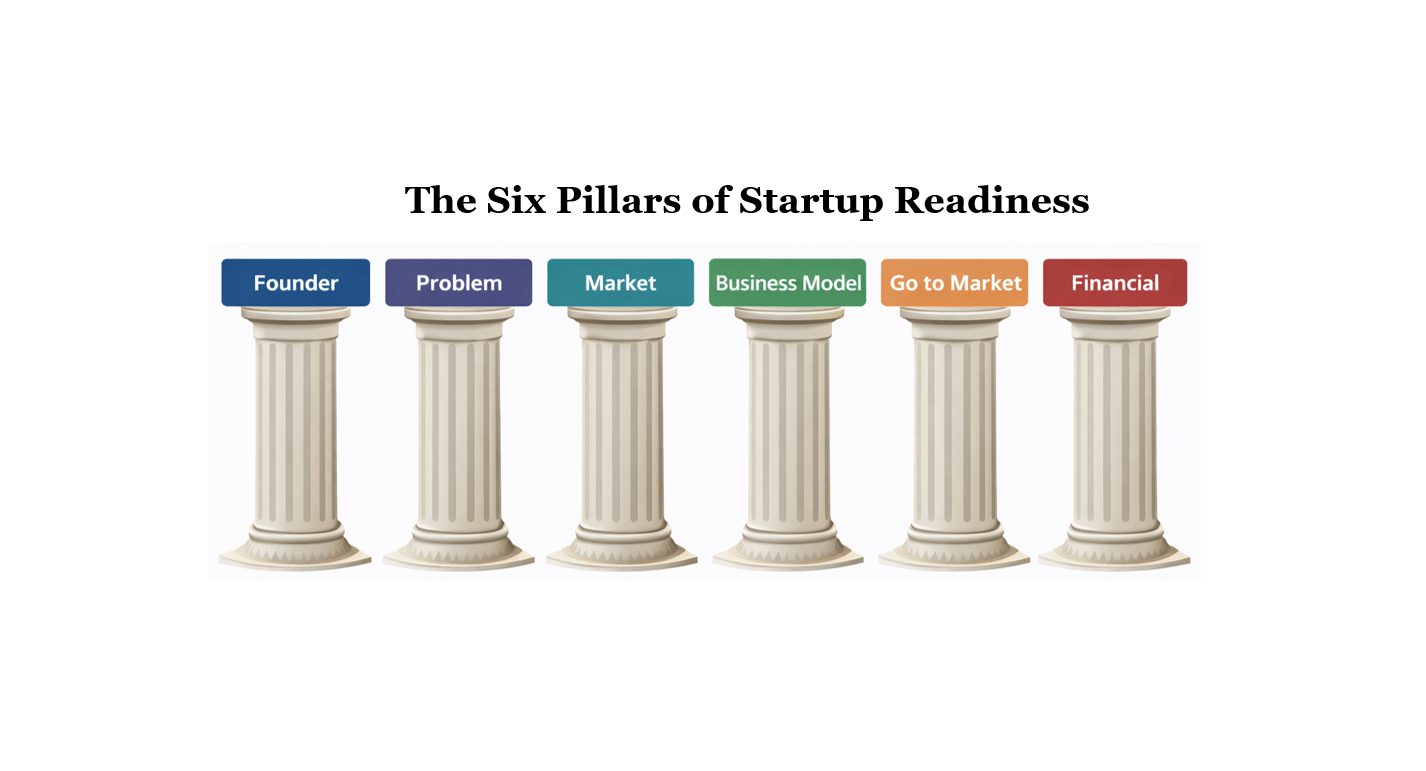
The Market Pillar is one of the 6 Pillars of Startup Readiness. It sits in the market fit layer alongside the Business Model Pillar: together they answer whether you can build a real business here, once the foundation of founder and problem is solid.
The Startup Readiness Assessment measures your Market Clarity alongside the other five, showing exactly where reachability breaks down before you spend real money finding out.
See Where Your Market Pillar Stands
The Startup Readiness Assessment scores your Market Pillar on concentration, proximity, and urgency, then routes you to the worksheets that close the gaps. Find out where reachability breaks down before you spend real money finding out.
What is the Market Pillar in the 6 Pillars framework?
The Market Pillar is the third of the 6 Pillars of Startup Readiness. It measures whether a specific, reachable group of people feels the problem intensely enough to act, evaluated through concentration, proximity, and urgency.
How do you validate your market?
Validate your market by proving three things hold in one place: concentration, proximity, and urgency. Pick a single situation where the problem occurs, have repeated conversations inside it, and confirm the same channel keeps producing new customers while the problem drives them to act. Target market validation starts with the smallest wedge where all three hold, then grows outward once it's proven.
What's the difference between a market and a wedge?
A market is often described as a broad category: "small businesses" or "freelancers." A wedge is the smallest place where the problem repeats in the same situation, you can reach more of those people, and the problem is urgent enough to drive action. Founders start with the wedge, not the category.
Why doesn't market size matter more at this stage?
A market is often described as a broad category: "small businesses" or "freelancers." A wedge is the smallest place where the problem repeats in the same situation, you can reach more of those people, and the problem is urgent enough to drive action. Founders start with the wedge, not the category.
How do I know if my market is too broad?
If describing your target customer requires a category rather than a specific recurring situation, and every new customer conversation requires a different outreach approach than the last, the market is likely too broad to produce repeatable traction yet. Startup market segmentation walks through why this happens and how to narrow it.
What does “startup readiness” actually mean?
Startup readiness refers to how clearly a founder understands the foundational assumptions behind their business. This includes whether the problem is real, whether the market is reachable, whether the business model works, and whether the founder can realistically execute. Readiness is about clarity before commitment, not just progress or activity.
Published: July 29, 2026
Last Updated: July 29, 2026
We use cookies to improve user experience. Choose what cookie categories you allow us to use. You can read more about our Cookie Policy by clicking on Cookie Policy below.
These cookies enable strictly necessary cookies for security, language support and verification of identity. These cookies can’t be disabled.
These cookies collect data to remember choices users make to improve and give a better user experience. Disabling can cause some parts of the site to not work properly.
These cookies help us to understand how visitors interact with our website, help us measure and analyze traffic to improve our service.
These cookies help us to better deliver marketing content and customized ads.