The Business Model Pillar: Does the Way Value Flows Through This Business Make Sense?
The Business Model Pillar: Does the Way Value Flows Through This Business Make Sense?
Business model validation answers a harder question than pricing: does value move cleanly from what you create to what you get paid for, and does that flow get lighter as you grow? A real problem and a reachable market get you in the room. The model decides whether you can stay.
This page shows you how to validate your business model on two layers, the transactional engine that moves value creation, value delivery, and value capture, and the structural moats that protect it: leverage, scalability, and defensibility, and how to spot where value leaks before growth makes it expensive.
TL;DR: Pricing Is Not the Problem. Alignment Is.
A business can have a real problem and a real market and still not work. Business model validation measures whether value moves cleanly enough to pay for the business and survive its own growth.
The Business Model Pillar measures a transactional engine, value creation, delivery, and capture, and the three structural moats that protect it, leverage, scalability, and defensibility.
A real problem and a reachable market don't guarantee a sustainable company. If the model doesn't work, value leaks at every step.
Signals your Business Model Pillar is fragile: delivering value requires founder heroics, or customers say "this is great" but hesitate at the price.
Founders often judge business models by format: subscription versus marketplace, SaaS versus services. Format doesn't determine strength. The Business Model Pillar measures whether value moves cleanly from what you create to what you get paid for, without distortion.
The Question This Pillar Answers
Does the way value flows through this business make sense?
Not: is the business model impressive or trendy. The question is whether customers get something measurably better, whether you can deliver that reliably, and whether the exchange of payment for value feels natural rather than forced.
What Business Model Validation Actually Measures
Business model validation works on two layers: a transactional engine that moves value, and the structural moats that protect it. The engine decides whether the business works. The moats decide whether it survives its own growth.
The transactional engine is how value moves through the business:
Value creation. The specific change the customer experiences from using your solution, not the thing you build. Customers buy relief, progress, protection, or advantage. When creation is clear, customers understand why the solution matters without explanation. Defining a measurable customer outcome is the difference between a feature list and a real value claim.
Value delivery. The operational reality of turning the promise into experience, repeatably and predictably, without founder heroics.
Value capture. How and when the business converts value into revenue. Strong capture aligns payment with perceived value, so the exchange feels logical. Discomfort charging is rarely a pricing problem. It usually signals that value creation and value capture are misaligned.
The structural moats decide whether the model holds up as it grows:
Leverage, the efficiency moat. The ability to decouple your time and effort from your results, through reuse, systems, and automation. It protects the founder from the linearity trap, where the only way to grow is to work more hours.
Scalability, the economic moat. The relationship between growth and complexity. As you grow 10x, does complexity grow 1x or 10x? High scalability keeps the marginal cost of the next customer near zero, so margins expand as you grow.
Defensibility, the competitive moat. Your resistance to entry, built into the logic of the product through network effects and high switching costs, so a fast-follower with more money can't simply raid your wedge. Real defensibility runs deeper than brand.
The engine runs as a loop. Strong creation makes delivery easier. Reliable delivery makes capture cleaner. Clean capture funds scalability. Scalability returns leverage to creation. The moats protect the loop as it turns: leverage keeps it from exhausting you, scalability keeps it from outrunning your margins, and defensibility keeps competitors from draining it.
A model is ready when the engine creates value predictably and the moats hold. An engine with no moats makes you a pioneer who proves the market for someone else. Moats with no engine leave you a fortress with no one inside.
Stable, Fragile, and Breaking
A business model rarely flips from broken to solid at a threshold. It moves along a spectrum set by how cleanly value moves through the loop, and most early models sit in the fragile middle.
Stable: Customers quickly understand what improves in their world. The exchange feels logical. Delivery gets smoother with each customer.
Fragile: The model works, but only under favorable conditions. Revenue depends on persuasion rather than pull. Pricing feels uncomfortable to defend.
Breaking: Delivering value requires constant improvisation or founder heroics. Growth increases complexity faster than it increases revenue.
A stable Business Model Pillar sounds like: "Each new customer improves the system." A breaking one sounds like: "This works for now, we'll clean it up later." Fragile models don't fail immediately. They drift until growth reveals what effort was hiding.
Four Signals Your Business Model Pillar Is Fragile
A fragile model can still be making money. These are the signs that the money is coming from your effort instead of the system.
Serving one more customer requires roughly the same manual effort as the last one.
Customers say the value is real but still hesitate, negotiate, or need convincing at the price.
You depend on discounts or exceptions more often than you'd like to admit.
You'd struggle to explain what specifically improves for the customer without listing product features.
None of these mean the model is wrong. They mean value is leaking somewhere between creation and capture, and finding the leak now beats discovering it at scale.
One Question to Sit With
What breaks if demand doubles tomorrow?
If the honest answer is "me," the model isn't validated yet. It's working because you're personally absorbing the strain. A model is proven when it holds under pressure. Ideal conditions with your full attention prove nothing.
"What breaks if demand doubles" is an assumption about your model. Stress-test it and you turn it into evidence. That loop, assumption to evidence to decision, is the unit the Startup Readiness Assessment tracks across all six pillars.
Why Business Model Validation Determines Whether You Scale
A real problem and a reachable market get you in the room. The business model determines whether you can stay there without burning out.
When value creation, value delivery, and value capture are aligned, growth reduces friction. When they're not, founders compensate with effort: more outreach, more customization, more exceptions, and the business gets harder exactly when it should be getting easier.
Run the checks. If value flows cleanly, delivery holds under more customers, and payment follows naturally, you have a model that can scale. If one link breaks, you have a specific place to fix before you grow. Either outcome moves you forward.
Where This Fits in the Framework
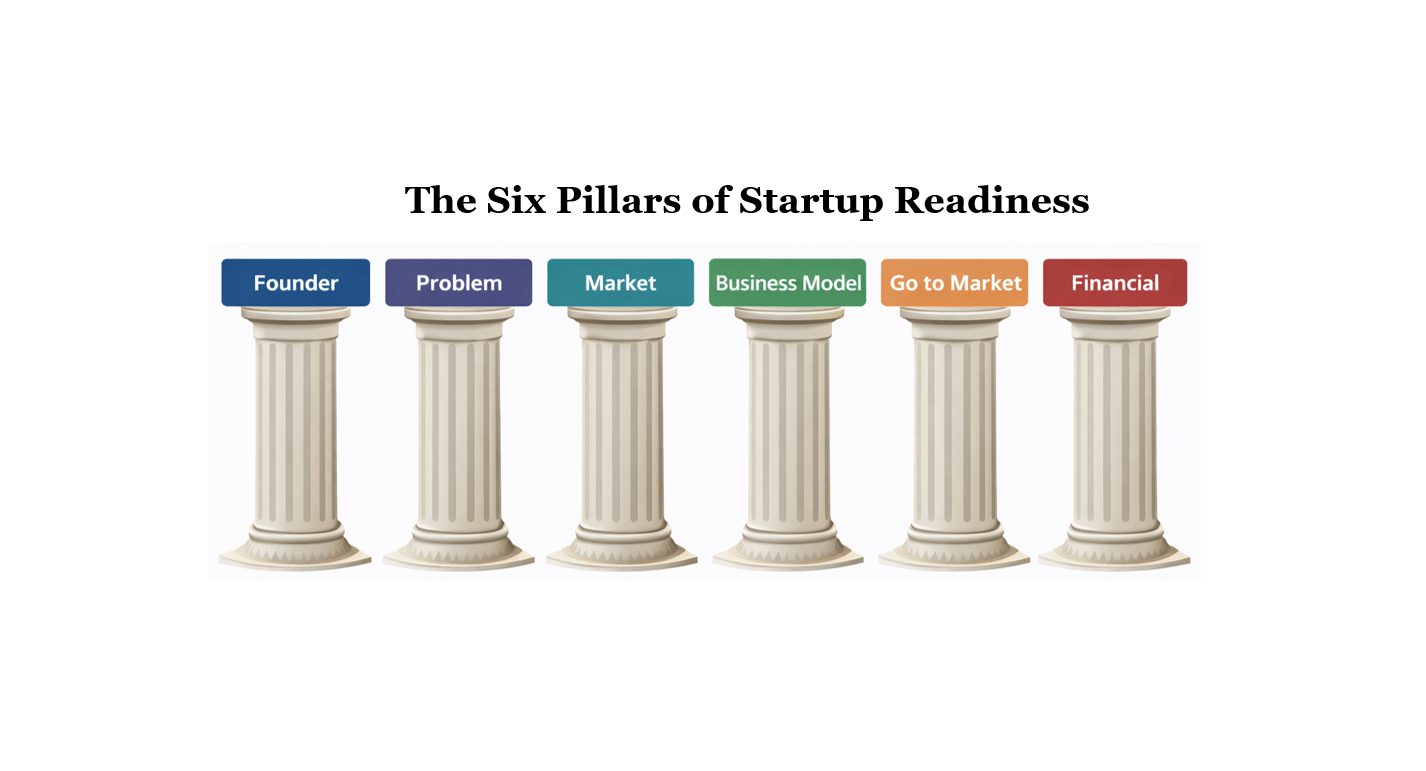
The Business Model Pillar is one of the 6 Pillars of Startup Readiness. It sits in the market fit layer alongside the Market Pillar: together they answer whether a real business can be built here.
The Startup Readiness Assessment evaluates your Business Model Pillar alongside the other five, showing you exactly where value is leaking before growth makes it expensive to fix.
See Where Your Business Model Pillar Stands
The Startup Readiness Assessment scores your Business Model Pillar on the transactional engine: value creation, value delivery, and value capture, and its structural moats: leverage, scalability, and defensibility, then routes you to the worksheets that close the gaps. Find out where value leaks before growth makes it expensive to fix.
What is the Business Model Pillar in the 6 Pillars framework?
The Business Model Pillar is the fourth of the 6 Pillars of Startup Readiness. It measures whether value creation, delivery, and capture work together cleanly, and whether the structural moats, leverage, scalability, and defensibility, protect the model as it grows.
How do you validate your business model?
Validate your business model by pressure-testing the flow from creation to delivery to capture. Confirm customers can name what improves for them, that you can deliver it without heroics, and that payment follows the value naturally. Then ask what breaks if demand doubles. A model that holds under that pressure is validated. A model that runs on your personal effort still has a link to fix.
What's the difference between a good idea and a good business model?
A good idea describes something customers want. A good business model describes how value reliably moves from creation to delivery to payment, and whether that flow gets easier or harder as the business grows. An idea can be strong while the model underneath it is still fragile.
Why do customers like my product but hesitate at the price?
This usually signals a mismatch between value creation and value capture. The price tag is rarely the real issue. If customers can't clearly connect what they're paying for to what specifically improves in their world, the exchange will keep feeling negotiated rather than natural.
How do I know if my business model will scale?
Ask what breaks if demand doubles. If the honest answer involves more of your personal time, attention, or intervention, the model depends on you rather than on the system you've built. Scalable models get easier to run with volume.
How do I strengthen my Business Model Pillar?
Describe the outcome customers get in one sentence, from their perspective. Map the steps required to serve one customer and reduce which ones depend on you personally. Introduce leverage, reusable assets, automation, standard processes, before you introduce scale.
Published: July 29, 2026
Last Updated: July 29, 2026
We use cookies to improve user experience. Choose what cookie categories you allow us to use. You can read more about our Cookie Policy by clicking on Cookie Policy below.
These cookies enable strictly necessary cookies for security, language support and verification of identity. These cookies can’t be disabled.
These cookies collect data to remember choices users make to improve and give a better user experience. Disabling can cause some parts of the site to not work properly.
These cookies help us to understand how visitors interact with our website, help us measure and analyze traffic to improve our service.
These cookies help us to better deliver marketing content and customized ads.