Startup Readiness Assessment for Early-Stage Founders

Startup Readiness Assessment (Free Tool for Early-Stage Founders)

Evaluate your startup idea, market, and execution before you commit time, money, or resources.

What is a Startup Readiness Assessment?


A startup readiness assessment is a structured evaluation that helps founders determine whether their idea, market, and execution are strong enough to move forward.

It identifies unclear assumptions, hidden risk, and gaps across key areas like problem, market, business model, go-to-market, and financial viability.

The Startup Readiness Score is a structured startup readiness assessment that helps early-stage founders evaluate and validate their startup idea and foundations, identify risk, and improve decision-making before making a major commitment.

The Problem (Why This Exists)


Many early-stage founders move fast. Few are clear on whether that speed is aimed in the right direction.

Teams make progress, build features, and prepare applications, yet still stall because core assumptions are unclear and untested.

As a result, many of these startups stall or fail not because of effort, but from foundational misalignment.

This is one of the most common reasons early-stage startups struggle to gain traction or get accepted into accelerators.

By the time this becomes obvious, rejections have happened, cycles have been wasted, and time, money, and resources have compounded in the wrong direction.

The Startup Readiness Framework exists to make those structural gaps visible so startups can build in the right direction.

Startup readiness assessment results showing overall score and six pillar diagnostics on a computer screen

What You Receive (FREE)

Every founder who completes the Startup Readiness Assessment receives a detailed breakdown of where their startup actually stands. No generic advice. A structured, pillar-by-pillar analysis of your strengths, your gaps, and where to focus next.

Overall Score & Diagnosis

A single Startup Readiness Score  (0–150) plus a concise diagnosis describing your current readiness profile and dominant constraint.

Six Pillar Diagnostics

For each pillar, you receive a clear diagnosis of what this foundation currently supports and where it breaks down.

Clarity Needed 

For each pillar, you’ll see the primary clarity gap holding readiness back and recommended actions designed to increase readiness through evidence, not activity.

*Run and receive your Startup Readiness Score up to twice for completely free.

How It Works


Answer the Assessment

Founders complete a short (15-20 minute) assessment designed to probe assumptions, alignment, and execution readiness across the six pillars of a strong startup foundation.
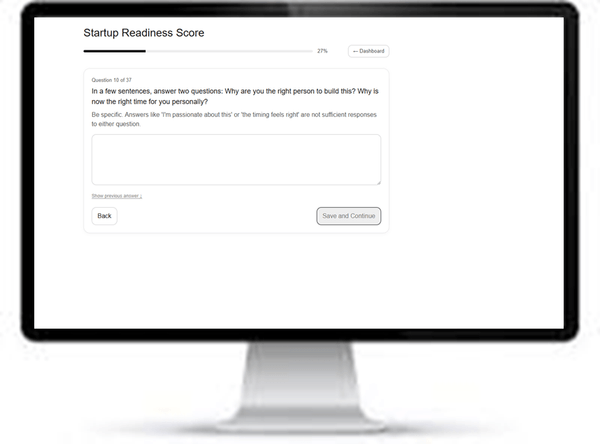
Founder completing a startup readiness assessment questionnaire on a computer screen

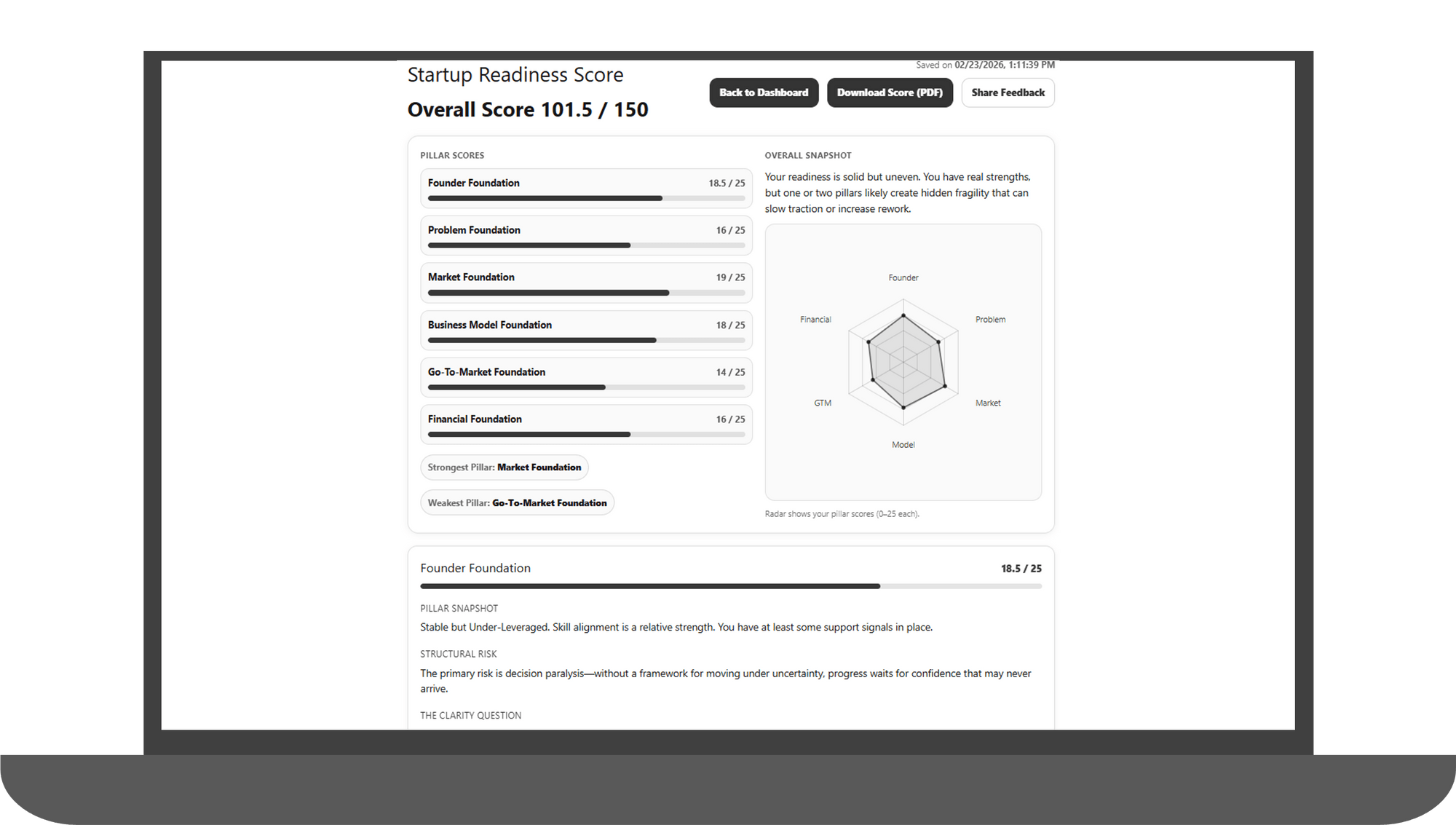
Receive Structured Insight

You receive an overall readiness score and a breakdown across each pillar, highlighting strengths, gaps, and potential risk areas.
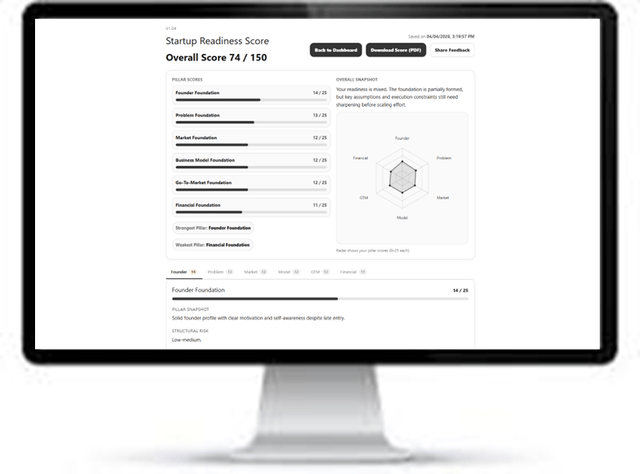
Example of startup readiness score report with detailed pillar breakdown displayed on desktop

Track Your Progress Over Time

Come back after you have made progress and take the assessment again to see where unclarity and risk remain. Track your startup clarity over time.
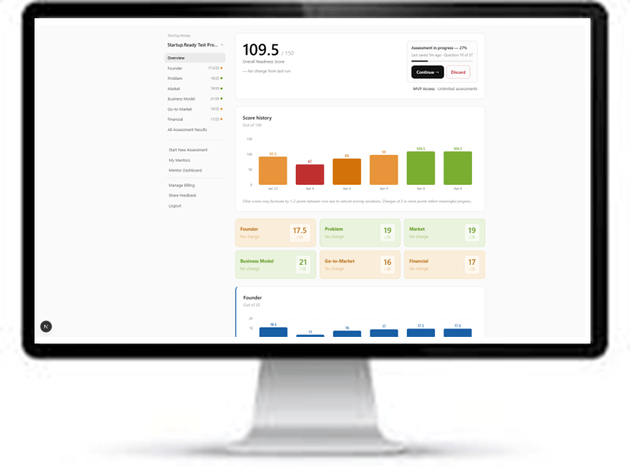
Startup founder dashboard displaying readiness score, insights, and progress across six pillars

The 6 Pillars

These are the 6 Pillars of a strong startup foundation.

Founder Pillar

Is the founder realistically positioned to carry this business forward?

Business Model Pillar

Does the way value flows through the business make sense?

Problem Pillar

Is the problem real, painful, and clearly understood in customer language?

Go-to-Market Pillar

Can this startup reliably reach customers in a way that matches their behavior?

Market Pillar

Is there a specific, reachable group of people who feel this problem most intensely?

Financial Pillar

Does the founder understand the financial realities that determine the startup's survivability?

When to Use a Startup Readiness Assessment


Founders typically use a startup readiness assessment when they need to evaluate or validate their startup before moving forward.

This is especially useful when:

  • You want to validate your startup idea before building.

  • You are preparing for an incubator or accelerator application.

  • You are considering raising pre-seed or seed funding.

  • You feel busy but stuck and need a clear diagnostic.

  • You want a structured alternative to a startup checklist.

When This Matters Most


This is most useful right before the stakes increase.

  • Preparing to apply to incubators or accelerators, where structured evaluation of founder, market, and execution readiness is critical

  • Thinking about early funding or formal investment conversations

  • Working with mentors or advisors and want a shared diagnostic

  • Feeling “busy but stuck” and unsure where the real issue lies

These are moments when clarity, narrative, and readiness really matter.

What the Startup Readiness Score Is


The Startup Readiness Score is a structured diagnostic that helps founders understand whether their startup is foundationally prepared to take the next step to move forward and what is still unclear. It evaluates a startup across six foundational areas and produces an evidence-based snapshot of readiness, alignment, and risk.

The Startup Readiness Score is not a success predictor, a funding signal, or a substitute for customer validation. It does not guarantee outcomes, remove uncertainty, or replace the work of learning directly from customers.

Who This is For


This is for:

  • Early-stage founders (pre-traction to early traction)

  • Founders applying to programs or funding

  • Mentors, advisors, and coaches working with early teams

  • Incubators and accelerators seeking a structured readiness signal

Ready to See Where You Stand?

Join the hundreds of founders who have gained clarity on their startup's foundation.

FAQ

Startup Readiness Assessment FAQs

What is a startup readiness assessment?

A startup readiness assessment is a structured evaluation tool used to determine whether a startup’s core foundations are strong enough to move forward. It examines areas like the founder, problem, market, business model, go-to-market, and financial understanding to identify where assumptions are clear and where risk is still unresolved. The goal is not to predict success, but to provide a clear diagnosis of readiness, alignment, and constraint.

How long does the startup readiness assessment take?

Most founders complete it in 15–20 minutes.

How do you know if your startup idea is good?

A startup idea is “good” when its core assumptions are clear, consistent, and supported by early evidence. Instead of relying on intuition, founders should evaluate whether the problem is real, the market is defined, and the solution aligns with how customers behave. A structured readiness assessment helps make these factors visible.


How do you know if your startup is ready for a program like a bootcamp, incubator, or accelerator?

A startup is typically ready for an accelerator when its core assumptions are clearly defined, internally consistent, and grounded in early evidence. This includes a well-understood problem, a specific target market, a coherent business model, and a founder capable of executing. A structured readiness assessment helps determine whether these elements are in place or whether key gaps still need to be addressed before applying.

What happens after I finish?

After completing the assessment, you receive a Startup Readiness Score, a clear diagnosis, and a pillar-by-pillar breakdown of your strengths, gaps, and risks. These outputs are designed to guide your next decisions and improve your startup’s foundation.

Can I share the results with an advisor or accelerator?

Yes. Many founders use their results to make conversations with advisors, mentors, and investors more structured, specific, and evidence-based.

How can founders identify startup risk early?

Most early-stage startup risk comes from unclear or untested assumptions, not visible execution mistakes. Founders can identify risk by systematically evaluating each part of the business—especially where clarity is low or decisions are based on belief rather than evidence. A structured diagnostic makes these gaps visible early, before they compound into larger issues.

How do you validate a startup idea before launching?

To validate a startup idea, founders must test key assumptions about the problem, customer, and solution before fully building. This includes confirming that the problem exists, that a specific group of customers cares, and that the proposed solution fits their behavior. A readiness assessment helps identify which assumptions are still untested or unclear.

Is there a checklist to evaluate a startup before launch?

There are many startup checklists, but most focus on surface-level tasks rather than underlying clarity and alignment. While they can be useful for organization, they often miss the deeper structural issues that determine whether a startup can move forward effectively. A structured, scored assessment provides a more rigorous way to evaluate readiness by diagnosing not just what has been done, but what is actually understood.

Is it really free?

Yes. Founders can complete the Startup Readiness Assessment and receive their Startup Readiness Score up to two times for free.

Who created this assessment?

Dr. Shaun Digan, PhD in Entrepreneurship, with 15+ years helping founders navigate ideation, strategy, funding, and startup milestones. Learn more About Us.

Published: April 11, 2026

Last Updated: April 14, 2026

Cookie Settings
This website uses cookies

Cookie Settings

We use cookies to improve user experience. Choose what cookie categories you allow us to use. You can read more about our Cookie Policy by clicking on Cookie Policy below.

These cookies enable strictly necessary cookies for security, language support and verification of identity. These cookies can’t be disabled.

These cookies collect data to remember choices users make to improve and give a better user experience. Disabling can cause some parts of the site to not work properly.

These cookies help us to understand how visitors interact with our website, help us measure and analyze traffic to improve our service.

These cookies help us to better deliver marketing content and customized ads.