The Founder Pillar: Is the Founder Ready to Carry This Business Forward?
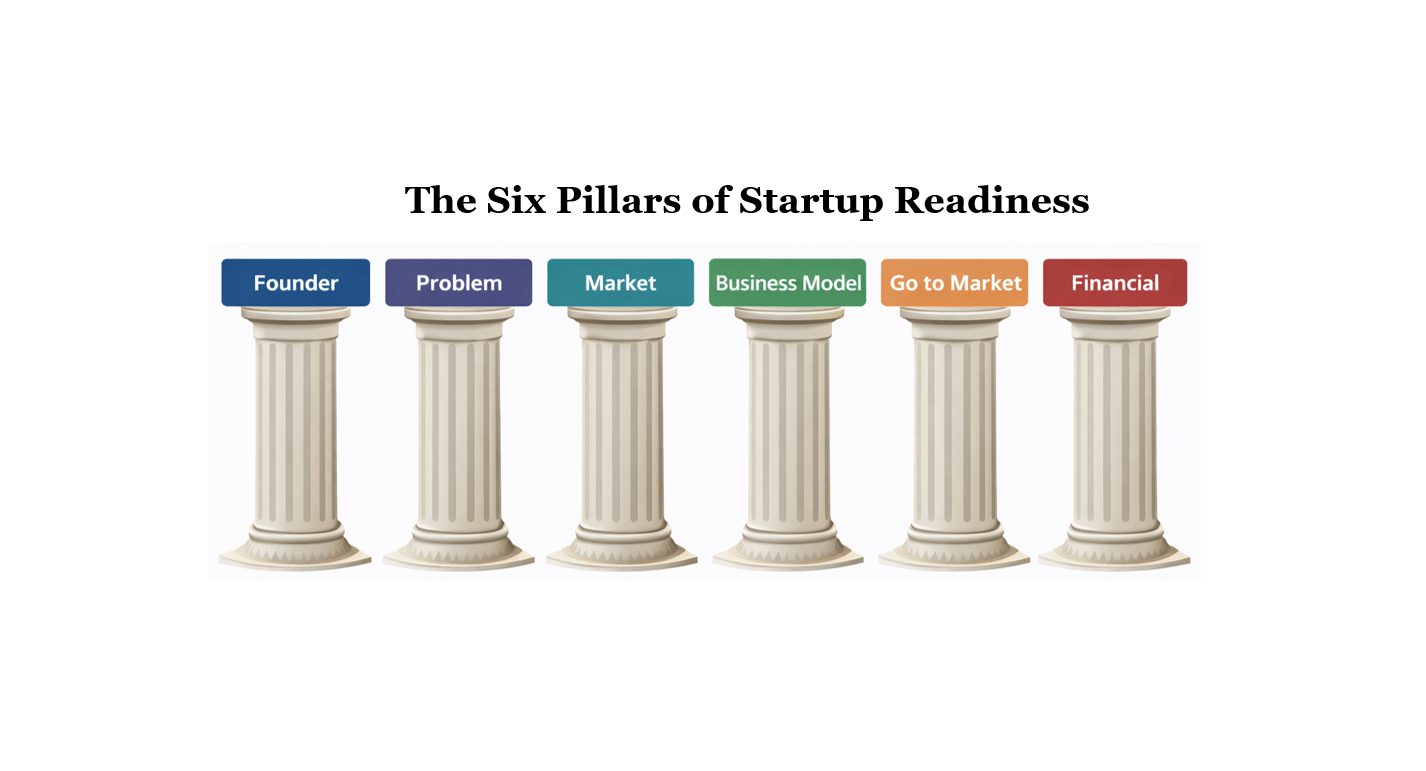
The Founder Pillar: Is the Founder Ready to Carry This Business Forward?
Am I ready to start a business? Most founders answer with motivation. That's the wrong measure. Readiness starts with capacity, the honest math of whether you can carry this specific business forward without breaking the person or the plan.
Founder readiness rests on four things: capacity, skills, motivation, and constraints. This page shows you how to read your own founder system honestly, before the market gives you a harder way to learn it.
TL;DR: Motivation Is Not the Problem. Capacity Is.
Am I ready to start a business? If you can't sustain the work this business needs, nothing else in the framework saves it. Founder readiness measures whether you realistically can, right now.
The Founder Pillar measures capacity, skills, motivation, and constraints, not talent or ambition.
It is the first of the 6 Pillars of Startup Readiness because nothing else works if the founder can't sustain the effort.
Signals you're in a fragile Founder Pillar: overestimating available time, avoiding the skill gap you already know about, deferring the constraint conversation, staying busy without traction.
The rest of this page shows you how to read your own founder system honestly, before the market gives you a harder way to learn it.
Most founders think they have a time management problem. They don't. They have a founder pillar problem, and time management is just where it shows up first.
The Question This Pillar Answers
Is the founder realistically positioned to carry this business forward?
Not: is the founder smart, motivated, or hardworking. Most founders clear that bar. The question is narrower and less comfortable: does the person building this business have the capacity, the skills, the motivation, and the freedom from constraint to sustain the work this specific business requires, right now.
You can validate a real problem, find a reachable market, and design a business model that works, and the startup still stalls if the founder system underneath it can't carry the load.
What Founder Readiness Actually Measures
Founder readiness comes down to four elements that have to hold at the same time. Strength in one can mask a gap in another, so the pillar is only as sound as the weakest of the four.
Capacity. Time and energy available without damaging critical obligations like work, family, or health.
Skills. The ability to personally execute the most critical work at this stage, or a real plan for closing the gap. If you're not sure which gap is actually slowing you down, here's how to find the specific skills gap that's stalling your startup.
Motivation. A reason for building this business that is specific, internally grounded, and tied to real stakes, not a vague aspiration or someone else's expectation.
Constraints. The limits, financial, relational, physical, that shape what's realistically possible, acknowledged rather than ignored.
Founder readiness is the alignment of all four with what this specific business demands. Any one of them can look impressive in isolation and still leave the pillar fragile if the four are out of honest alignment.
Stable, Fragile, and Breaking
The Founder Pillar isn't binary. It doesn't flip from broken to fine once you hit some threshold. It moves along a spectrum, and most early-stage founders are somewhere in the fragile middle without realizing it.
Stable: Responsibilities are clearly owned. Skill gaps are known and managed. Constraints are designed around, not ignored. Decisions run on evidence.
Fragile: Commitment is real but alignment is still forming. "We'll figure that out later" is a common refrain. Progress looks like momentum but runs on personal overextension.
Breaking: The business requires skills no one on the team can realistically acquire in time. Constraints get overridden instead of designed around. Evidence that threatens the plan gets avoided.
A stable Founder Pillar sounds like: "This is the hardest part of the business right now, and it's on me." A breaking one sounds like: "I just need to push through this phase." The difference is whether the founder is naming reality or compressing it. Confidence has nothing to do with it.
Four Signals Your Founder Pillar Is Fragile
A fragile Founder Pillar looks a lot like a busy one. These are the signals that separate real readiness from momentum running on overextension.
You've said "once we get traction, this will be easier" about a constraint that isn't actually temporary.
You know which skill gap is most likely to stall progress next, and you haven't made a plan for it.
Your available time and energy estimate hasn't been tested against an actual week.
Your reason for building this business would sound thin if you said it out loud to someone who knows you.
None of these mean you should stop. They mean you have a specific question to answer before the next commitment. The feeling is just the signal.
One Question to Sit With
After accounting for work, family, and stress, how much focused effort do I realistically have left each week, and does this business's near-term plan actually fit inside that number?
Most founders answer this with what they hope is true. The honest version of this question is uncomfortable on purpose. Capacity sets the speed limit. Overestimate it, and you build a business that quietly overextends the person running it. If undirected effort rather than total effort is the real issue, burnout is often a capacity problem in disguise, worth ruling out directly.
Your capacity estimate is an assumption. Test it against a real week and you have evidence. That loop, assumption to evidence to decision, is the unit the Startup Readiness Assessment tracks across all six pillars.
Why the Founder Pillar Comes First
The Founder Pillar sits first for one reason: a startup can adapt to a market. It can't adapt to a founder or team stretched past their limits. When this pillar is stable, every other pillar gets easier to build and test. When it's breaking, no other pillar can compensate.
Run the four checks. If capacity, skills, motivation, and constraints all hold, you have a foundation the rest of the framework can build on. If one of them fails, you have a more specific question to answer before you commit further. Either outcome moves you forward.
Where This Fits in the Framework
The Founder Pillar is one of the 6 Pillars of Startup Readiness, the framework used to evaluate whether an early-stage startup has the foundation to move forward. It's paired closely with the Problem Pillar: together they form the foundation layer everything else depends on.
The Startup Readiness Assessment scores your Founder Pillar alongside the other five and shows you exactly where your foundation holds and where it doesn't, before the stakes get higher.
See Where Your Founder Pillar Stands
The Startup Readiness Assessment scores your Founder Pillar on capacity, skills, motivation, and constraints, then routes you to the worksheets that close the gaps. Answer "am I ready to start a business?" with evidence, before the stakes get higher.
What is the Founder Pillar in the 6 Pillars framework?
The Founder Pillar is the first of the 6 Pillars of Startup Readiness. It measures whether the founder has the capacity, skills, motivation, and freedom from constraint to sustain the work this specific business requires.
Am I ready to start a business?
The honest answer comes from four checks: capacity, the time and energy you actually have; skills, your ability to execute the critical work now; motivation, a real and grounded reason to build this; and constraints, the limits you design around instead of ignore. Founder readiness is the alignment of all four with what this specific business demands. A gut feeling won't tell you. The four checks will. If one comes back fragile, you have a specific question to answer before you commit further.
How is the Founder Pillar different from founder motivation?
Motivation is one of four elements the Founder Pillar measures. A highly motivated founder can still have a fragile Founder Pillar if capacity is overestimated, a critical skill gap is unaddressed, or constraints are being ignored rather than designed around.
Can a strong idea compensate for a weak Founder Pillar?
No. A brilliant problem and a reachable market don't hold up if the founder system underneath can't sustain the execution they require. The Founder Pillar is evaluated first because the other five pillars are built on top of it. If you're weighing whether you're personally the right fit for this specific problem, that's a related but separate question, worth testing directly through founder-problem fit.
How do I know if my Founder Pillar is fragile?
Fragility usually sounds like deferral: "we'll figure that out later," "once we get traction, this will be easier," "I know I'm stretched, but it's temporary." These statements aren't always wrong, but they're worth testing against evidence rather than accepting on faith.
How do I strengthen my Founder Pillar?
Start by naming your real capacity against a real week, the one you actually have. Identify the one skill gap most likely to stall progress and make a specific plan for it. Name your constraints out loud and design the business around them instead of hoping they resolve themselves.
Published: July 29, 2026
Last Updated: July 29, 2026
We use cookies to improve user experience. Choose what cookie categories you allow us to use. You can read more about our Cookie Policy by clicking on Cookie Policy below.
These cookies enable strictly necessary cookies for security, language support and verification of identity. These cookies can’t be disabled.
These cookies collect data to remember choices users make to improve and give a better user experience. Disabling can cause some parts of the site to not work properly.
These cookies help us to understand how visitors interact with our website, help us measure and analyze traffic to improve our service.
These cookies help us to better deliver marketing content and customized ads.