The Financial Pillar: Do You Understand the Financial Clock Running in the Background?
The Financial Pillar: Do You Understand the Financial Clock Running in the Background?
Financial planning for startups usually means a spreadsheet and a five-year projection. This pillar measures something more useful: startup financial readiness, whether you can see the financial clock running right now.
What one customer costs to acquire and serve. When money actually changes hands. How long the business can operate before those numbers have to work. Get that visibility, and the projections take care of themselves. Miss it, and no forecast saves you.
This page shows you the single-customer test that reveals whether your system is strengthening or quietly draining you.
TL;DR: Running Out of Ideas Is Not the Problem. Running Out of Time Is.
Startup financial readiness is whether you can see the clock running under the business. Read it early, and you get time to fix things. Miss it, and the math runs out before you do.
The Financial Pillar measures revenue clarity, cost clarity, unit economics, business cycle timing, and runway, not whether your projections look good on a slide.
Startups rarely fail from a lack of ideas. They fail because they run out of time and money before the idea gets to prove itself.
Signals your Financial Pillar is fragile: revenue requires constant persuasion, or you can't say what it actually costs to serve one customer.
The rest of this page shows you how to run the single-customer test that reveals whether your system is strengthening or quietly draining you.
Founders often treat financial clarity as a forecasting problem: build a better spreadsheet, project further out. This pillar measures something else. It measures visibility into what's happening right now. The prediction can wait.
The Question This Pillar Answers
Does the founder understand the financial realities that determine this startup's survivability?
Not: do you have an impressive financial model. The question is whether you know, with evidence rather than hope, what it costs to acquire and serve a customer, when money actually changes hands, and how long the business can operate before those numbers have to work.
What Startup Financial Readiness Actually Measures
Startup financial readiness rests on five kinds of visibility. Together they tell you whether value is moving, leaking, stalling, or compounding.
Revenue clarity. Whether you can describe exactly what must happen for money to change hands, and whether that trigger repeats without constant exceptions, discounts, or founder intervention.
Cost clarity. Whether you can name the things that actually consume the most resources, before they show up as a dangerous number on paper.
Unit economics. Whether you understand what one customer pays, what it costs to serve them, and what it costs to acquire them. Get this wrong and growth accelerates losses rather than profit. Startup unit economics is the discipline underneath it.
Business cycle clarity. Whether you understand the time from first contact to payment, from payment to value delivery, and from effort to learning. Long cycles delay learning, and delayed learning burns runway even when the underlying idea is sound.
Runway awareness. How long the business can operate with current resources, and which assumptions are consuming that runway fastest. Runway includes founder energy and attention alongside the cash in the bank. Start with a real monthly burn rate calculation rather than a guessed one.
Read together, these five show whether the business is compounding or quietly draining. Alone, any one of them can look fine while another empties the runway.
Stable, Fragile, and Breaking
A Financial Pillar doesn't fail on a single day. It shifts slowly, and the clock is usually running faster than the plan assumes long before anyone notices.
Stable: Revenue occurs with decreasing exceptions and less founder intervention over time. Costs are understood at the unit level. Runway decisions are intentional.
Fragile: Revenue exists but is irregular or conditional. Costs feel manageable individually but unclear collectively. Runway shrinks faster than expected without an obvious cause.
Breaking: Revenue requires constant intervention to occur at all. Delivery costs erase margin. Runway is being consumed faster than decisions can correct for it.
A stable Financial Pillar sounds like: "We know what one customer actually costs us. Growth feels optional, not urgent." A breaking one sounds like: "Once we close this next deal, everything changes." That sentence is compression. It usually means reality is about to catch up.
Four Signals Your Financial Pillar Is Fragile
A fragile Financial Pillar can hide behind real revenue. These are the signs the clock is running faster than the numbers on paper suggest.
Runway runs out before you reach the milestones that were supposed to justify it.
You discover late that it costs more to acquire a customer than they return over their lifetime.
You can't say how long it takes to close a deal, so cash-flow planning is guesswork.
Months go by on activity that never moves the revenue needle.
None of these mean the business can't work. They mean a number you haven't pinned down is deciding your runway, and pinning it down now buys you time.
One Tool to Use This Week: The Single-Customer Test
Follow one customer end to end. What did it cost to acquire them, in time, attention, or cash? What did it cost to deliver the promised value once? When did money actually change hands? What's left afterward, more margin, more clarity, more confidence, or exhaustion?
The test passes when the business has more capacity after serving that customer than before. It fails when one customer leaves the system tighter, noisier, or more dependent on founder heroics to keep going, regardless of what revenue looks like on paper.
The single-customer test turns an assumption about your economics into evidence you can act on. That loop, assumption to evidence to decision, is the unit the Startup Readiness Assessment tracks across all six pillars.
Why Financial Clarity Determines How Long You Have to Figure This Out
Every other pillar can be technically sound and the business can still fail if the founder doesn't see the financial clock running underneath it. Financial clarity determines two things: how long you have to figure this out, and whether the unit economics will ever work.
If the single-customer test passes, and delivering value leaves the system stronger, you have a financial foundation that can absorb repetition. If it doesn't, you have a specific leak to find before you add volume. Either outcome moves you forward.
Where This Fits in the Framework
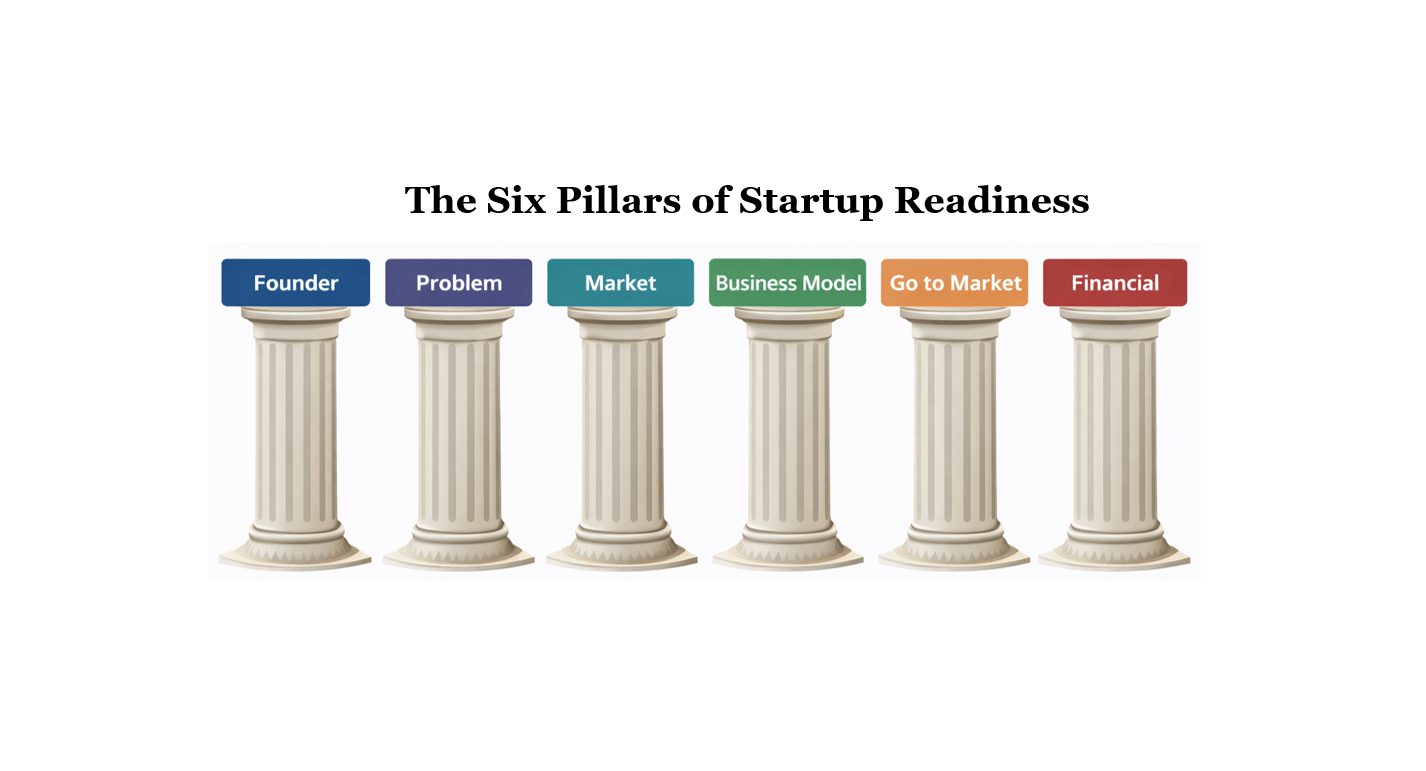
The Financial Pillar is one of the 6 Pillars of Startup Readiness. It sits in the execution layer alongside the Go-to-Market Pillar: together they determine whether you can reach customers and survive long enough to prove the business works.
The Startup Readiness Assessment evaluates your Financial Pillar alongside the other five, showing you exactly where the clock is running faster than your plan accounts for.
See Where Your Financial Pillar Stands
The Startup Readiness Assessment scores your Financial Pillar on revenue clarity, cost clarity, unit economics, business cycle timing, and runway, then routes you to the worksheets that close the gaps. It reveals whether you understand the financial clock ticking in the background, and whether the math works.
What is the Financial Pillar in the 6 Pillars framework?
The Financial Pillar is the sixth of the 6 Pillars of Startup Readiness. It measures whether a founder has visibility into revenue clarity, cost clarity, unit economics, business cycle timing, and runway, the realities that determine how long a startup can survive.
What is startup financial readiness?
Startup financial readiness is visibility into the numbers that decide survival: revenue clarity, cost clarity, unit economics, business cycle timing, and runway. It's less about projecting far into the future and more about knowing, with evidence, what one customer pays, what it costs to serve and acquire them, when money changes hands, and how long you can operate before those numbers have to work.
What does good financial planning for startups look like?
Good financial planning for startups starts with visibility, not projection. Before you model five years out, know what it costs to acquire and serve one customer, when money actually changes hands, and how long your runway lasts at today's pace. Planning built on those real numbers holds up. Everything else is a forecast resting on hope.
Why do startups run out of money even when the idea is good?
Startups rarely fail from a lack of ideas. They fail because they run out of time and money before the underlying idea gets a fair chance to prove itself. Financial clarity is what gives an idea the runway it needs to be tested properly.
What's the single-customer test?
It's a way to check financial reality before scale: follow one customer through acquisition, delivery, and payment, and see whether the business ends up stronger or more depleted. If serving one customer leaves the system tighter or more dependent on founder effort, scaling will only make that worse.
Why does time matter as much as cash?
Long cycles between effort and financial feedback delay learning, and delayed learning quietly burns runway even when margins look fine on paper. A business can have strong unit economics and still run out of patience or energy before clarity arrives.
How do I strengthen my Financial Pillar?
Define exactly what triggers payment and reduce the exceptions around it. Calculate what it costs to serve one customer at the unit level. Measure how long each cycle actually takes. Treat runway as a design constraint you actively manage. A simple runway estimate is the place to start [link green text to Article 73: If You Can't Say Your Runway in One Sentence, You Haven't Finished the Math] if you don't have one yet.
Published: July 29, 2026
Last Updated: July 29, 2026
We use cookies to improve user experience. Choose what cookie categories you allow us to use. You can read more about our Cookie Policy by clicking on Cookie Policy below.
These cookies enable strictly necessary cookies for security, language support and verification of identity. These cookies can’t be disabled.
These cookies collect data to remember choices users make to improve and give a better user experience. Disabling can cause some parts of the site to not work properly.
These cookies help us to understand how visitors interact with our website, help us measure and analyze traffic to improve our service.
These cookies help us to better deliver marketing content and customized ads.