Week 14: Sankaran Venkataraman and the Gap Between the Research Agenda and the Founder's Desk
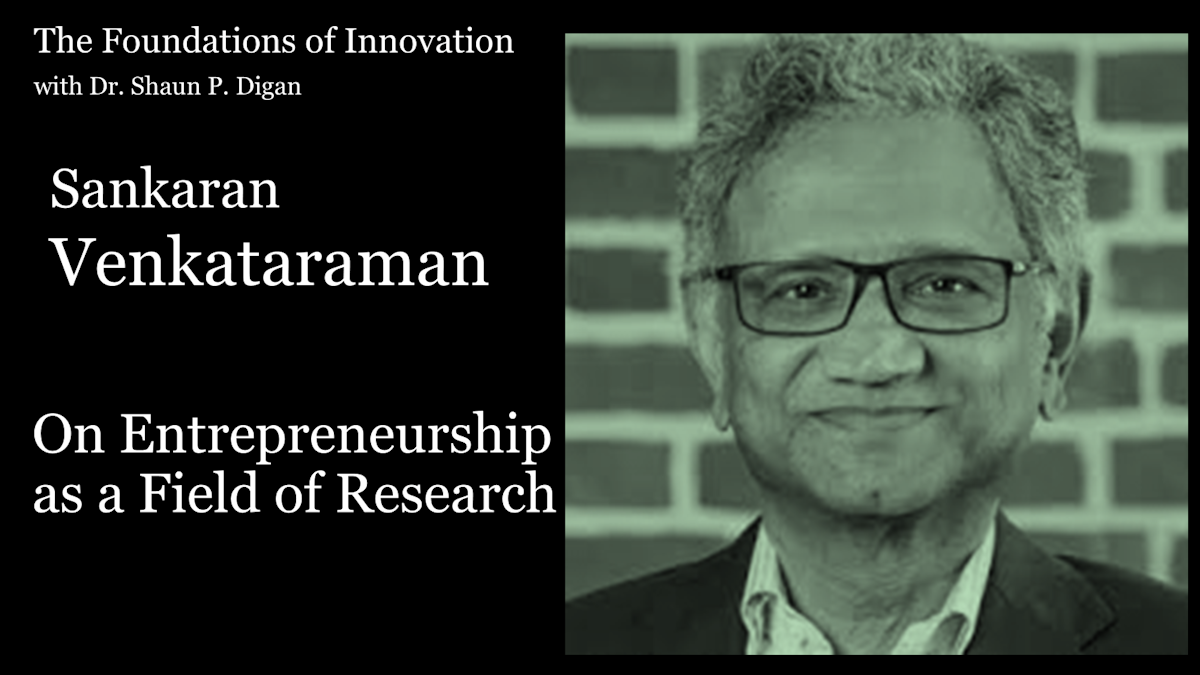
In 2000, two scholars published a short paper that told an entire field what it was for.
The field was entrepreneurship research. The scholars were Scott Shane and Sankaran Venkataraman. The paper was called "The Promise of Entrepreneurship as a Field of Research," it ran fewer than ten pages, and it did something most papers never attempt. It defined the domain.
Before that paper, entrepreneurship research was a borrowed thing. It took its theories from economics, its methods from psychology, its frameworks from sociology, and its questions from whoever happened to be writing. It had conferences and journals and tenured chairs. What it did not have was a question of its own.
Venkataraman had been building toward that question for years. His 1997 chapter, "The Distinctive Domain of Entrepreneurship Research," made the case that the field needed a center. The 2000 paper, written with Shane, supplied one.
That is the contribution. The field's modern self-understanding starts here.
The Question the Field Had Been Asking
For decades, the central question of entrepreneurship research was a question about people.
Who becomes an entrepreneur. What traits they share. Whether they are higher in need for achievement, in tolerance for risk, in internal locus of control. The field ran study after study trying to find the psychological signature of the founder, the stable set of characteristics that separated the people who started companies from the people who did not.
The results were thin. The traits that showed up in one study failed to replicate in the next. The effect sizes were small. The founders who succeeded did not share a personality. They shared almost nothing except the fact of having founded something.
Venkataraman looked at the wreckage of that research program and drew a conclusion most of the field had been avoiding. The question was wrong.
Asking who entrepreneurs are had produced a generation of inconclusive trait studies because the trait was never the thing doing the work. Two people with identical psychological profiles will behave entirely differently depending on what is in front of them. One sees an opportunity. The other sees nothing. The difference is not inside the person alone. It sits between the person and the situation.
The Nexus
Shane and Venkataraman moved the unit of analysis.
The field, they argued, should not study entrepreneurs. It should study the nexus of two things: enterprising individuals and valuable opportunities. Entrepreneurship happens where a particular person meets a particular possibility. Neither half explains the event on its own. A great opportunity sitting in front of the wrong person produces nothing. A capable person with no opportunity in view produces nothing. The phenomenon lives in the join.
From that move, they wrote the sentence the field has been citing ever since. Entrepreneurship research is the scholarly examination of how, by whom, and with what effects opportunities to create future goods and services are discovered, evaluated, and exploited.
Read that sentence slowly, because every clause is load-bearing.
How, by whom, and with what effects. Three questions, not one. The field had been stuck on the second. The first and third had barely been asked.
Opportunities to create future goods and services. The object of study is the opportunity, not the person. For Shane and Venkataraman, the opportunity is real, it exists in the world, and it can be examined.
Discovered, evaluated, and exploited. A sequence. Opportunities are not simply acted on. They are first noticed, then judged, then committed to. Three distinct cognitive and practical operations, each of which can be done well or badly.
That definition gave the field a spine. It told researchers what counted as an entrepreneurship question and what did not. It explained why the trait studies had failed and what should replace them. It is, by a wide margin, the most cited statement of purpose the discipline has ever produced.
Why It Mattered
A field without a domain is a collection of methods looking for a subject. That is what entrepreneurship research was before Venkataraman gave it a center.
The 2000 paper did three things at once.
It established legitimacy. Entrepreneurship could now claim a distinctive question that no neighboring discipline was asking. Economics studied markets. Psychology studied individuals. Strategy studied firms. None of them studied the nexus where a person discovers, evaluates, and commits to an opportunity that does not yet exist as a business. That gap was the field's to own.
It supplied coherence. A definition this precise lets researchers know whether they are working on the same problem. It made cumulative progress possible, because for the first time the work could build on a shared object rather than scattering across borrowed ones.
And it relocated the action. By putting the opportunity at the center and the discovery-evaluation-exploitation sequence around it, the paper turned entrepreneurship into something with structure. An opportunity is not a flash of luck. It is something that gets noticed, assessed, and acted on, in steps, by a reasoning person. The moment you say that, you have admitted the process can be studied. And anything that can be studied can, in principle, be improved.
Venkataraman opened that door. He stood in the doorway and described the room behind it with more precision than anyone before him.
What It Left Open
What he did not do, and never set out to do, was walk the founder through it.
Here is the thing about the definition. It is a definition of a field of research.
How, by whom, and with what effects opportunities are discovered, evaluated, and exploited. That is a magnificent question for a scholar. It tells the researcher exactly what to examine and exactly what would count as an answer. It does not tell the founder anything.
Look at the verbs again. Discovered. Evaluated. Exploited. Founders do all three, and evaluation in particular is founder work, not only researcher work. The problem is not that the words are academic. The problem is that they are descriptive rather than operational. They name the activity. They do not specify how to perform it. Written in the passive voice, they describe the process from the outside, and a founder cannot run a passive verb. The founder is standing inside an opportunity right now, with rent due, and needs to know whether this one is worth another six months.
Venkataraman defined what scholars should study. He did not define what founders should do.
That is not a flaw in the paper. The paper was never trying to do the second thing. Its job was to give a discipline its subject, and it did that better than any paper before or since. But the success of the research agenda exposed the gap underneath it. The field now had a precise account of the phenomenon and almost nothing to hand the person living through it.
The discovery-evaluation-exploitation sequence is real. Founders move through it constantly. They notice something. They form a judgment about whether it is worth pursuing. They commit resources. The field described that sequence well. It did not operationalize it for the person inside it.
The gap between the research agenda and founder practice is the gap the field has not closed. Twenty-five years of scholarship accumulated on top of Venkataraman's definition, and it produced real tools. Customer discovery. Effectuation. Lean experimentation. The business model canvas. Opportunity-assessment instruments. Each one is useful. Each one addresses a slice. What none of them added up to was a single, integrated framework a founder could run across the whole venture to decide whether this opportunity is ready to commit to. Founders do not experience these as separate academic problems. They experience them as one venture. The field produced many partial instruments, from several traditions that often disagreed with one another. It did not produce a coherent founder-facing one. It learned to explain the founder to itself faster than it learned to equip the founder.
What This Means for Founders Now
You live on the nexus. That is the first thing to take from Venkataraman.
The opportunity you are working on is not a property of you, and it is not a property of the market. It is the relationship between the two. This is why generic advice keeps failing you. The advice addresses one half of the nexus while the answer lives in the join. Whether your opportunity is real depends on the fit between what you specifically can see and do and what this specific market specifically needs right now. That fit is the thing to examine. Not your grit. Not the size of the market. The fit.
The second thing is harder, and it is the reason this series exists.
Venkataraman gave the discovery-evaluation-exploitation sequence to researchers. The same sequence describes your actual work, but you have to run it on yourself, in real time, with money on the line. Discovery is noticing the opportunity, which you have already done. Evaluation is the part most founders skip. It is the honest judgment about whether the opportunity survives contact with evidence. Exploitation is commitment, the decision to pour the next year of your life into this rather than something else.
Some traditions push back on the order here. Effectuation, which this series has already taken seriously, argues that opportunities often emerge through action rather than prior evaluation. Fair. Even then, you still face repeated commitment decisions, and each one demands judgment about what evidence justifies the next step. The evaluation does not disappear. It gets distributed across the path.
The field studied that middle step closely for twenty-five years, across traditions that rarely agreed on much. The question for you is narrower than any of theirs. Not how opportunities get evaluated in general. Whether this one holds up. That means asking which of your assumptions are load-bearing, what evidence actually supports them, and what breaks if one of them is wrong. The research agenda named the operation. It did not hand you an integrated way to perform it.
This is what the six pillars are built for. Founder, Problem, Market, Business Model, Go-to-Market, Financial. They take Venkataraman's question, the one written for scholars, and turn it into something you can run on your own venture this week. The opportunity gets pulled apart into the specific assumptions it rests on, across the dimensions where founders actually go wrong. The evaluation step stops being a research topic and becomes a practice.
Describing the founder's work well is not the same as equipping the founder to do it. The first took the field a generation. The second is still open.
Theoretical Takeaway
Venkataraman's contribution to the argument this series is building is the field's organizing question itself. He defined what entrepreneurship research should study: how, by whom, and with what effects opportunities are discovered, evaluated, and exploited. That definition gave the discipline a domain, a unit of analysis, and a generation of cumulative work. What he left open is the translation. He defined what scholars should study. He did not define what founders should do. The discovery-evaluation-exploitation sequence is an accurate description of founder work and not, by itself, an instruction for performing it. The gap between the research agenda and founder practice is not a footnote to the field. The field spent twenty-five years producing valuable but fragmented approaches to it, narrowing the gap without closing it. Closing it is the work this series is built to name.
Follow on Substack to get the weekly series directly to your inbox.
Next week: Geoffrey Moore and crossing the chasm. Why the customers who validate an opportunity and the customers who build a market are rarely the same people, and what that does to a founder who mistakes the first group for the second.
Originally Published in the Startup.Ready. Foundations of Innovation Series at https://www.startupreadinessscore.com/essays/venkataraman-research-agenda
Original Publication Date: June 12, 2026
Last Updated: June 12, 2026
By Dr. Shaun P. Digan, MBA, PhD
Sources
The Distinctive Domain of Entrepreneurship Research, Sankaran Venkataraman, in J. Katz (ed.), Advances in Entrepreneurship, Firm Emergence and Growth, Vol. 3, JAI Press (1997), pp. 119–138
The Promise of Entrepreneurship as a Field of Research, Scott Shane and Sankaran Venkataraman, Academy of Management Review, Vol. 25, No. 1 (2000), pp. 217–226
About the Author
Dr. Shaun P. Digan is the founder of Startup.Ready and the creator of the Startup Readiness Framework, a research-based system for evaluating and strengthening the foundations of early-stage startups. He holds a PhD in Entrepreneurship from the University of Louisville and has spent 15 years teaching, advising, and consulting with founders. In this series, The Foundations of Innovation, he writes on the ideas that built the startup world and the one idea still missing from all of them.