Week 13: Scott Shane and the Individual-Opportunity Nexus
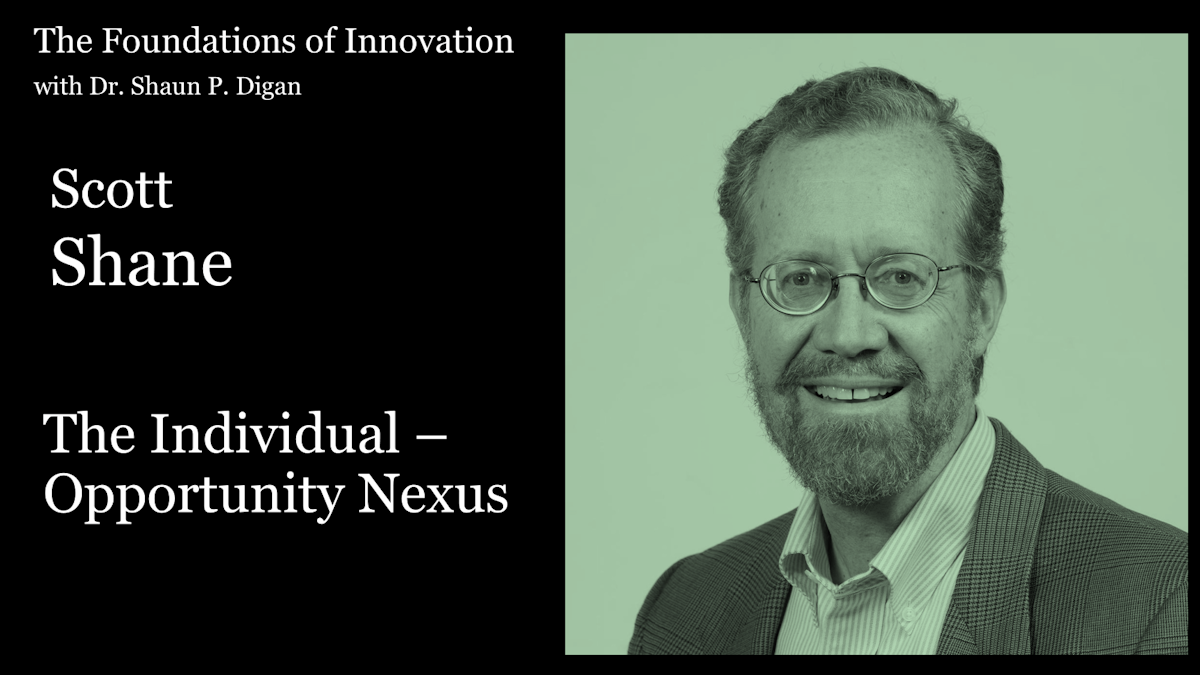
For most of the twentieth century, entrepreneurship research had a problem it could not name.
It studied entrepreneurs. It studied opportunities. It studied outcomes. It produced a steady stream of findings about founder personality traits, about market structure, about the conditions under which new firms emerged. What it did not have was a clear answer to a basic question: what, exactly, was the field studying.
Was entrepreneurship a property of certain people? A type of person, with measurable traits, who founded companies the way other types of people became surgeons or sales executives? Decades of research had failed to find a stable personality profile. The trait approach had collapsed under its own contradictions.
Was entrepreneurship a property of certain situations? A function of market conditions, available capital, and timing? That framing was tidy, but it stripped the founder out of the equation. It could not explain why the same conditions produced different ventures in different hands.
Scott Shane proposed something simpler than either, and harder. He proposed that the field had been looking at the wrong unit of analysis the whole time.
The Nexus
In 2000, Shane and Sankaran Venkataraman published "The Promise of Entrepreneurship as a Field of Research" in the Academy of Management Review. The paper did something that academic articles rarely do. It told the field what it should have been studying.
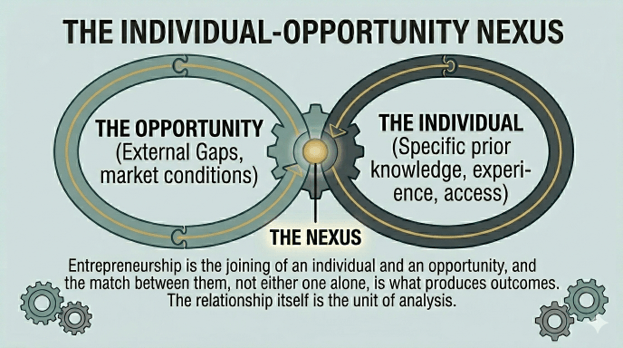
Their answer: the entrepreneur and the opportunity are not separate objects. The field's actual unit of analysis is the relationship between them. They called this the individual-opportunity nexus.
The argument has two pieces, and both matter.
The first piece is that opportunities exist. Not as fully formed business plans waiting to be picked up off the ground. As real conditions in the world, structural gaps between what markets currently produce and what they could produce given existing technologies, demographics, and resources. The conditions are external. They do not require any particular entrepreneur to exist.
The second piece is that opportunities do not act on themselves. The same conditions can be visible to many people and built into ventures by very few. The opportunity becomes a venture only through the work of a specific individual whose prior knowledge, experience, and access make the opportunity legible to them and actionable in their hands.
Neither piece is sufficient. An opportunity without a founder is a market gap that closes when someone else fills it. A founder without an opportunity is someone with energy and nowhere useful to put it. Entrepreneurship is the joining.
Why the Nexus Was a Real Discovery
What Shane named had been hiding in plain sight, which is what made the naming consequential.
Before the nexus framing, the field was largely talking past itself. Economists studied opportunities and treated entrepreneurs as interchangeable arbitrageurs. Psychologists studied entrepreneurs and treated opportunities as background. Sociologists studied conditions and networks. Each discipline had captured something real and missed what the other disciplines were holding.
The nexus said the field's actual subject was the structure that none of those disciplines, alone, could see. The match.
That move had practical consequences. It changed what counted as a research question. Asking "what kind of person becomes an entrepreneur" produced a literature that contradicted itself. Asking "what kind of person becomes an entrepreneur given which kind of opportunity" produced a literature that began to converge.
It changed what counted as an explanation for outcomes. A venture's success or failure could no longer be attributed cleanly to founder quality or market quality alone. It was, in significant part, a function of fit between the two. Misalignment in one corner of the nexus was as consequential as weakness in the other.
And it changed what counted as opportunity itself. Opportunities were not equal. They were not interchangeable units of "good ideas" that any sufficiently motivated person could pursue. They were specific, structured, and only legible to founders whose prior exposure had given them the conceptual apparatus to see them.
Prior Knowledge as the Mechanism
Shane's 2000 paper "Prior Knowledge and the Discovery of Entrepreneurial Opportunities," published in Organization Science, did the empirical work that the nexus framing demanded.
He studied eight ventures built around a single technology developed at MIT, a three-dimensional printing process. The technology was the same in every case. Each founder had licensed it. Each had to decide what to build with it.

What Shane found was that the founders did not see the same opportunity. They did not even see the same technology in the same way.
Each founder identified an opportunity that was specifically legible to them through the lens of their prior knowledge. The founder who had worked in pharmaceutical manufacturing saw an opportunity in drug delivery devices. The founder who had worked in metal fabrication saw an opportunity in custom industrial parts. The founder who had worked in design saw an opportunity in architectural modeling.
The technology was identical. The opportunities that emerged from it were not. The opportunities were a function of the match.
Shane identified three dimensions of prior knowledge that shaped which opportunities a founder could see:
Prior knowledge of customer problems. Direct exposure to the specific friction the customer experiences. Without this, the founder is solving a problem they have inferred rather than a problem they know.
Prior knowledge of markets. Familiarity with how a specific industry buys, what its customers care about, where its information flows. Without this, a founder cannot recognize that a technological capability solves a real problem for actual people who would pay for the solution.
Prior knowledge of how to serve markets. Operational understanding of the channels, partners, and processes through which the industry's work gets done. Without this, the founder may see the opportunity but cannot reach the customer who would buy it.
The implication is sharp. Opportunity recognition is not a generic skill that some people have and others do not. It is a specific match between a particular person's history and a particular structural condition in the world. Change the person, and the opportunity becomes invisible. Change the opportunity, and the person's prior knowledge no longer applies.
This is why the nexus framing matters. Without it, the question "is this a good opportunity" has no clean answer. With it, the question becomes "is this a good opportunity for this founder," and that question is at least answerable in principle.
What the Nexus Did for the Field
Shane's framing reorganized entrepreneurship research in ways the field is still working through.
It gave the discipline a coherent unit of analysis, which is what Venkataraman's 1997 paper had already argued the field needed. It connected back to Kirzner's alertness and forward to the cognitive science of pattern recognition that would dominate the next two decades. It made room for the empirical work on opportunity recognition, opportunity discovery, and opportunity creation that has accumulated since.
It also gave practitioners a sharper vocabulary. The phrase "founder-market fit," which is now a piece of standard investor language, is a downstream simplification of the nexus argument. So is "founder-problem fit." Both phrases assume the structure Shane named. The match is what gets evaluated, not the founder or the market in isolation.
The argument was strong enough that within a decade the field had reorganized around it. Shane's 2003 book, A General Theory of Entrepreneurship, extended the nexus framework into a full account of opportunity discovery, evaluation, and exploitation. The field's modern self-understanding, the one Venkataraman and Shane had argued for in 2000, was largely in place.
What did not settle was the question of what an opportunity is. Shane treated opportunities as real structural conditions that exist independently of the entrepreneur and are discovered through prior knowledge. That framing was the field's first organized answer, and a lot of subsequent work was built on it. Other scholars pushed back. Sarasvathy, working from her studies of expert entrepreneurs, argued that opportunities are often enacted through action rather than found in advance. Gartner pressed the field to study venture creation as a process rather than entrepreneurs as a type. Davidsson, whose work appears later in this series, argued that opportunities emerge through the interaction of founder action and external enablers, not as objects waiting to be picked up. The debate is live and is not the work of this essay to resolve. What survives across the different positions is the relational insight Shane named. Whether the opportunity is discovered, constructed, or enacted, the founder and the situation are still the joint unit of analysis. The match is still the thing that produces outcomes.
And then the framework stopped short of the question that matters most to the founder reading it.
What Shane Did Not Build
The nexus is a research framework. It tells scholars what to study and how to interpret what they find. It is precise about the structure of the entrepreneurial situation. It is precise about why the same opportunity produces different ventures in different hands.
It is not precise about what a founder is supposed to do with this information.
A founder who reads Shane comes away knowing that their match with their opportunity is a real thing, that prior knowledge is the mechanism, and that the match shapes which opportunities are legible to them. What that founder still does not have is a way to know whether the match they believe they have is the match they actually have.
The founder who feels strongly connected to the problem they are building around could be experiencing a genuine match grounded in prior knowledge that gives them an information advantage. They could also be experiencing the cognitive comfort of a problem that is familiar enough to feel important without being understood well enough to produce a real advantage. From the inside, those two states are nearly indistinguishable.
This is the gap Shane left open.
The nexus is a category. The diagnostic that helps a founder locate themselves inside that category is not part of the framework. Shane gave the field a unit of analysis. He did not give the founder a tool.
The cost of that gap is visible in practice. Founders pursue opportunities they believe they are matched to, on the basis of intuitions they have not stress-tested.
Investors evaluate founder-market fit through pattern recognition that is itself shaped by the investor's own prior knowledge, which may or may not transfer to the founder's situation.
Programs select for founder-problem fit using rubrics that capture some of the structure Shane named and miss the rest.
The match is real. The capacity to verify it, and to develop it where it is thin, is not yet built.
What This Means for Founders Now
Shane's framework hands the founder a question, not an answer.
The question is not "do I love this problem." The question is whether the founder's prior knowledge, across the three dimensions Shane named, gives them an actual information advantage over a competent stranger who would start tomorrow.
Concretely, that means auditing three things, not as a one-time self-assessment, but as a working inventory the founder revisits as the venture moves.
The first is the founder's prior knowledge of the market. What does this founder know about how this industry buys, sells, and decides, that a smart outsider would have to spend six months learning? If the honest answer is "nothing specific," the founder has identified an opportunity that is legible to them from a distance but not yet legible from inside.
The second is the founder's prior knowledge of how to serve the market. What channels, relationships, and operational patterns does this founder already understand? Not in the abstract. Through direct exposure. If the founder's plan to reach customers depends on relationships they would have to build from scratch, the nexus is weaker than it looks.
The third is the founder's prior knowledge of the customer's problem. Has this founder seen the problem from inside, repeatedly, long enough to have noticed what the people closest to it have normalized? Or are they working from a problem statement they constructed from secondary sources?
The point of these questions is not to disqualify founders who answer thinly. Many real ventures have been built by founders who came in with a weaker nexus than their pitch deck suggested, and who closed the gaps deliberately once they could see them.
Prior knowledge is not only what the founder brought with them. It is also what they build through sustained, structured exposure to the people, the channels, and the friction they did not start with.
Founders who enter an industry as outsiders and later look like insiders did the work of becoming insiders. They went where the customer is, repeatedly, until the patterns the people closest to the problem had normalized became legible to them too.
The gaps in the match are knowable. The work of closing them is concrete. Pretending the match is stronger than it is moves no work forward, and treating a thin starting nexus as a verdict misreads what Shane's research predicts about how fit develops.
Founders who treat their match with the opportunity as a starting assumption build companies that struggle in ways that look like execution problems but are fit problems. Founders who treat the match as something to verify, and then to develop where it is thin, build companies that may take longer to start but encounter fewer of the failure modes Shane's research predicted.
The nexus is real. The work of verifying it, and of developing it where it is missing, is the founder's.
Follow on Substack to get the weekly series directly to your inbox.
Theoretical Takeaway
Shane's contribution to the argument this series is building is the unit of analysis the field had been missing. Entrepreneurship is the joining of an individual and an opportunity, and the match between them, not either one alone, is what produces outcomes. The nexus is real. What Shane left open is the diagnostic and the development path that follow from it. He gave the field a category that organizes its research. He did not give the founder a tool that helps them know whether their own match is real or imagined, and where it is thin, what work would close the gap. The scaffolding problem is precisely this: the match the founder believes they have and the match they actually have are not always the same, the difference is not visible from the inside without external structure, and the work of closing the gap is structured work that no current instrument scaffolds.
Next week: Venkataraman and the modern research agenda. The companion paper that named what the field should study, and what the gap between research agenda and founder practice still costs.
Original Publication Date: June 1, 2026
Last Updated: June 1, 2026
By Dr. Shaun P. Digan, MBA, PhD
Sources
The Promise of Entrepreneurship as a Field of Research, Scott Shane and Sankaran Venkataraman, Academy of Management Review (2000)
Prior Knowledge and the Discovery of Entrepreneurial Opportunities, Scott Shane, Organization Science (2000)
A General Theory of Entrepreneurship: The Individual-Opportunity Nexus, Scott Shane, Edward Elgar Publishing (2003)
About the Author
Dr. Shaun P. Digan is the founder of Startup.Ready and the creator of the Startup Readiness Framework, a research-based system for evaluating and strengthening the foundations of early-stage startups. He holds a PhD in Entrepreneurship from the University of Louisville and has spent 15 years teaching, advising, and consulting with founders. In this series, The Foundations of Innovation, he writes on the ideas that built the startup world and the one idea still missing from all of them.