Week 18: Everett Rogers and the Curve Every Founder Wants to Be On
Every founder has a growth story, and it tends to have the same shape. A few early users who love the thing. Then word spreads. Then the early majority arrives, the curve bends upward, and it takes off.
It is a good story. Most founders can draw the curve before they have a single user on it.
Drawing the curve is not the same as being on it.
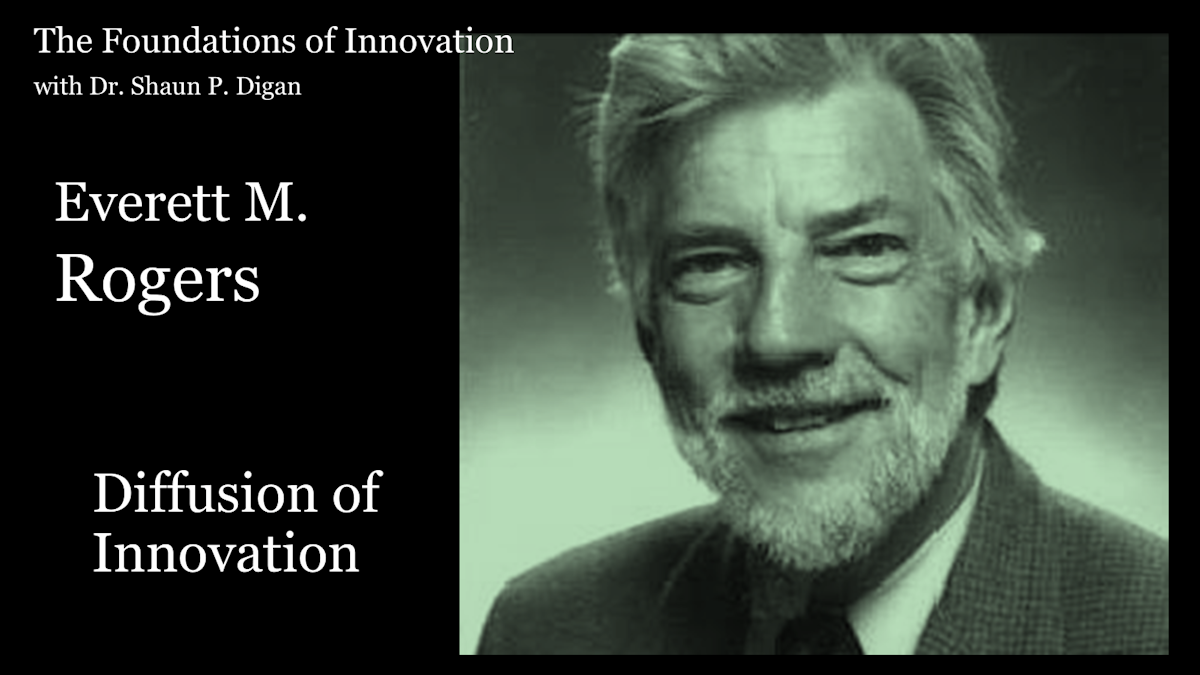
That curve has an author. Everett Rogers spent his career studying how new things actually move through a population, and he drew the map every founder now borrows without reading.
Rogers was born in 1931 on a farm in Carroll, Iowa, and the farm is where the question started. His father loved machines. He bought the newest equipment the moment it appeared. But he refused the new hybrid seed corn for years, even though it yielded a quarter more and held up in dry weather. Then came the drought of 1936. The neighbors' hybrid corn stood tall. The corn on the Rogers farm wilted. Only then did his father switch.
That gap stayed with Rogers. The innovation was obviously good. What fascinated him was the slow, uneven, deeply human process by which people came to use it anyway. The puzzle was never whether hybrid corn worked. The puzzle was the years his smart, capable father spent not using it with the proof standing across the fence.
He took the question to Iowa State, finished a PhD in rural sociology in 1957, and in 1962 published Diffusion of Innovations. The book pulled together hundreds of studies across farming, medicine, education, and public health into one account of how new things spread. It became one of the most cited works in all of social science and stayed in print across five editions. Early adopters, the adoption curve, opinion leaders. The words founders reach for came largely from this book.
Keep one thing in view from here. Rogers explained how an innovation spreads once it exists. He said almost nothing about whether yours should exist, or whether it was ever built to spread.
Rogers's Contribution
Rogers's core claim is that diffusion is not random. It has a structure you can study, and once you have studied enough cases, a structure you can partly predict.
He defined it precisely.
Diffusion is the process by which an innovation is communicated through certain channels over time among the members of a social system.
Four elements, all load-bearing. The innovation. The channels it travels through. Time. And the social system it moves inside. Change any one and the spread changes. Diffusion was not a property of the product alone. It was a property of the product moving through a particular network of people.
The most famous result was the shape. Plot the cumulative number of people who have adopted an innovation over time and you get an S. Slow at first, then a steep climb as adoption feeds on itself, then a flattening as the last holdouts trickle in. The same curve appeared again and again, across wildly different innovations, because the same social process was running underneath.
Then Rogers cut the curve into people. Adoption is not spread evenly across a population. A small group moves first, a small group moves last, and the bulk sits in the middle. He named five categories by how quickly people adopt. Innovators, the venturesome few, around two and a half percent. Early adopters, about thirteen percent, respected locally and watched by others. The early majority, a third of the population, deliberate and a step behind. The late majority, another third, skeptical and adopting mostly under pressure. And laggards, the last sixth, who move only when they have no other choice.
The categories mattered because of who sits where. Rogers showed that adoption is driven less by advertising than by people watching other people. The early adopters are the opinion leaders, the ones the early majority checks with before committing. Diffusion runs on interpersonal influence, on social proof traveling from a trusted neighbor to a cautious one. The neighbor's hybrid corn standing in the drought was worth more than any seed company's brochure.
Rogers went further than the curve. He asked why some innovations race across it while others crawl, and he named five features of the innovation itself that predict the speed. Relative advantage, how much better it is than what it replaces. Compatibility, how well it fits the adopter's existing life and values. Complexity, how hard it is to understand and use. Trialability, whether you can test it cheaply before committing. Observability, whether others can see the results. An innovation strong on all five spreads fast. One weak on them stalls, however good it looks on paper. The same attribute even reads differently by adopter category, where complexity signals exclusivity to an innovator and a dealbreaker to the early majority. The traits that attract the first users can become barriers to the next ones. Diffusion runs on different groups evaluating the same innovation differently, not on one audience slowly coming around.
Why It Mattered
Before Rogers, the spread of a new thing looked like luck or magic. Some innovations caught on, some did not, and the explanations were mostly stories told after the fact. Rogers showed there was a process under the noise, regular enough to study and, at the population level, regular enough to anticipate.
That gave entire fields a shared language and a real tool. Public health workers used it to understand why a free, obviously beneficial practice, boiling drinking water, a new contraceptive, could take a decade to move through a village. Marketers used the adopter categories to sequence a launch. Technologists used the S-curve to reason about where a product sat in its life. The framework was general because the social process underneath it was general.
It also reframed what spreading actually requires. A better mousetrap does not sell itself. Rogers's own father proved it. Adoption is a social act, gated by trust and visibility and fit. That pushed organizations to stop reciting product specifications and start engineering for observability and trialability, to find the opinion leaders and let influence do the work advertising could not.
And it seeded thinking the series has already met. Decades later Geoffrey Moore, the subject of Issue 15, took Rogers's smooth curve and found a crack in it. The early adopters and the early majority, Moore argued, want fundamentally different things, and the gap between them is a chasm where most technology products die. Moore could only find the chasm because Rogers had drawn the curve. The map came first.
What It Left Open
Here the series has to be precise, because Rogers is more useful than most founders realize and still leaves the founder's first question untouched.
Start with what he assumed before the model begins. Diffusion theory starts with an innovation that already exists. It has been invented, built, and judged worth releasing. It is already moving through a social system. Rogers's entire apparatus, the curve, the categories, the channels, describes what happens after all of that is settled. It is a theory of spread, and spread is a late problem. The founder's hardest problem comes earlier. Should this thing exist at all.
Rogers did address the innovation itself, in the five attributes, and that is the strongest part of the theory for a founder. But notice what those attributes are. Perceived, measured in adopters, derived from innovations that had already launched and already succeeded or failed. They explain variance in adoption rate across many cases, after the fact. Relative advantage over what, for whom, felt how strongly? Rogers names the variable. He hands the founder no way to know its value before the market has spoken. Read forward by one founder, pre-launch, with no adopters yet, the five attributes are not facts the theory supplies. They are assumptions the founder still has to test.
There is a deeper limit in the unit of analysis. Diffusion is a population-level theory. It describes the average behavior of thousands of adopters over time. A founder does not have a population. They have one venture, one set of beliefs about one segment, and a few months of runway to find out if any of it is true. The smooth S-curve is what regularity looks like from far away, across many innovations, most of which we only study because they spread. The founder is inside a single case, near the start, where the curve is just a flat line that has not yet decided whether it will ever bend.
And the curve carries a quiet survivorship bias. We draw it from the innovations that diffused. Diffusion theory describes what happens after adoption begins, and many startups fail before adoption ever starts. The ones that never found a first real adopter, that solved a problem nobody urgently had, that targeted a segment that could not be reached, do not show up as failed curves. They show up nowhere. They were never on the curve to begin with. Many failed startups are not failures of diffusion at all. They are ventures that never earned a curve, because the thing should not have been built, or not built for them.
So Rogers tells a founder how adoption works for innovations that adopt. He does not tell them whether theirs is one of them. The curve describes the journey. It is silent on whether you are holding a ticket.
What This Means for Founders Now
Start with the part Rogers got right, because founders skip it constantly. Adoption is social. People adopt what trusted people near them already use. The implication is concrete. Your first job is narrow. Win a small, specific group of early adopters so completely that the people watching them have a reason to follow. The neighbor's corn in the drought. Find the segment that feels the problem hardest, serve it visibly, and let observability do the work no ad budget can.
The trap is borrowing the vocabulary and skipping the work. A founder who says "we are targeting early adopters, then we will cross to the early majority" has described a hope in Rogers's words. The sentence sounds like a plan. It contains no evidence. It assumes the early adopters exist, that they are reachable, that the problem is sharp enough to move them, and that the thing is good enough to be worth watching. Every one of those is an assumption, and the curve treats all of them as already answered.
So the work the curve hides sits upstream of the curve. Before you can reason about how your innovation spreads, you have to earn the right to ask the question. Is the problem real and sharply felt by a specific group. Is that group reachable. Does the thing have an advantage they would feel and others would see. These are the questions that decide whether there is a curve to climb at all. Almost everyone reads Rogers's five attributes backward. The innovations that spread had relative advantage, so the attribute reads as an explanation for what already happened. Read them forward, before launch, and they flip. Relative advantage stops being a finding and becomes a hypothesis. The five attributes are not a launch checklist. They are the assumptions your launch is betting on.
Here is one move that turns the theory into a test. Name the specific group you believe will adopt first, ten real people or one tight segment, and for each of Rogers's five attributes write down two things: what you are assuming, and what evidence you actually have. Relative advantage, better than their current option, by how much, says who. Compatibility, fits their existing workflow, or asks them to change it. Trialability, can they try it without betting the farm. Where the evidence column is empty, you have not found a soft spot in your go-to-market. You have found a belief your whole company depends on that you have never tested.
There is an honest limit here. Doing this work does not make the innovation spread. Only the market makes it spread. What the work changes is which question you are answering. The founder who maps these assumptions and tests the shakiest, most load-bearing one first is reasoning about whether they are on the curve at all. The founder who skips to the curve is decorating a guess. Both might fail. Only one will know why.
Rogers drew the most useful map we have of how new things travel through the world. The mistake is treating the map as a ticket. The curve shows the road taken by the innovations that made it. It says nothing about whether yours is on the road, and that question, not the shape of the climb, is the one that decides most startups.
If you can name your first adopters, show real evidence that the thing has an advantage they would feel, and point to why others would see them adopt it, you have the beginnings of a reason to believe there is a curve under you. If you cannot, you do not have a diffusion problem yet. Most founders worry about how to climb the curve. The first question is whether there is one beneath you at all.
Theoretical Takeaway
Rogers established that diffusion is a structured, social process. New things spread through a population in a recognizable pattern, the S-curve, driven by distinct adopter categories and by interpersonal influence running from opinion leaders to the cautious majority. He even named five attributes of an innovation that predict how fast it travels. What the theory presupposes is the founder's actual problem. Diffusion begins after the innovation exists, after it is judged worth building, after it is already moving through a social system. The model is population-level and retrospective, drawn from the innovations that spread, and silent on the ones that never earned a curve. The five attributes, read forward by a single founder before launch, are not facts the theory supplies. They are assumptions the founder still has to test. Rogers tells you how adoption works for innovations that adopt. Whether yours is one of them, whether the problem is real, the segment reachable, the advantage felt, is the upstream reasoning the curve assumes and the founder still has to do. That reasoning is the part the instrument is built to address.
Next week: Albert Bandura and self-efficacy. Why belief in your own capacity to execute is one of the most reliable predictors of founder persistence, and why the founder who is confident for the right reasons and the founder who is confident for the wrong reasons look identical from the outside.
Originally Published in the Startup.Ready. Foundations of Innovation Series at https://www.startupreadinessscore.com/essays/rogers
Original Publication Date: June 30, 2026
Last Updated: June 30, 2026
By Dr. Shaun P. Digan, MBA, PhD
Sources
Diffusion of Innovations, 5th Edition, Everett M. Rogers, Free Press (1962; fifth edition 2003)
The Diffusion of Hybrid Seed Corn in Two Iowa Communities, Bryce Ryan and Neal C. Gross, Rural Sociology 8(1) (1943)
Crossing the Chasm, Geoffrey A. Moore, HarperBusiness (1991)
About the Author
Dr. Shaun P. Digan is the founder of Startup.Ready and the creator of the Startup Readiness Framework, a research-based system for evaluating and strengthening the foundations of early-stage startups. He holds a PhD in Entrepreneurship from the University of Louisville and has spent 15 years teaching, advising, and consulting with founders. In this series, The Foundations of Innovation, he writes on the ideas that built the startup world and the one idea still missing from all of them.