Your Customers Are Already Telling You Everything. You're Just Not Listening in the Right Places.
Most founders think customer research means booking time on someone's calendar.
It does not. At least not at first.
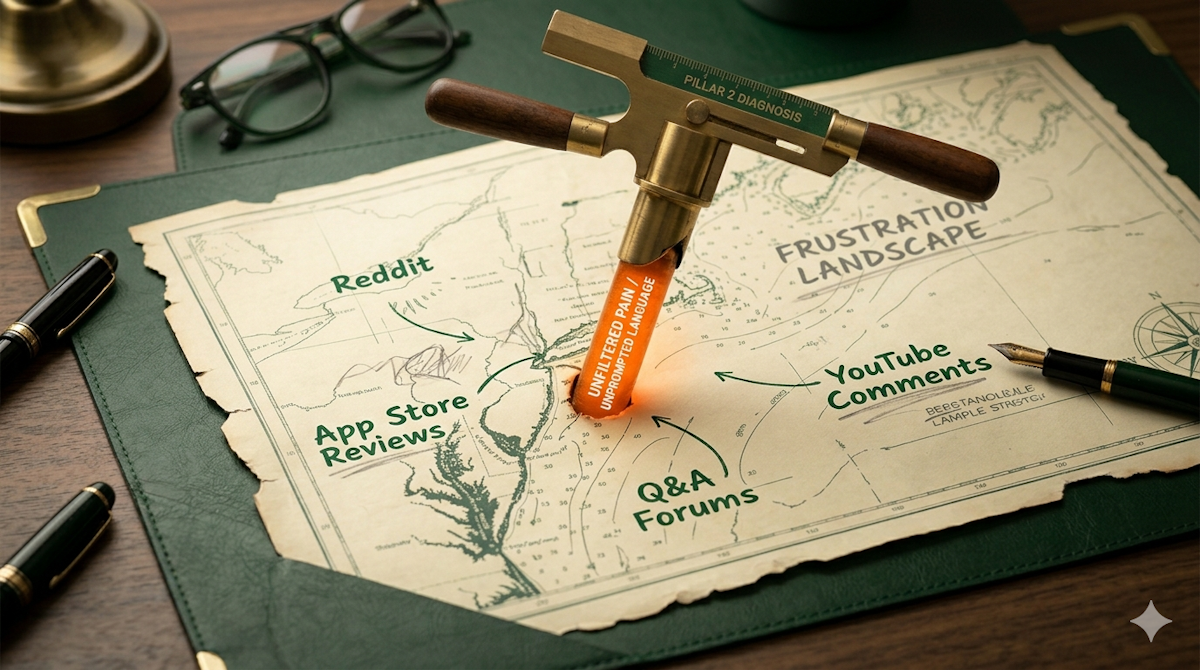
Before you send a single cold message, before anyone agrees to talk to you, your future customers are already describing their pain points in vivid, unfiltered detail. They are doing it right now in Reddit threads, in one-star reviews, in community forums, in comment sections on YouTube videos they found at 11pm while trying to figure something out on their own.
They did not write any of it for you. That is exactly what makes it valuable.
TL;DR
The strongest customer pain points are not discovered through interviews first. They show up unprompted, in reviews, forums, and communities where customers describe what is actually breaking for them.
Four signals indicate you are working with real pain point evidence:
Recurring language that appears across multiple independent sources.
Specific descriptions of what failed, what was tried, and what it cost (time, money, effort).
Visible workarounds that signal existing solutions are insufficient.
Emotional intensity (frustration, confusion, resignation) tied to a repeated experience.
If you cannot find this level of evidence, you do not yet have a validated problem. Just a hypothesis. This article shows where to find customer research before you do a single customer interview, how to interpret it, and how it feeds directly into your Problem Clarity before you build.
What is a Customer Pain Point?
A customer pain point is a specific, recurring problem that causes measurable frustration, inefficiency, or cost for a user. The strongest pain points show up in what customers say unprompted, in their own words, when something is not working.
Why Most Founders Miss Customer Pain Points Early
When someone leaves a two-star review, they are not trying to help a startup founder understand their market. They are frustrated, and they are saying precisely what frustrated them. No softening. No trying to be helpful. Just the thing that broke and what it cost them.
That is the clearest signal in early-stage market research. Most founders never look at it.
The pattern I see most often goes like this. A founder develops a problem hypothesis and language to describe it. Language that made sense when the idea first clicked for them. Then they build everything downstream, the product, the messaging, the pitch, in that same language.
The problem is that language came from inside their own head.
Their customer uses different words. Searches for different things. Describes the frustration from a completely different angle. So when the founder finally shows up with a solution, it does not quite land. Founders who get this wrong don’t just struggle with messaging. They build products around misdiagnosed problems. Not because the problem is the wrong problem to solve. Because the description of the problem is wrong.
You cannot solve a customer pain point in language your customer does not recognize.
What Real Customer Pain Points Look Like (Unprompted Examples)
A general problem is something people are aware of. A customer pain point is something they are actively experiencing, describing, and trying to work around right now.
The internet is full of unfiltered pain point evidence. People vent in forums. They leave reviews that explain exactly why something failed them. They ask questions in communities that reveal what they cannot figure out on their own.
None of that was written for you. Which is exactly what makes it more reliable than a survey you designed or an interview where someone is trying to be polite.
Unprompted language is unfiltered pain. It is what your customer actually thinks, not what they think you want to hear.
Where to Find Customer Pain Points Before Interviews
The first step is knowing where to look. Your customers are already gathering somewhere. The goal is to find the places where they talk honestly about their frustrations.
Start with these sources:
Reddit is one of the highest-value sources for raw customer language. Search for subreddits where your target customer gathers and look for threads where people describe problems, ask for help, or vent about current solutions.
Q&A platforms like Quora or industry-specific forums surface the questions people cannot answer on their own. A question with thousands of views and no satisfying answer is a pain point with confirmed demand.
Community forums and Facebook or LinkedIn groups for your specific niche often contain the most concentrated, context-specific language available. Members speak to each other without the filter they would use talking to a vendor.
YouTube comment sections on videos about your problem space are underused and surprisingly valuable. People react honestly in comment sections in ways they would not in a formal research setting.
One and two-star reviews on competing or adjacent products are among the most direct expressions of unmet need available anywhere. G2, Trustpilot, the App Store, Google Play, and Amazon are all worth mining depending on your space. These reviewers were disappointed enough to say something. That emotional register is exactly what you are looking for.
One thing worth doing before you search anywhere else: check the platforms you already use. If you are genuinely close to your customer, you may already be inside the right communities without realizing it.
How to Identify Customer Pain Points Without Interviews
Once you know where to look, you need to search for the frustration, not for references to your solution or product category.
Use search phrases like:
"Why is [problem area] so hard"
"Does anyone else struggle with [task]"
"I can't believe there isn't a better way to [task]"
"Frustrated with [tool or process]"
"Is there a better way to [task]"
"Tired of [workaround]"
You are not looking for people who know your product exists. You are looking for people who have never heard of you and are already living with the problem you think you are solving.
Read what they actually wrote. Not what you want it to mean. What it says.
Example: What This Looks Like in Practice
A founder exploring invoicing tools for freelancers might search “tired of chasing invoices” or “why don’t clients pay on time.” In a Reddit thread or a one-star review, they might find something like:
“I spend hours every Friday chasing unpaid invoices and still don’t know who’s going to pay me. I’ve tried two apps and end up tracking everything in a spreadsheet anyway.”
This is not a feature request. It is a description of lived frustration.
What it tells you:
The problem is recurring (weekly)
The cost is time (hours lost)
Existing solutions are failing (tools → spreadsheet workaround)
The emotional tone is frustration and uncertainty
That level of specificity is what you are looking for. Not opinions about what might work. Evidence of what is already breaking.
How to Find Customer Pain Points (summary)
The process is straightforward once you know what you are looking for. In practice it comes down to four steps:
Identify where your customer talks
Search for frustration, not solutions
Capture exact language
Look for repeated patterns
The detail behind each step is above. The sequence is what matters.
How to Use Customer Pain Point Data in Your Startup
Two things will happen when you do this work seriously.
Either you will find evidence that the pain is real (that people are actively venting about it across multiple sources in consistent language) in which case you now have the exact words to use in your messaging. Or you will find very little, in which case that is also important data.
Both outcomes are useful. Only one of them is available to founders who skip this step and go straight to building.
The output of this research is not a validated hypothesis. It is something more useful.
It is your customer's voice. The specific words they reach for when something is broken. The consequence they name. The workaround they are already using that tells you exactly where the gap is.
That language belongs underneath everything else you build: your positioning, your messaging, your sales conversations, your product decisions. Not your description of the problem. Theirs.
Because if you can describe their customer pain points better than they can, they will trust you to solve them.
How Customer Pain Point Research Improves Your Problem Readiness Score
In the Startup Readiness Framework, Problem Readiness evaluates whether a founder has moved beyond a personal hypothesis to evidence grounded in real customer language. It is one of the most consistently underscored pillars in early assessments. Not because founders have not thought about the problem, but because they have thought about it entirely in their own words.
A founder who can describe a problem clearly has demonstrated awareness. A founder who can describe that same problem in the language their customer actually uses (pulled from the places their customer actually gathers) has demonstrated readiness.
If your Problem Readiness score flagged an abstract problem description, the diagnostic questions in this article are the starting point. The work is straightforward: find three places your customer gathers, spend an hour searching for the frustration, and capture the exact language you find. Do that before your next product or messaging decision.
If your customer is already describing the problem in their own words, your job is not to invent better language. It’s to listen closely enough to recognize it.
Problem Readiness is one of six pillars in the Startup Readiness Framework. The Startup Readiness Assessment gives you a full-system diagnostic across all six pillars in under twenty minutes.
Take your Startup Readiness Score free today at startupreadinessscore.com → before you build on a problem you haven’t validated in real customer language.
Published
By Dr. Shaun P. Digan
Originally Published on Startup.Ready.’s Startup Readiness: Validation, Framework, and Tools Blog at: https://www.startupreadinessscore.com/startup-readiness
Original Publication Date: April 21, 2026
Last Updated: April 21, 2026
About the Author
Dr. Shaun P. Digan is the founder of Startup.Ready and the creator of the Startup Readiness Framework, a research-based system for evaluating and validating early-stage startups before launch and early growth. He holds a PhD in Entrepreneurship from the University of Louisville and has spent over 15 years teaching, advising, and consulting with founders on startup strategy, validation, and growth.
In his writing, including The Foundations of Innovation, he focuses on how founders can make better decisions by improving clarity, alignment, and readiness before scaling.