The Founder-Problem Fit: Why You (Specifically) are the One to Solve This
Most founders spend months validating their problem-solution fit. They obsess over the market, the product-led growth metrics, and the unit economics. They run customer interviews, build landing pages, and iterate on positioning.
But they overlook the most critical foundation of all: whether they are actually the right person to solve this problem.
In the early stages of a startup, the business is not a product. It is a reflection of the founder's ability to learn, adapt, and endure. If there is a misalignment between the nature of the problem and the nature of the person solving it, the startup carries a hidden execution risk that no amount of capital, mentorship, or market timing can fix.
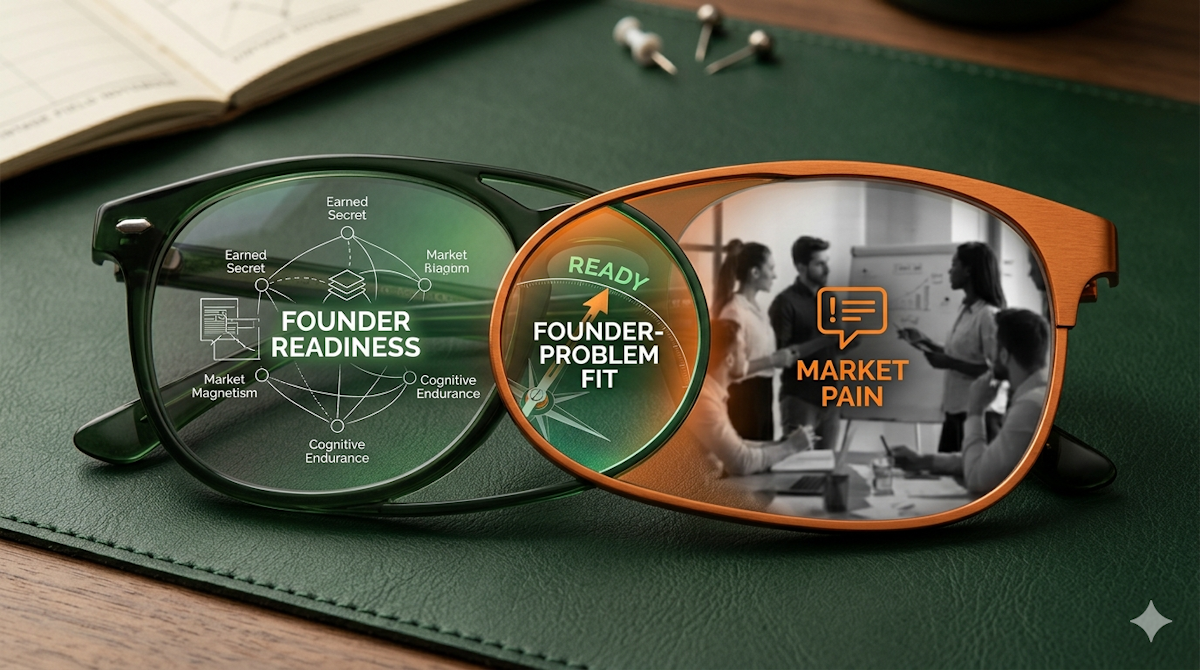
This is what the Startup Readiness Framework calls Founder Readiness: the first pillar evaluated, and the one everything else depends on. Founder-Problem Fit is the conceptual lens for understanding why that pillar matters.
TL;DR: A Good Idea Is Not Enough. The Right Founder for the Right Problem Is.
Most startup failures are not market failures. They are fit failures. The founder ran out of conviction before the market had a chance to respond. Or they lacked the access to move quickly enough. Or they were solving a problem they understood intellectually but had never actually lived.
Founder-Problem Fit evaluates three things:
Whether you have an Earned Secret: a non-obvious insight into the problem that competitors cannot easily replicate.
Whether your background gives you direct access to the customer and the credibility to move faster than someone starting from zero.
Whether your personal connection to the problem is durable enough to survive the period between starting and traction.
If any of these three are weak, the rest of your startup is building on an unstable foundation. The Startup Readiness Score evaluates whether you have the capacity, skills, motivation, and resources to execute: the operational foundation that Founder-Problem Fit requires to become real.
What Founder-Problem Fit Actually Means
Founder-Problem Fit is the intersection of a founder's professional expertise, personal history, and cognitive style with the specific requirements of the problem they are solving.
It is not about passion. Passion is a starting point, not a qualification. It is not about domain knowledge in the abstract. Plenty of knowledgeable people build companies that fail because their knowledge was theoretical rather than earned through direct exposure to the friction they are trying to eliminate.
Founder-Problem Fit is the answer to the most difficult question an investor (or your own subconscious, at eleven at night when the progress is slow) will eventually ask: why you, why now, and why will you be the one still standing when everyone else has quit?
Most founders have a practiced answer to that question. Fewer have an honest one.
The Three Dimensions of Founder-Problem Fit
1. The Earned Secret
An Earned Secret is a non-obvious insight into the problem that you have developed through direct, repeated exposure- the kind of understanding that cannot be acquired by reading about an industry, attending a conference, or talking to a few customers.
It is what you know that others don't. Not because you are smarter, but because you have been close enough to the problem, for long enough, to see the friction that everyone else has normalized. The workaround that the whole industry accepts as "just how things work." The inefficiency that insiders roll their eyes at but have stopped trying to solve. The gap between what the tools promise and what practitioners actually experience every day.
The Earned Secret matters because it is the foundation of defensible positioning. A founder without one is starting from the same baseline as every competitor who reads the same market reports and attends the same events. A founder with one has an asymmetric advantage that is genuinely difficult to replicate.
To test whether you have an Earned Secret, ask this: can you describe something specific about this problem that would surprise someone who has spent six months researching the market? If the answer is no, if your insight is something a smart generalist could find in a weekend of desk research, you do not yet have an Earned Secret. You have familiarity. That is not the same thing.
2. Founder-Market Alignment
Founder-Market Alignment is the degree to which your background, network, and credibility give you direct, efficient access to your target customer.
This dimension is less about what you know and more about who you can reach and how quickly. A founder building for emergency room physicians who has spent ten years working in hospital administration has a structural advantage over a founder who identified the same opportunity through a market analysis. Not because the second founder is wrong about the problem, but because the first founder can get a meeting, earn trust, and interpret customer feedback in a context the second founder will spend months trying to develop.
The friction-to-execution ratio is the practical test here. How many steps does it take you to get in front of your target customer? How many layers of credibility do you need to establish before they will tell you the truth about their problem? How much of what they say will you understand on the first pass, without follow-up questions to decode the industry vocabulary?
High Founder-Market Alignment means that ratio is low. You move faster, learn more accurately, and waste less runway on the wrong assumptions. Low alignment does not disqualify you, but it is a cost that needs to be accounted for honestly in your timeline and your team.
3. Cognitive Endurance
Cognitive Endurance is the durability of your motivation when the feedback loops turn negative; and in early-stage startups, they nearly always do.
This is the dimension founders are most likely to overestimate. In the early days, when the idea is new and the possibilities are open, motivation is easy. The test is what happens six months in, when the customer interviews are producing mixed signals, the product is behind schedule, and the competitive landscape looks more crowded than it did at the start. What keeps you working on this problem when the rational case for continuing is genuinely unclear?
The honest answer to that question reveals whether your connection to the problem is intrinsic or instrumental. Instrumental motivation, i.e. building because the market is large, because the timing is right, because someone told you it was a good idea, is not sufficient to carry a founder through the trough of sorrow. It evaporates precisely when you need it most.
Intrinsic motivation is different. It is rooted in a personal connection to the problem that exists independent of the outcome. You have experienced the friction yourself, or you have watched someone you care about struggle with it, or solving it is an extension of work you would do regardless of whether it produced a company. That kind of motivation compounds rather than depletes.
The signal is not how motivated you feel today. It is whether you can describe why you would still be working on this problem in two years if no one had funded it, validated it, or told you it was going to work.
Why Activity Masks Poor Fit
One of the most consistent patterns in early-stage founders is the use of activity as a substitute for conviction. Landing pages get built. Ads get run. Features get iterated. The calendar stays full.
But activity is not progress. And when Founder-Problem Fit is weak, activity becomes the mechanism founders use to avoid confronting that weakness. Movement feels like momentum. A full schedule feels like a company. The metrics of busyness stand in for the metrics of traction.
The tell is in the decision-making. A founder with strong Founder-Problem Fit makes decisions with incomplete data because their pattern recognition fills the gaps. They know what a real signal looks like because they have seen the problem from the inside. They know which customer objections are worth pivoting for and which ones are noise.
A founder without that fit waits. They collect more data. They run another interview. They wait for the market to tell them what to do next. Not because they are lazy, but because they lack the intuitive foundation that makes ambiguous decisions navigable.
If you find yourself consistently waiting for more certainty before acting, that is not a research problem. It is a fit problem.
The Diagnostic Questions
The following questions are designed to surface evidence of Founder-Problem Fit, or the absence of it. Answer them based on what you can demonstrate, not what you believe.
What is your Earned Secret? Describe the specific, non-obvious insight you have into this problem. Where did it come from? How long did it take to develop? Could a well-funded competitor replicate it in six months?
How did you get your last five customer conversations? Did you reach them through your existing network, your industry credibility, or a cold outreach process that required significant effort? The answer tells you where your Founder-Market Alignment actually stands.
What have you sacrificed to work on this? Not what you are willing to sacrifice in the future. What you have already given up. Past behavior is a more reliable indicator of durability than stated intention.
What would have to happen for you to quit? Name it specifically. If the answer is "nothing" you are not being honest. If the answer is something that is likely to happen in the next twelve months, you have identified a Cognitive Endurance gap.
If this problem never becomes a company, would you still be working on it? If the answer requires a long pause, the motivation may be more instrumental than it appears.
The Hidden Cost of Misalignment
When Founder-Problem Fit is missing, execution risk compounds in ways that are invisible until they aren't. The decisions that require intuition get delayed. The customer conversations that should produce insight produce confusion instead. The talent you are trying to recruit can feel the absence of conviction even when they cannot name it. The investors who pass often cannot articulate exactly why, but they are responding to the same signal.
High Founder-Problem Fit does not guarantee success. But it changes the nature of the challenge. Decisions become more intentional. Risks become more visible. The path through the early-stage fog becomes navigable rather than arbitrary.
The Startup Readiness Framework evaluates Founder Readiness as the first pillar because everything else is downstream of it. Founder-Problem Fit is the standard that pillar is measuring toward: the degree to which the founder's expertise, access, and motivation are genuinely aligned with the problem they are solving.
You are not ready because you have a great idea. You are ready when the problem you are solving is a genuine extension of who you are, what you know, and what you are willing to endure to solve it.
Evaluate Your Founder Readiness
Founder-Problem Fit is the conceptual foundation of the first of six pillars in the Startup Readiness Framework. The others (Problem Clarity, Market Clarity, Business Model, Go-to-Market, and Financial Clarity) all depend on the foundation it establishes.
The Startup Readiness Score evaluates your capacity to execute, your skills, your motivation, and the constraints on your runway. The operational layer that sits beneath Founder-Problem Fit. Use it to find out whether your foundation is strong enough to build on before the market finds the gaps for you.
Published
By Dr. Shaun P. Digan
Originally Published on the Startup.Ready.’s Startup Readiness: Validation, Framework, and Tools Blog at: https://www.startupreadinessscore.com/startup-readiness
Original Publication Date: April 20, 2026
Last Updated: April 20, 2026
About the Author
Dr. Shaun P. Digan is the founder of Startup.Ready and the creator of the Startup Readiness Framework, a research-based system for evaluating and validating early-stage startups before launch and early growth. He holds a PhD in Entrepreneurship from the University of Louisville and has spent over 15 years teaching, advising, and consulting with founders on startup strategy, validation, and growth.
In his writing, including The Foundations of Innovation, he focuses on how founders can make better decisions by improving clarity, alignment, and readiness before scaling.