Customer Encounter Design: How to Reach Your First Customers at the Right Moment
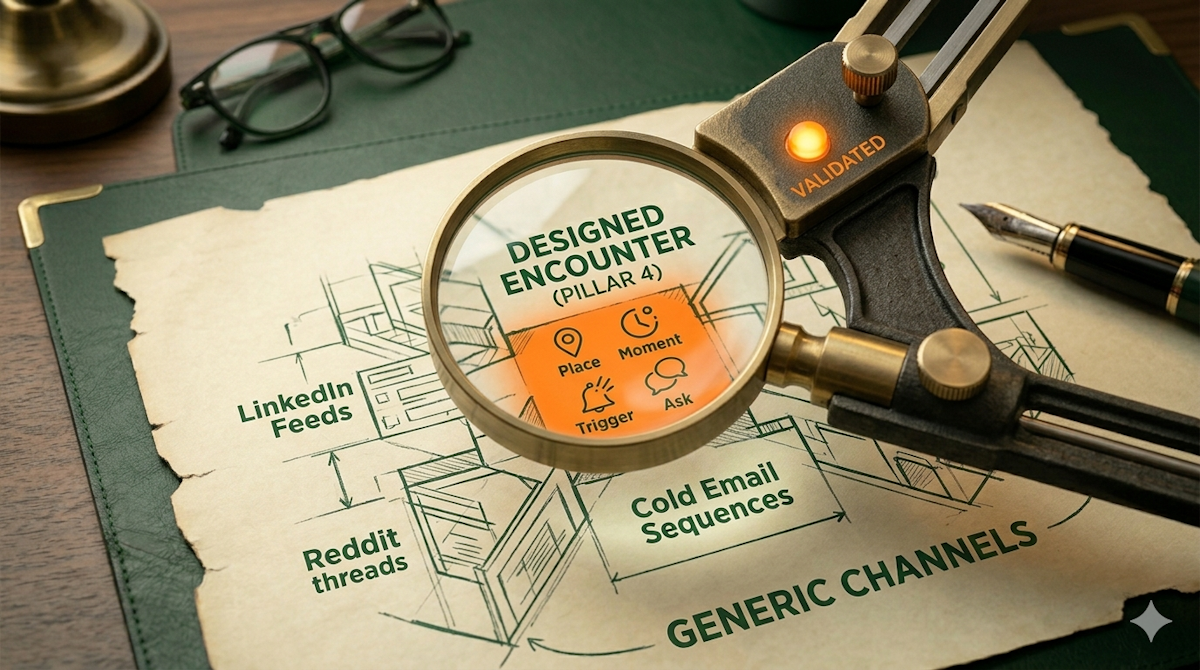
Most founders have a go-to-market strategy. Very few have a designed customer encounter.
The difference is not semantic. It is the reason some founders generate traction from their first ten outreach attempts and others spend months posting, messaging, and showing up without converting anyone into a customer.
The strategy tells you which channels to use. The encounter tells you what actually happens when you get there.
TL;DR: A Channel Is Not an Encounter. A Designed Scene Is.
Most go-to-market strategies describe where a founder will show up. Customer encounter design describes what happens when they do.
A customer encounter has four components that together form a scene specific enough to execute and evaluate:
Place: Where the customer is when they encounter you
Moment: What is happening in their world at that point
Trigger: What brought them there and what they are trying to figure out
Ask: The single action you want them to take as a result
Three signals indicate your encounter is designed rather than assumed:
You can describe the scene in enough detail that someone else could execute it without asking a clarifying question
Every component is grounded in observed customer behavior, not inference
The ask matches where the customer is in their awareness, not where you want them to be
If your go-to-market plan describes channels but not scenes, you are generating activity without control over outcomes. This article shows you how to build a customer encounter from the ground up.
Why Must Startup Go-to-Market Strategies Fail to Convert
The way founders are taught to think about go-to-market makes this problem almost inevitable.
Every framework, every accelerator curriculum, every startup advice article in circulation tells founders to identify their channels, define their messaging, and go find their customers. That instruction is not wrong. It is just incomplete. It stops at the level of distribution and never gets to the level of contact.
A channel is a delivery mechanism. LinkedIn, cold email, a conference, a Reddit community, a referral network. These are all ways to get in front of people. None of them tell you what to do when you get there. None of them tell you what your customer is doing in that moment, what brought them there, or what they are ready to do next.
The result is go-to-market activity that produces impressions rather than responses. Founders post, they reach out, they show up, and they get inconsistent results they cannot diagnose or improve. Not because the channels are wrong. Because the encounter was never designed precisely enough to test.
You cannot optimize something you have not defined.
What Is a Customer Encounter? (And Why It Matters for Early Customer Acquisition)
A customer encounter is not an ad, a post, or a message. It is a specific moment of contact between you and a customer who is in a particular place, experiencing a particular context, and capable of taking a particular next step.
Most founders think about go-to-market in terms of channels. Channels are not encounters. A channel tells you the medium. An encounter tells you everything that matters: where the customer is, what is happening around them, what brought them there, and what you are asking them to do.
LinkedIn is a channel. Most founders stop at “post on LinkedIn about [problem].” That is a channel decision without an encounter. It tells you where you will show up, but not what will happen when you do.
But a founder scrolling their feed on a Tuesday morning after a frustrating client call, seeing a post that names exactly what went wrong, and clicking a link to learn more. That is an encounter.
The difference between those two descriptions is the difference between a distribution decision and a go-to-market strategy.
The 4 Components of a Customer Encounter (With Examples)
Every encounter worth designing has four components. Together they form a scene specific enough to act on and evaluate.
Place is where the customer is when they encounter you. Not the channel in the abstract. The specific platform, community, event, or context. Not "LinkedIn" but "a LinkedIn group for independent consultants in the operations space." Not "email" but "a cold email sent to founders who just posted a hiring announcement for their first operations hire." The more specific the place, the more precisely you can design everything else around it.
Moment is what is happening in the customer's world at the point of contact. What have they just done or just experienced? What state are they in? A customer who just had a frustrating experience with the problem you solve is in a completely different state than a customer who is idly browsing. The moment determines receptivity. A founder who ignores the moment designs encounters that reach people at the wrong time regardless of how good the message is.
Trigger is what brought the customer to this place at this moment. What are they looking for or trying to figure out? The trigger is not the same as the moment. The moment is what is happening. The trigger is what caused it. A customer scrolling LinkedIn at 8am is a moment. The frustrating client call they just got off is the trigger. If those two sound the same in your encounter design, you have not separated them clearly enough.
Ask is the single action you want the customer to take as a result of this encounter. Not a menu of options. Not a vague invitation to learn more. One specific, low-friction action that is the natural next step given where the customer is in their awareness of the problem and your solution.
The ask is the most consistently underdeveloped component of customer encounter design. Most founders either ask for too much before any trust has been established, or ask for nothing and hope the customer figures out the next step on their own. A well-designed ask is singular, low friction, and matched to the customer's current awareness level. If the ask requires explanation, multiple steps, or a decision that feels larger than the moment, it is too heavy for this encounter.
Most founders think they have this defined until they try to write it down and realize one or more components are still vague.
How to Know If Your Encounter Is Designed or Assumed
There is a reliable test for whether an encounter is designed or assumed. Read back your description of each component and ask: is this grounded in something I observed, or something I inferred?
An observed encounter is one where the place, moment, trigger, and ask are all drawn from real customer behavior. You have seen this scene play out. You have heard customers describe it. You found evidence of it in forums, reviews, or direct conversations.
An assumed encounter is one where the components make logical sense but have not yet been confirmed in the real world. That is not necessarily wrong at the earliest stage. But it should be labeled honestly. An assumed encounter is an experiment. An observed encounter is a repeatable play. The founders who build durable go-to-market engines are the ones who know which one they are running at any given moment.
The pressure test is a single sentence: my customer encounter happens at this specific place, when this specific moment, because this specific trigger, and the ask is this specific action, which I know is right because this specific evidence.
If you cannot complete that sentence with something concrete and honest, the encounter is not yet designed. It is imagined.
What Changes When You Design the Encounter
When you design the customer encounter, the difference is not incremental. It is binary. You either know why something worked or you do not.
Your messaging stops being written for everyone who has the problem and starts being written for the specific person in the specific moment. Your channel selection stops being based on where your customers generally exist and starts being based on where they are when the trigger fires. Your ask stops being the thing you want them to do and starts being the thing they are actually ready to do given where they are.
And when something does not work, you know exactly what to test. Was it the place? The moment? The trigger? The ask? A designed encounter gives you four specific variables to adjust. An undesigned one gives you nothing to improve except trying harder.
That is the practical argument for customer encounter design that has nothing to do with strategy and everything to do with the ability to learn quickly from early go-to-market activity.
This only works if you have already done the upstream work. The encounter is where you act on the pain you identified and the trigger you understand. Without those, you are designing scenes without context.
Customer Encounter Design and Your Go-to-Market Clarity
In the Startup Readiness Framework, Go-to-Market Clarity evaluates whether a founder has moved beyond channel selection to designed, executable moments of customer contact. Generic or fuzzy encounter design is one of the most consistent flags in early assessments. Not because founders have not thought about go-to-market, but because they have thought about it at the level of channels rather than scenes.
A founder who can name their channels has demonstrated awareness. A founder who can describe a specific, observable encounter with evidence behind every component has demonstrated readiness.
If your Go-to-Market Clarity is a generic or fuzzy customer encounter, the diagnostic questions in this article are the starting point. Pick one channel you already use. Design one encounter scene. Describe the place, the moment, the trigger, and the ask in enough detail that someone else could execute it without asking you a clarifying question. Execute it within the next 48 hours.
One designed encounter executed and evaluated is worth more than a dozen channel strategies built on assumption.
Go-to-Market Clarity is one of six pillars in the Startup Readiness Framework. If your go-to-market understanding is strong, the next question is whether the rest of your startup is as ready as your GTM evidence.
The Startup Readiness Assessment gives you a full-system diagnostic across all six pillars in under twenty minutes.
Take your Startup Readiness Score free today at startupreadinessscore.com →
Published
By Dr. Shaun P. Digan
Originally published on the Startup.Ready. Blog at startupreadinessscore.com/startup-readiness
Original Publication Date: April 21, 2026
Last Updated: April 21, 2026
About the Author
Dr. Shaun P. Digan is the founder of Startup.Ready and the creator of the Startup Readiness Framework, a research-based system for evaluating and validating early-stage startups before launch and early growth. He holds a PhD in Entrepreneurship from the University of Louisville and has spent over 15 years teaching, advising, and consulting with founders on startup strategy, validation, and growth.
In his writing, including The Foundations of Innovation, he focuses on how founders can make better decisions by improving clarity, alignment, and readiness before scaling.