How to Measure the Value Your Startup Delivers Before You Try to Sell It
Most founders believe their product delivers value.
Very few can prove it when a customer asks, “What will actually be different for me after I pay for this?”
That gap is not a confidence problem. It is an evidence problem. And it shows up at the worst possible moment (in a sales conversation, in a pitch, in a customer onboarding call).
If the answer requires explanation, hedging, or a feature list, the value has not yet been defined clearly enough to sell.
TL;DR: Believing Your Product Delivers Value Is Not the Same as Being Able to Demonstrate It
Most startups can describe what their product does. Far fewer can describe what specifically changes for the customer as a result, in terms the customer would recognize, measure, and verify.
Value proof is not a marketing exercise. It is a business model requirement. Without it, pricing is a guess, messaging does not convert, and churn is higher than it needs to be because customers cannot tell whether the outcome they experienced matched the outcome they were promised.
Four signals indicate your value is defined rather than assumed:
You can describe the customer's situation before and after your product in specific, observable terms
You can quantify the value delivered in at least one measurable category
You have customer language, direct observation, or data that supports the claim
A skeptical customer could read your value statement and verify it after using the product
If you cannot satisfy all four, this article shows you where to start.
Why Founders Struggle to Prove the Value They Deliver
The way most founders think about value makes this problem almost inevitable.
Early-stage founders are close to their product. They understand what it does, how it works, and why it is better than the alternatives. That proximity is an asset for building. It is a liability for selling. Because the closer you are to what you built, the easier it is to describe it in terms that only make sense from the inside.
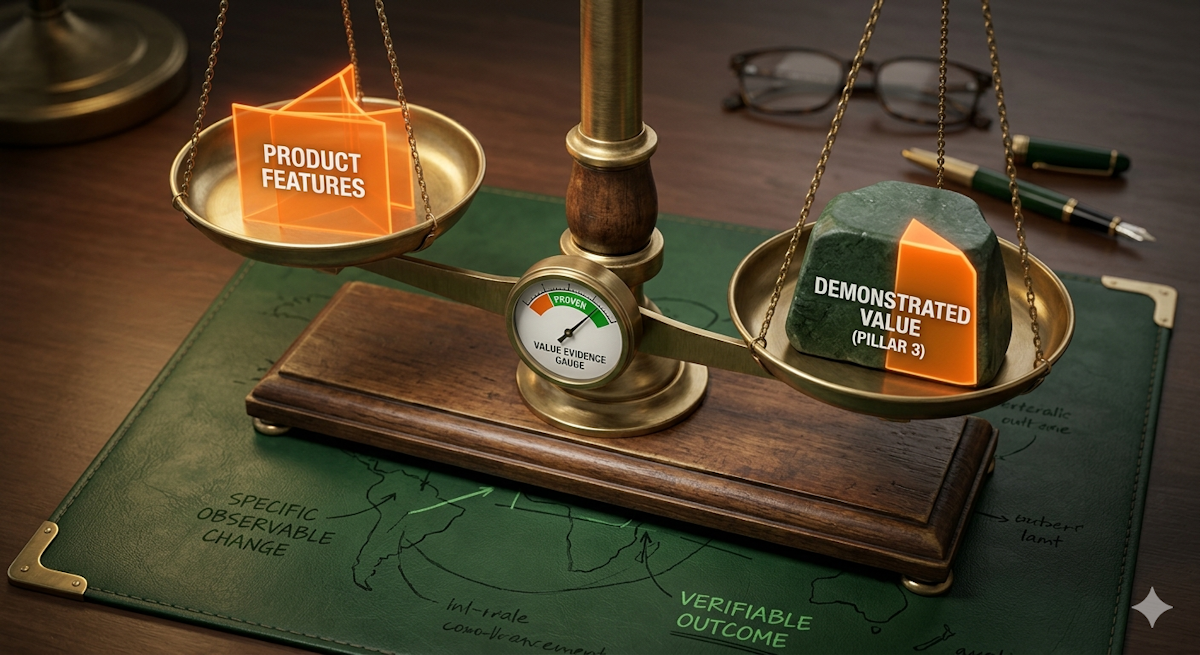
Features are inside language. Value is outside language. A feature describes what the product does. Value describes what changes for the customer as a result. Those are not the same sentence, and most founders write the first one when they need to be writing the second.
The other problem is abstraction. Value statements like "saves time," "reduces costs," and "improves efficiency" are directionally correct but functionally useless. Every competitor says the same thing. None of it is specific enough to be believed, measured, or chosen over an alternative.
Customers do not buy improvements in the abstract. They buy a specific, observable change in their situation. And they buy it from the founder who can describe that change most clearly before the transaction happens.
Value Is the Distance Between Two States
Before you can measure the value your startup delivers, you need to define what value actually means in the context of your specific customer.
Value is the distance between two states: where the customer is before your product and where they are after. The wider and more observable that distance, the more compelling the value.
The Before state is what the customer is doing, how long it takes, what it costs, what risk they are carrying, and what frustration they are living with. The After state is what is different, what is easier, what is faster, what is cheaper, what risk is reduced, what frustration is gone.
Most founders can describe the After state in general terms. The work is making both states specific enough that a customer would recognize themselves in the Before, and believe the After is achievable and verifiable.
Two questions test whether you are there. Is the Before state something the customer would describe as a real problem, or something they have mostly accepted as normal? Is the After state something the customer would immediately recognize as valuable, or something that requires explanation to appreciate?
If the Before state has been accepted as normal, it is not generating urgency. If the After state requires explanation, it is not generating desire. Both are evidence problems, not product problems.
How to Measure the Value Your Startup Actually Delivers
Once the Before and After states are defined, the next step is translation: turning that difference into something a customer can anticipate before buying and verify after. Specifically, translating the distance between those two states into measurable terms a customer can anticipate before buying and verify after.
Value almost always falls into one or more of six categories.
Time saved is the most common and the easiest to quantify. How much time does the customer save, on what specific task, and how often does that task recur? A product that saves two hours per week is saving over 100 hours per year. That number is more compelling than "saves time."
This only works if the task, the time saved, and the frequency are specific enough to be observed.
Money saved or earned is the most directly persuasive category when it can be demonstrated. What specific cost is reduced or what specific revenue is enabled? The more precisely you can name the dollar amount and the mechanism, the more credible the claim.
Capacity freed or created is about what the customer can now do that they could not do before, or do more of. This is particularly relevant for products that remove bottlenecks or automate tasks that were previously consuming founder or team bandwidth.
The clearer the new capacity is, the easier it is for the customer to recognize and act on that value.
Risk reduced or eliminated is the most underused category in early-stage value communication. What specific risk, error, or consequence does your product eliminate or reduce? For customers where the cost of a mistake is high, risk reduction is often more compelling than efficiency gains.
The value from reduced or eliminated risk does not become compelling until the risk and its consequence are named concretely.
Confidence or certainty is the value of better decisions. What does the customer decide better, faster, or with less anxiety as a result of your product? This is common in diagnostics, research tools, and decision-support products where the primary value is not the output but the clarity it produces.
This is strongest when tied to a specific decision the customer is already making.
Compliance or safety applies when the product helps a customer meet a requirement, avoid a penalty, or reduce exposure to legal, regulatory, or reputational consequences. In regulated industries this is often the primary purchase driver.
The more clearly the requirement or consequence is defined, the more immediate the value becomes.
The goal is not to claim all six. It is to identify the one or two categories where your product delivers the strongest, most specific, most measurable value, and to put a number on it. Even a rough estimate grounded in observed behavior is more compelling than a directional claim with no anchor. An ungrounded estimate is still a guess.
If you cannot quantify the value in at least one category, you do not yet have proof. You have a direction.
The Evidence That Separates a Value Claim from a Value Promise
A value claim without evidence is a promise. Evidence is what makes that promise credible.
At the early stage, evidence comes from three sources.
Customer observation is what you have directly seen or heard. Have you watched a customer experience the outcome you claim to deliver? Have you heard them describe what changed in their own words after using the product? Direct observation is the strongest form of early evidence because it is specific, contextual, and tied to a real interaction.
Customer language is what customers say unprompted. Exact phrases are more valuable than paraphrases. When a customer describes the outcome in their own words without being prompted, that language is your most powerful marketing asset. It is the difference between a value statement that sounds like it was written by a founder and one that sounds like it was written by a customer.
Measurement is any data that makes the Before and After states observable rather than assumed. Time logs, cost comparisons, error rates, usage patterns, before and after comparisons. It does not have to be a controlled study. It has to be specific enough that a skeptical customer could look at it and find it credible.
If you have none of these, your value proposition is still a hypothesis. That is not a reason to stop. It is a reason to prioritize evidence gathering over everything else before you invest further in messaging or sales activity.
The One Sentence That Tells You Whether You Have Done the Work
There is a single sentence that reveals whether your value is defined or still assumed:
My product delivers [specific outcome] for [specific customer] by [specific mechanism], which I know because [specific evidence], and a customer can verify it by [specific observable change in their situation].
This is not a writing exercise. It is a constraint.
If you cannot complete this sentence without hedging, generalization, or explanation, your value is not yet defined. It is still inferred.
If you can complete it, the next test is credibility. Would a skeptical customer believe it? Could they verify it after using the product? If not, the gap is not in the sentence. It is in the evidence behind it.
Most founders avoid this level of specificity because it forces a direct confrontation with what they can and cannot prove. That is the point.
A value statement that cannot survive this constraint will not survive a real buying decision.
Value Proof and Your Business Model Clarity
In the Startup Readiness Framework, Business Model Clarity evaluates whether a founder has moved beyond describing what their product does to demonstrating what it actually changes for the customer.
Unclear or generic value delivery is one of the most consistent flags in early assessments. Not because founders have built the wrong thing, but because they have not yet translated what they built into proof a customer would recognize and act on.
A founder who can describe their product has demonstrated awareness. A founder who can describe the specific, measurable, evidence-backed outcome their product delivers in language their customer would use has demonstrated readiness.
If your Business Model Clarity doesn't include evidence backed value delivery, the diagnostic questions in this article are the starting point.
Define the Before and After.
Identify the value category where your product is strongest.
Find one piece of evidence, one customer observation, one phrase, one data point, that makes the claim real rather than aspirational.
Then write the sentence.
If you cannot write it cleanly, go back. The gap is still open.
Business Model Clarity is one of six pillars in the Startup Readiness Framework. If your business model is clear and your value is demonstrable, the next question is whether the rest of your startup is as ready as your evidence.
The Startup Readiness Assessment gives you a full-system diagnostic across all six pillars in under twenty minutes.
Take your Startup Readiness Score free today at startupreadinessscore.com →
Published
By Dr. Shaun P. Digan
Originally published on the Startup.Ready. Blog at startupreadinessscore.com/startup-readiness
Original Publication Date: April 22, 2026
Last Updated: April 22, 2026
About the Author
Dr. Shaun P. Digan is the founder of Startup.Ready and the creator of the Startup Readiness Framework, a research-based system for evaluating and validating early-stage startups before launch and early growth. He holds a PhD in Entrepreneurship from the University of Louisville and has spent over 15 years teaching, advising, and consulting with founders on startup strategy, validation, and growth.
In his writing, including The Foundations of Innovation, he focuses on how founders can make better decisions by improving clarity, alignment, and readiness before scaling.