Week 5: What Drucker Actually Said About the Business You're Building
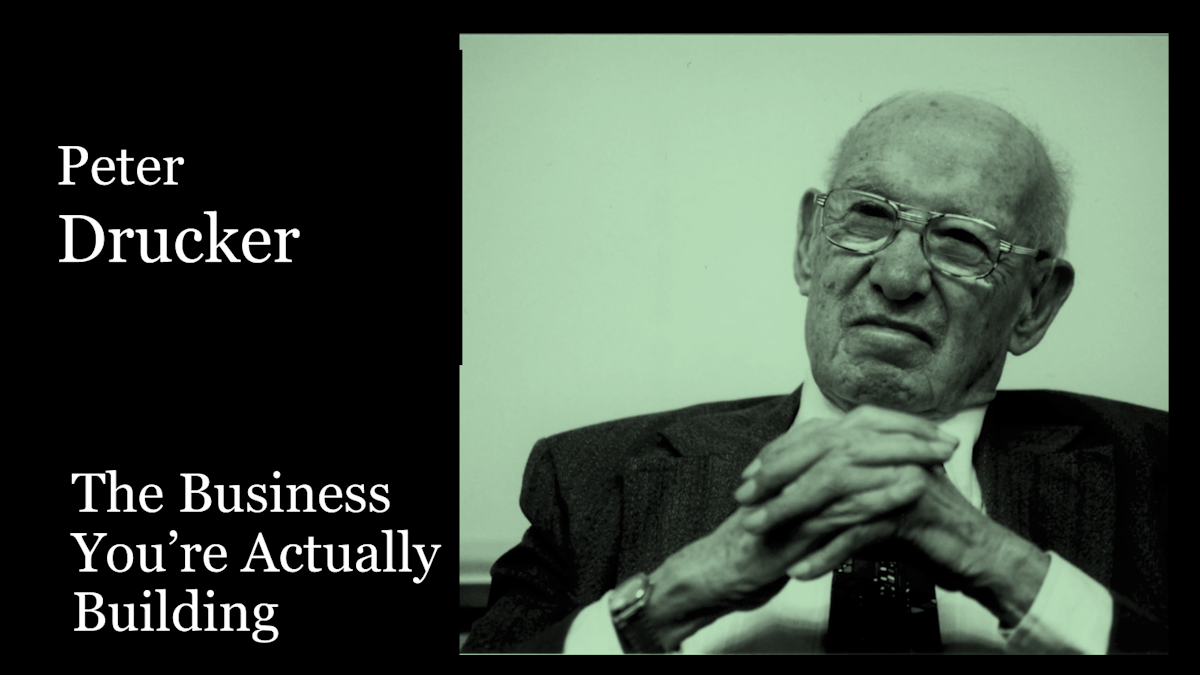
Week 5: What Drucker Actually Said About the Business You're Building
In 1994, Peter Drucker published an essay in Harvard Business Review that should be required reading for every founder before they write a single line of code, talk to a single customer, or raise a single dollar.
Most founders have never read it.
Drucker was the defining management thinker of the twentieth century. He spent five decades studying how organizations actually work, why they succeed, and why they fail. His contributions shaped modern management so completely that most of what we now take for granted about running a business traces back to something Drucker said first.
But the essay, The Theory of the Business, contains an insight that most startup advice has never fully absorbed.
Drucker's Contribution
Drucker's argument was deceptively simple.
Every organization operates on a set of assumptions. Assumptions about the environment it operates in. Assumptions about its specific mission. Assumptions about the core competencies it needs to deliver on that mission.
Together, these assumptions constitute what Drucker called the theory of the business.
The theory of the business is not a strategy document. It is not a mission statement. It is the implicit logic that drives every decision the organization makes. What it pays attention to, what it ignores, what it builds toward, and what it treats as given.
When the theory is valid, the organization performs. When the theory becomes obsolete, the organization struggles. Not because it is executing poorly. Because it is executing confidently in the wrong direction.
Drucker's observation was that most organizational failures are not failures of execution. They are failures of assumption. The organization kept doing what had always worked. The world changed. The theory did not.
This was a radical reframing. It shifted the question from how are we performing to what are we assuming. And it introduced a discipline that most organizations, and almost all early-stage founders, never practice: the deliberate examination of the assumptions the entire enterprise is built on.
Why It Mattered
Before Drucker, the dominant explanation for organizational failure was execution. Companies failed because they moved too slowly, managed poorly, or lacked the right talent.
The solution was always operational. Do the same things better, faster, with more discipline.
Drucker challenged this at the root. He pointed to organizations that were executing extremely well and still failing. Not because of bad management but because the theory they were executing against had stopped being true.
His most compelling examples were companies at the peak of their competence. Organizations that had mastered their model so thoroughly that they could not see the model itself.
They optimized the system without questioning the system's premises. By the time the mismatch became visible, it was already severe.
For founders, the implication is uncomfortable. The skills that help you build momentum (conviction, focus, speed, pattern recognition) are the same skills that make it hard to examine your own assumptions. The more confident you become, the less likely you are to question the theory underneath your confidence.
Drucker gave the business world a name for this failure mode and a framework for detecting it before it became fatal.
That framework was not about strategy or tactics. It was about epistemics. About how an organization knows what it knows, and whether what it knows is still true.
What It Left Open
Drucker's theory of the business was designed for established organizations. His examples were General Motors, IBM, AT&T, companies with decades of operating history, proven models, and the organizational inertia that comes from sustained success.
He was asking: how does a company that once knew what business it was in recognize that the answer has changed?
For early-stage founders, the question is different and harder. They have not yet proven their theory. They are operating on a theory that has never been tested in the market. The assumptions underneath their business are not obsolete. They are unexamined.
This is what Drucker left open for founders specifically. He described the failure mode with precision. He did not describe the discipline required to prevent it before the business has any operating history at all.
A founder who cannot clearly answer what business they are actually in is not facing an execution problem. They are facing a theory problem. They are building on a foundation of assumptions they have not yet surfaced, let alone examined.
The theory of the business is not something you articulate once the company is working. It is the thing you have to get right before the company can work. And getting it right requires a discipline most founders skip entirely, but because far too often the startup advice ecosystem rewards movement over reflection, and shipping over thinking.
What This Means for Founders Now
Drucker's question, “What business are you actually in?”, sounds simple. It is not.
Most founders answer it with a product description. We build software that does X. We sell a service that helps Y. That is not an answer to Drucker's question. That is a description of what you make.
What business you are actually in is determined by what your customer is trying to accomplish, what problem they are paying you to solve, and what job your product actually does in their life or work. Those answers are not always the same as what the founder believes them to be.
The railroad companies in Drucker's era believed they were in the railroad business. They were actually in the transportation business. That distinction sounds semantic. It was not. It determined everything… What they paid attention to, what they invested in, what they treated as a threat, and ultimately whether they survived the emergence of commercial aviation.
For an early-stage founder, the equivalent error happens constantly and quietly. A founder who believes they are selling productivity software when their customers are actually buying peace of mind will build the wrong features, write the wrong copy, and attract the wrong users. They will execute well against the wrong theory.
The work Drucker points toward is not strategic planning. It is assumption mapping. It is the discipline of surfacing what you actually believe about your customer, your problem, your market, and your model. And then asking whether those beliefs are grounded in evidence or whether they are the theory you have never thought to question.
Build-measure-learn tells you how to test assumptions. Drucker asks whether you know which assumptions most need to be tested.
The answer to that question starts with knowing what business you are actually in.
Not what you build. Not what you sell. What your customer is actually paying you to do.
If you cannot answer that clearly, the loop has nowhere useful to go.
Follow on Substack to get the weekly series directly to your inbox.
Next week: Clayton Christensen and the question that makes founders most uncomfortable. Not whether you are building the right thing, but whether you are building for the right moment.
Published April 6, 2026
Last Updated April 6, 2026
By Dr. Shaun P. Digan, MBA, PhD
Sources
The Theory of the Business, Peter Drucker, Harvard Business Review (1994)
Managing in a Time of Great Change, Peter Drucker (1995)
About the Author
Dr. Shaun P. Digan is the founder of Startup.Ready and the creator of the Startup Readiness Framework, a research-based system for evaluating and strengthening the foundations of early-stage startups. He holds a PhD in Entrepreneurship from the University of Louisville and has spent 15 years teaching, advising, and consulting with founders. In this series, The Foundations of Innovation, he writes on the ideas that built the startup world and the one idea still missing from all of them.