Issue 3: Kahneman Knew Founders Think Fast and Slow
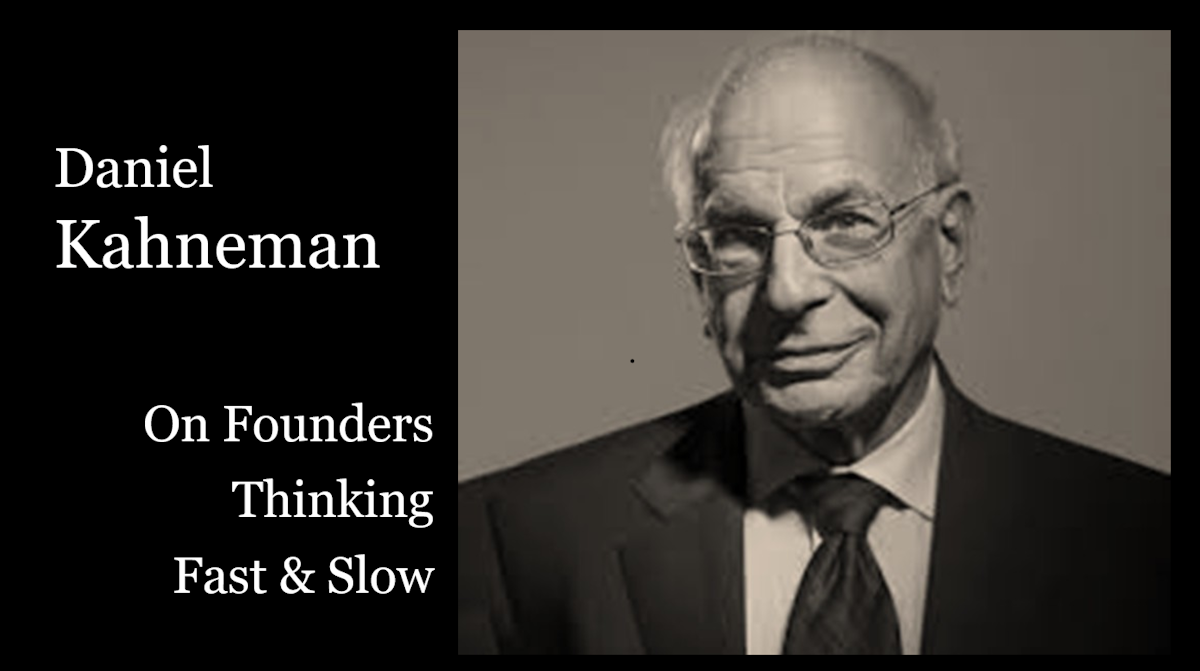
In 2011, Daniel Kahneman published a book that should have changed how every founder thinks about every decision they make.
It largely did not.
Kahneman was a psychologist who spent his career doing something unusual for his field. He studied not how humans should think, but how they actually do.
Alongside his longtime collaborator Amos Tversky, he spent decades designing careful experiments that revealed the systematic patterns in how human beings make judgments under uncertainty.
Their work was so consequential that in 2002 Kahneman was awarded the Nobel Prize in Economics, remarkable for a man who never took a single economics course. Tversky, who died in 1996, would almost certainly have shared it.
Thinking Fast and Slow, published when Kahneman was 77, was his attempt to bring a lifetime of research to a general audience. It introduced a framework he and Tversky had been building for decades.
The framework is deceptively simple. Human thinking operates through two distinct systems. System 1 is fast, automatic, intuitive, and effortless. System 2 is slow, deliberate, analytical, and effortful. Most of the time, System 1 is running the show. System 2 only activates when System 1 signals that it needs help, which it does far less often than it should.
The implications of this for how founders make decisions are significant, uncomfortable, and almost entirely ignored by the startup advice ecosystem.
Kahneman's Contribution
Kahneman's contribution was not the observation that humans make mistakes. That was already well understood. His contribution was the mechanism.
He and Tversky demonstrated, through decades of controlled experiments, that human error is not random. It is systematic, predictable, and traceable to specific features of how the mind processes information under uncertainty.
System 1 is genuinely remarkable. It allows humans to navigate complex environments with speed and confidence, to pattern-match across vast stores of experience, to make thousands of micro-decisions every day without conscious deliberation.
In domains where a person has deep expertise and reliable feedback loops, System 1 produces excellent judgments. The experienced surgeon who detects something wrong before they can articulate why. The veteran investor who reads a founder in the first five minutes of a meeting.
The problem Kahneman identified is that System 1 does not know the difference between domains where it has earned the right to be trusted and domains where it has not.
It generates confident, fluent answers regardless. And it produces a feeling of correctness that has nothing to do with whether the answer is actually correct. That feeling is simply evidence that System 1 has completed its job, which is to produce a fluent answer, not necessarily an accurate one.
This distinction, between fluency and accuracy, between confidence and correctness, is one of the most practically important ideas in the history of behavioral science.
Why It Mattered
Before Kahneman and Tversky, the dominant model of human decision-making assumed that people were roughly rational agents who processed information objectively and made choices that served their interests.
Errors were treated as exceptions, as noise around a signal of general rationality.
Kahneman and Tversky dismantled this entirely. They demonstrated that the errors were the signal. Confirmation bias, the planning fallacy, overconfidence, anchoring.
These were not random mistakes made by irrational people. They were predictable outputs of a cognitive architecture that every human being shares.
Confirmation bias is the tendency to search for, interpret, and remember information in ways that confirm what you already believe.
The planning fallacy is the systematic tendency to underestimate the time, cost, and difficulty of future tasks while overestimating the benefits.
Overconfidence is the tendency to be more certain about judgments than the evidence warrants.
Anchoring is the tendency to rely too heavily on the first piece of information encountered when making a decision.
None of these are signs of bad thinking. They are signs of human thinking. System 1 produces all of them reliably, in everyone, including the most experienced and successful people in any field.
What Kahneman (and Tversky) gave the world was a precise, empirically grounded map of how human judgment goes wrong and why. That map changed economics, medicine, law, public policy, and every other field where human decisions have consequences.
In fact, Kahneman and Tversky's cumulative work spanning hundreds of academic articles, book chapters, and books is so influential on human decision making that I have another article planned later in the series to dig into more of Kahneman and Tversky's contributions.
What It Left Open
Kahneman was extraordinarily precise about the problem. He was less precise about the solution.
The uncomfortable finding buried in decades of research on cognitive bias is that awareness does almost nothing.
Understanding that you are subject to confirmation bias does not make you less subject to it.
Knowing that the planning fallacy affects your projections does not make your projections more accurate.
Knowing that System 1 is running the show does not automatically activate System 2.
What Kahneman left open was the infrastructure question. If awareness is insufficient, what actually changes behavior?
His research pointed toward structure.
External frameworks that prompt deliberate thinking at the moments when intuition is most likely to mislead.
Processes that force the articulation of assumptions before commitments are made.
Questions designed to activate System 2 rather than accept System 1's first answer.
But Kahneman was a researcher, not a builder. He mapped the territory with extraordinary precision. He did not draw the roads.
What This Means for Founders Now
Early-stage founders are, almost by definition, operating in a domain where they have not yet earned the right to trust their instincts. They have never built this specific company before. They have never sold to this specific customer before. They have never operated in this exact market configuration before.
System 1 does not know this. It reaches for the closest available pattern, applies it with confidence, and produces a judgment that feels correct.
That feeling is not evidence. It is the sound of System 1 doing its job.
The customer conversation that confirms the idea is remembered vividly.
The customer who said they would never pay for this is explained away as an outlier.
The financial model is a masterpiece of the planning fallacy. The sales cycle shorter than it will be. The product shipping faster than it will. The customers converting at a higher rate than they will.
The first valuation heard anchors every valuation that follows.
The first customer segment successfully sold to anchors every assumption about who the customer is.
None of this is a character flaw. It is what System 1 does when asked to navigate genuine uncertainty without adequate feedback.
The goal is not to suppress System 1. Fast thinking is necessary. The founder who deliberates endlessly over every decision never ships anything. Pattern recognition, intuition, and the ability to make quick judgments under uncertainty are genuine advantages in early-stage building.
The goal is to know which system to trust at which moment. To develop the awareness to recognize when System 1 is confidently wrong.
When the feeling of correctness is a product of fluency rather than accuracy. When the assumption that feels obvious is exactly the one that most needs to be examined.
That awareness is not innate. It is developed. Through practice, through structure, and through the discipline of asking the one question that System 1 never asks on its own.
What would have to be true for me to be wrong about this?
Follow on Substack to get the weekly series directly to your inbox.
Next week: On the Lean Startup's Missing Layer. Eric Ries solved the iteration problem. He left a harder one untouched.